 EXCLUSIVE MEMBERS ONLY ACCESS
To access this month’s edition & Member’s only resources, enter your registered email address.




Perth, Western Australia
The Results of the August 2021 census were made public on 12th July 2022, and revealed that Australia has become a majority migrant nation, as the census data shows for the first time that more than 50 per cent of residents were born overseas or have an immigrant parent.
Australia’s 2026 Migration Program has been carefully designed to boost the social and economic outcomes that meet Australia’s needs. In fact, the migration programme was first launched in 1945 following the aftermath of World War 2. Given this long history, it is worth understanding how it works. The Australian Immigration Bulletin exists to help explain this in more detail.
As we’ve entered the 1st month of the year, join us for a look at the latest news and developments in the world of Australian Immigration!


In Australia we value the rich diversity of our multicultural identity, underpinned by a commitment to pluralism and the inalienable right to belonging. The country’s success and character are inseparable from its diversity.
We do not take this for granted.
A study by the Scanlon Foundation, found that the vast majority of Australians think multiculturalism is good for our country, and the Australian Government, unequivocally stand for multiculturalism – not just as a policy first introduced in the 1970s but as a true reflection of our national identity. We stand against those who would seek to sow divisions in our country or intimidate any one of our migrant communities.
And the Australian Government backs our words with action. Our government’s policies underscore our commitment to inclusion and social cohesion.
Earlier this year, we opened Australia’s first national Office for Multicultural Affairs, to not only celebrate the richness of our diversity but also to acknowledge multiculturism as a fundamental aspect of our identity – it is key to who we are.
Today, multiculturalism is woven into the social and cultural fabric of modern Australia. From Lunar New Year to Diwali and Rosh Hashanah – these events are celebrated in small towns and big cities, from coast to coast.
Australia is a country defined by migration built on the foundation of the world’s oldest continuing culture on the planet. Our story starts with deep historic roots, dating back over 65,000 years with our First Nations Australians. And building on this ancient and proud culture, generations of new Australians have come from countries across the world to make Australia their home. They have done so to access a world-class education system, to take up career opportunities, to find safe harbour for their families, or to access opportunities that were not available in the country they were born.
Over generations, each group of migrants has brought with them hopes and dreams for a new and brighter future. Their hard work and effort have contributed to a stronger and more prosperous Australia – and a nation connected by our people, to our region and the world.
Migrant families have played such a vital role in Australia’s economic success and continue to add depth to our social and cultural richness.
Over half of Australians were either born overseas themselves, or has a parent who was born overseas. I came to Australia from Egypt with my parents when I was just two years old and my family settled in Sydney’s western suburbs. We quickly became part of the local community, together with neighbours from Greece, China and the former Yugoslavia.
Today, Indians make up the fastest growing and second largest group of migrants to Australia. But Indians were also amongst the very first migrants to Australia, and centuries ago, it was the Indian traders who connected Australia with the rest of the world and Indian cameleers who connected outback Australian communities and towns.
There are now more than one million people of Indian heritage who call Australia home. They are making remarkable contributions across every sector of society: from medicine and engineering to education, hospitality, and the arts. Their entrepreneurial spirit is evident in the thousands of small businesses they have established, enriching the local economies in which they live.
But they do so much more than that. Indian Australians – same as all new Australians – also make positive contributions to their local communities. Whether it be through charitable organisations, sport or religion they are making a difference.
Whether you come to Australia for study, work opportunities, a holiday, or to live permanently, each visit strengthens our bond. And if you’re considering coming to Australia, know this: we welcome you with open arms.

Visa applicants from around the world can now apply for an Australian visa more easily, thanks to the latest expansion of the Australian Immi App.
Eligible applicants can now use the Australian Immi App to submit their facial biometrics and passport information from their smartphones, removing the need for in-person visits to biometric collection centres. The Australian Immi App also reduces the costs associated with a visa application as there is no charge to use the app. To be eligible to use the app, clients must have previously provided their biometrics (facial image and fingerprints) to the Department and hold a valid passport.
From 24 November 2025, the Department of Home Affairs introduced the app in a further 19 countries, bringing the total number of supported countries to 34.
Available countries
From 24 November, eligible applicants in the following countries will be able to use the Australian Immi App:
With the app now available in 34 countries, the Australian Government is delivering on its promise to make the visa process faster, simpler and more convenient.
A final expansion to all remaining countries in Australia’s biometric collection program is scheduled for early 2026.
The Department of Home Affairs looks forward to continuing to expand the app’s reach in 2026. It aims to give easier access to Australia’s visa system for more people, in more places.
For full eligibility details, supported visa subclasses, step-by-step guidance and technical requirements, visit Australian Immi App.

Stats NZ released migration data, which showed that large numbers of Kiwis continue to leave, mostly for Australia.
Net migration was only 11,929 in the year to October 2025, down from a net gain of 35,400 in the October 2024 year.
The current net migration inflow is a fraction of the circa 130,000 peak in 2023 and is well below the decade’s average annual net inflow of about 50,000.
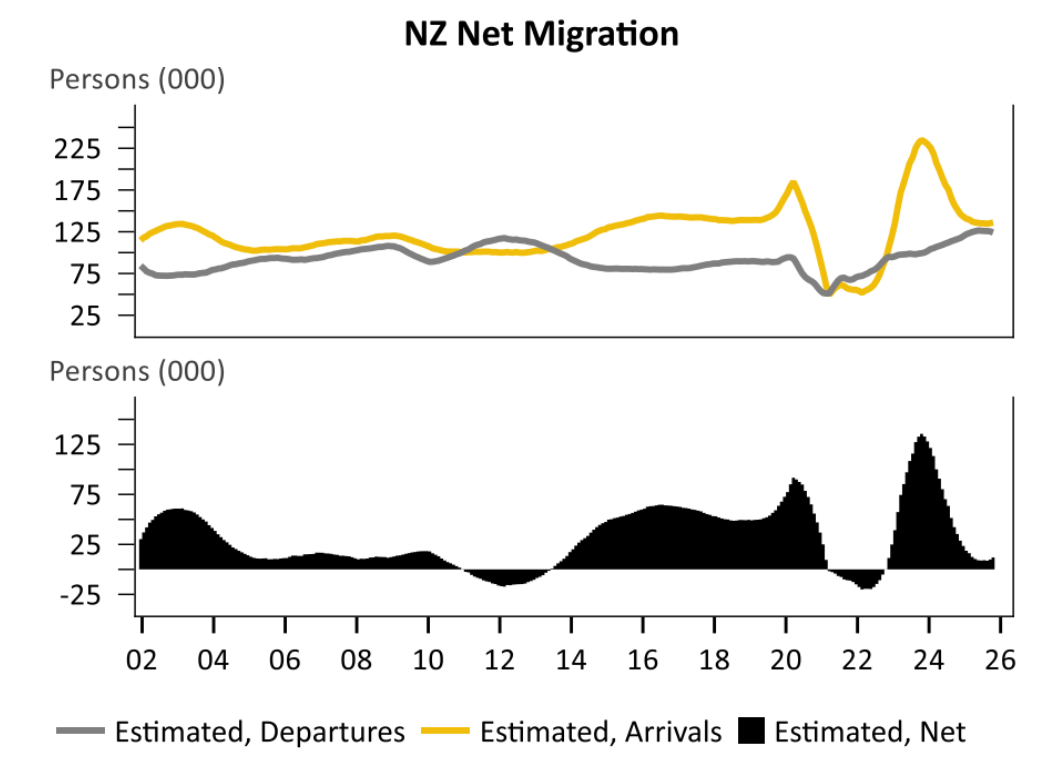
The decline in net migration has been driven by a strong net outflow of Kiwi citizens.
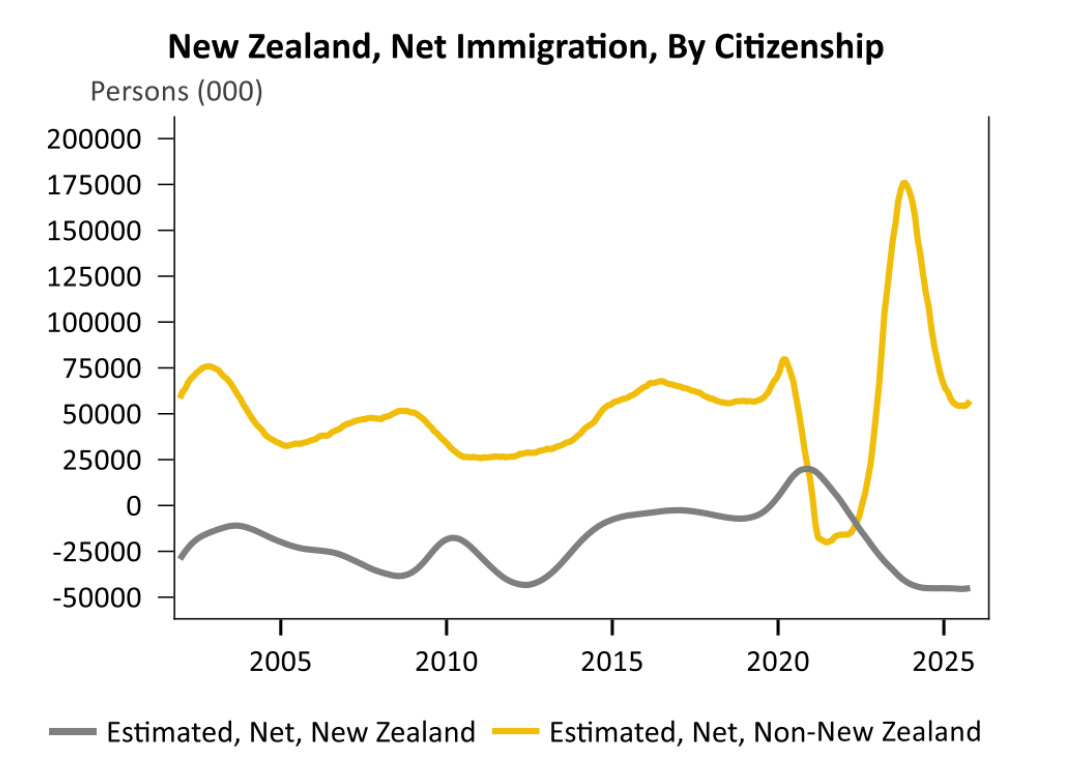
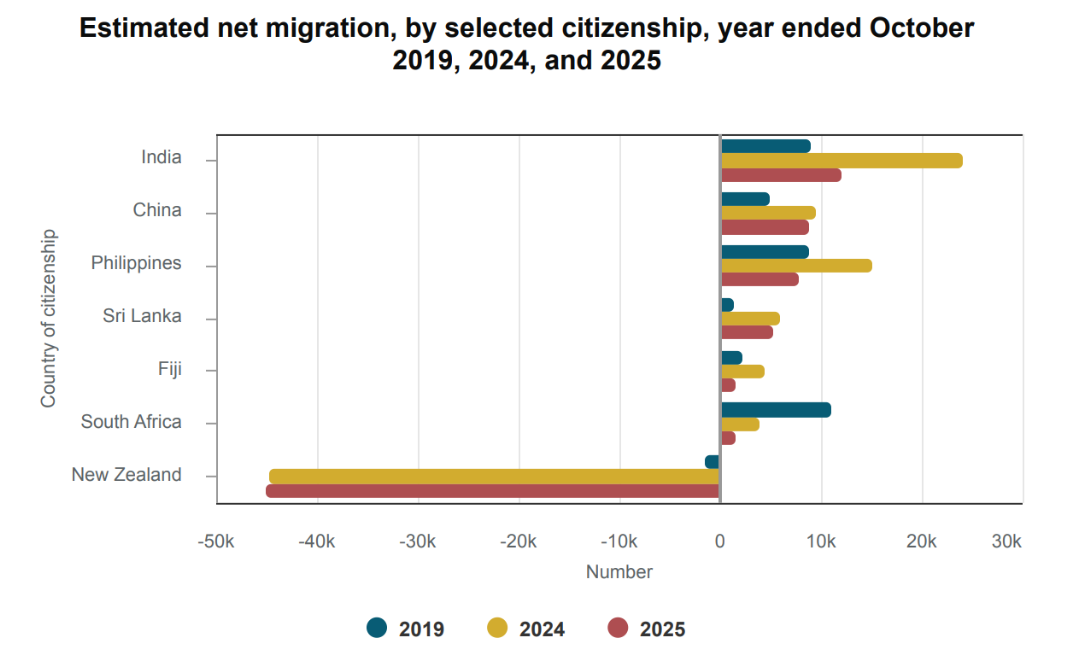
In the year to October 2025, a net 45,088 New Zealand citizens departed the country, offset by significant (but falling) arrivals from Asia:
The next chart shows that the outflow of New Zealand citizens is tracking at its highest level since 2011-12:
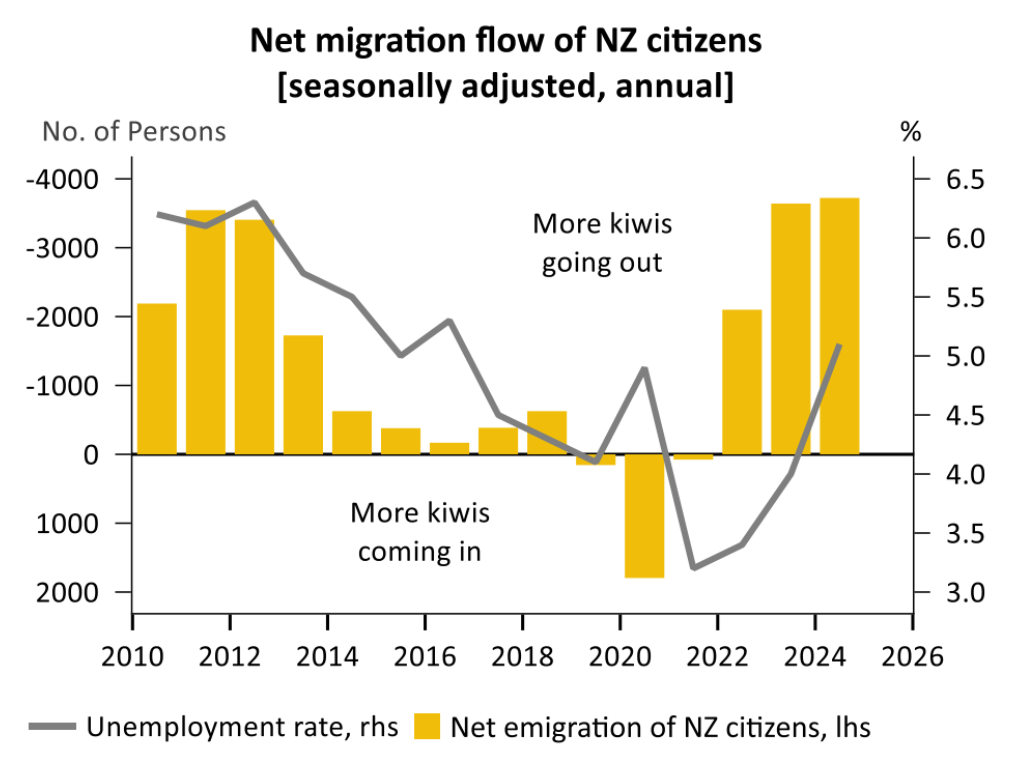
Around 30,000 of New Zealand’s migrant outflow was to Australia, which allows open entry and access to the labour market.
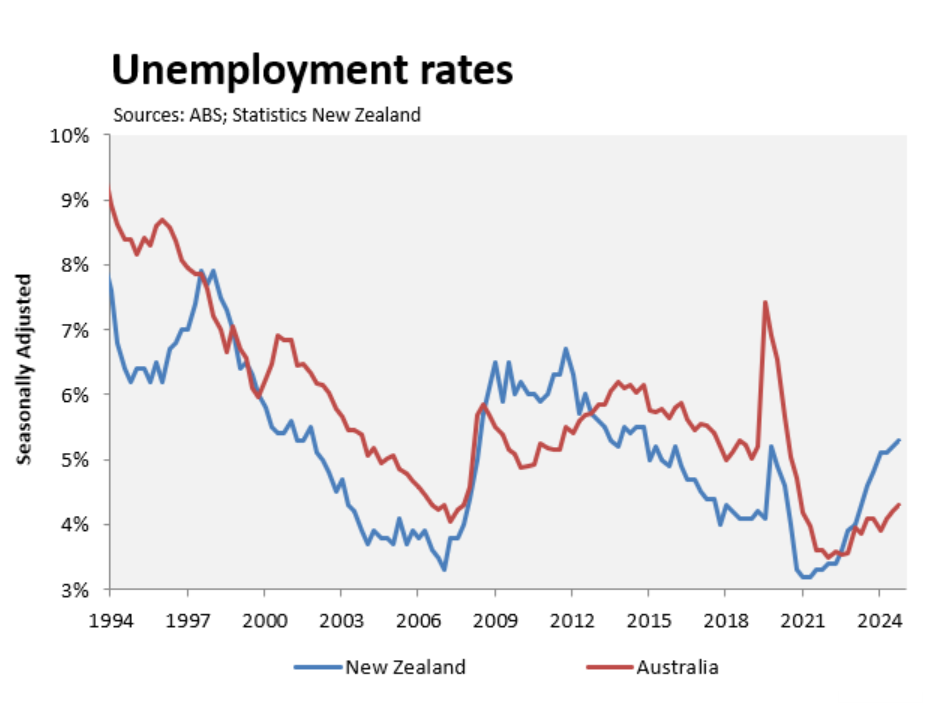
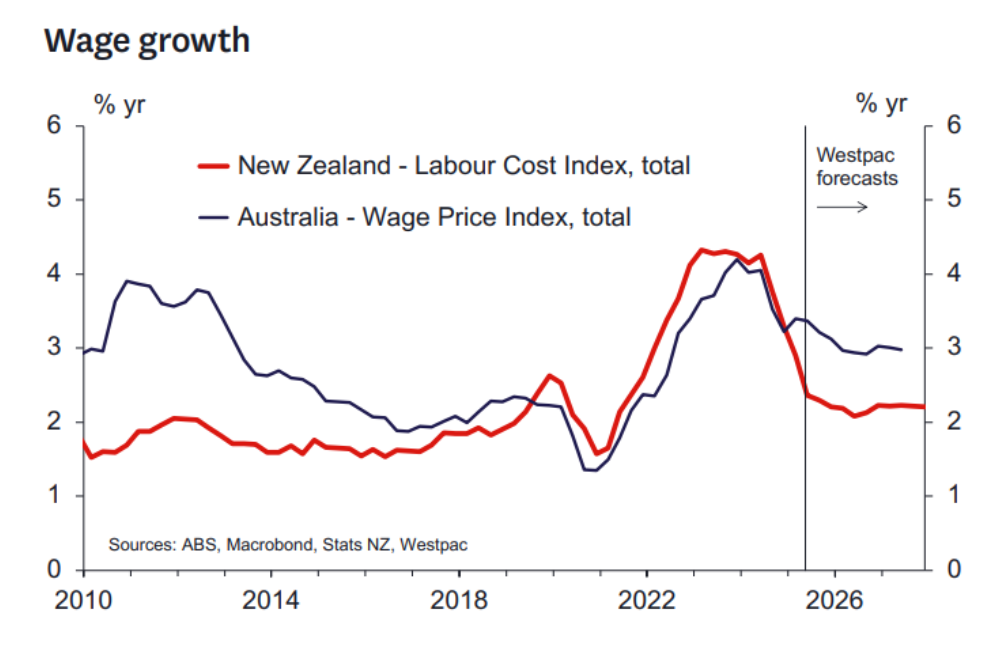
The rapid outflow of citizens to Australia is being driven by the strongly divergent labour market outcomes between the two nations. Australia’s unemployment rate of 4.3% was 1% lower than New Zealand’s in October.
Australia has also experienced significantly stronger wage growth:
Commenting on the results, major bank ASB doesn’t expect an imminent turnaround in migration flows:
“The sharp decline in net immigration over the past two years is a key contributor to lower population growth, softer domestic demand and the sluggish housing market”.
“We do not expect to see an imminent turn around, reducing a key support to the NZ economy”.
“Slowing net immigration does help to slow labour supply growth, which will contain the peak in the unemployment rate but also temper trend growth in the NZ economy”.
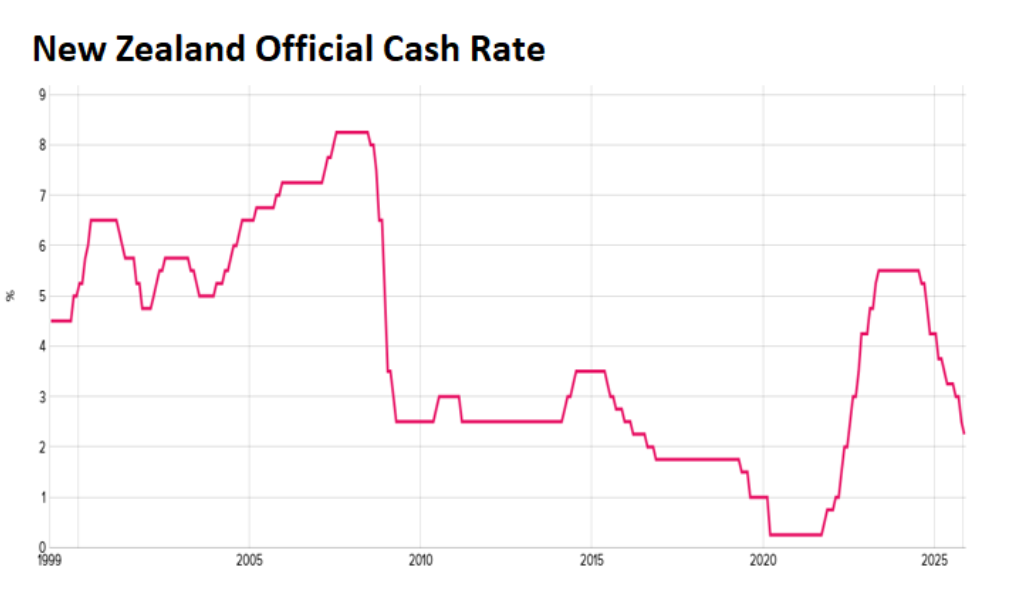
ASB also believes that the Reserve Bank will need to keep interest rates low to “to rev the economy up and to start eroding still-abundant spare capacity in the NZ economy”.
If you are interested in applying for a general skilled migration visa to Australia, it is important to have a good understanding of the skilled visa options and how the migration points test works, so that you can maximise your chances of being eligible to apply for a skilled visa.
A general skilled migration visa is an option available to skilled workers who are seeking to qualify for a skilled visa independently, or under a state or family sponsorship. It is an alternative to an employer sponsored visa.
One of the key criteria to qualify for a general skilled migration visa is the points test (a criterion that does not apply to employer sponsored visas). This is often the most challenging aspect for prospective skilled visa applicants to overcome when seeking an invitation to apply for the relevant skilled visa.
If you are considering applying for a general skilled migration program visa, an important concept to understand is the Expression Of Interest (EOI).
If you are considering applying for a general skilled migration visa, it is important to be aware that for certain visas in this visa class, you will first be required to lodge an EOI with the Department of Home Affairs (the Department) through SkillSelect. The EOI is not a visa application, but rather, it is the process by which you can express your interest in applying for the relevant skilled visa (It’s important to note, that there is NO fee to submit an EOI).
This requirement applies to the following skilled visa subclasses:
Let’s take a brief look at each of these visas below:
The ‘subclass 189’ is a federal sponsored visa that grants automatic permanent residence in Australia. It is subject to nil visa conditions or obligations. For this reason, it is often considered to be the most flexible of the skilled visa options available.
A subclass 189 points-based visa allows you to live and work in any state or territory permanently.
The ‘subclass 190’ is a state/ territory sponsored permanent residence visa. It is another points-based visa for which invitations are issued throughout each month by individual states and territories. One of the benefits of applying for state nomination is that you will be granted an additional 5 points.
An important aspect to consider, which does not apply to the subclass 189 visa is that there is an added step in the application process. In this case, you must also apply for nomination approval to a state or territory government. Only upon receipt of an invitation from the relevant state or territory to which you apply can you then apply to the Department for the visa itself.
Your obligations as a subclass 190 visa holder are that you must commit to your nominating jurisdiction’s obligations and commit to residing in your nominating State or Territory for two years from visa grant.
The ‘subclass 491’ is also a points-based state/ territory (or family) sponsored visa. It is a regional visa with a term of five years. The Department issues invitations for family sponsored EOI applications only (in invitation rounds). Invitations for state sponsorship are issued by individual states and territories throughout each month. This will grant you an additional 15 points for the nomination.
Being a provisional visa, this means it provides a pathway to permanent residence in Australia with the Subclass 191 Permanent Residence (Skilled Regional) visa, subject to meeting specified requirements.
Be mindful that as a subclass 491 visa holder, you must abide by visa condition 8579, which requires you to live, work and study in a designated regional area of Australia. For migration purposes, most locations of Australia outside of major cities (Sydney, Melbourne, Brisbane, Perth, etc.) are classed as regional areas.
If your EOI is successful, you will receive an invitation to apply for the visa, as specified in the invitation letter. This then enables you to proceed with lodgement of your visa application (provided you meet all other visa lodgement and visa grant requirements).
Please note, the below State and Territory program updates is a general overview only. It does not take into account any of your personal circumstances. You must check the State/Territory information carefully to ensure you can meet all the requirements for nomination.
Australia is currently facing a shortage of skilled migrants to fill workforce demands. In response, states and territories have been easing the conditions of their visa programs to help attract skilled workers from overseas.
Below is the monthly update for some of the State and Territory opportunities available.
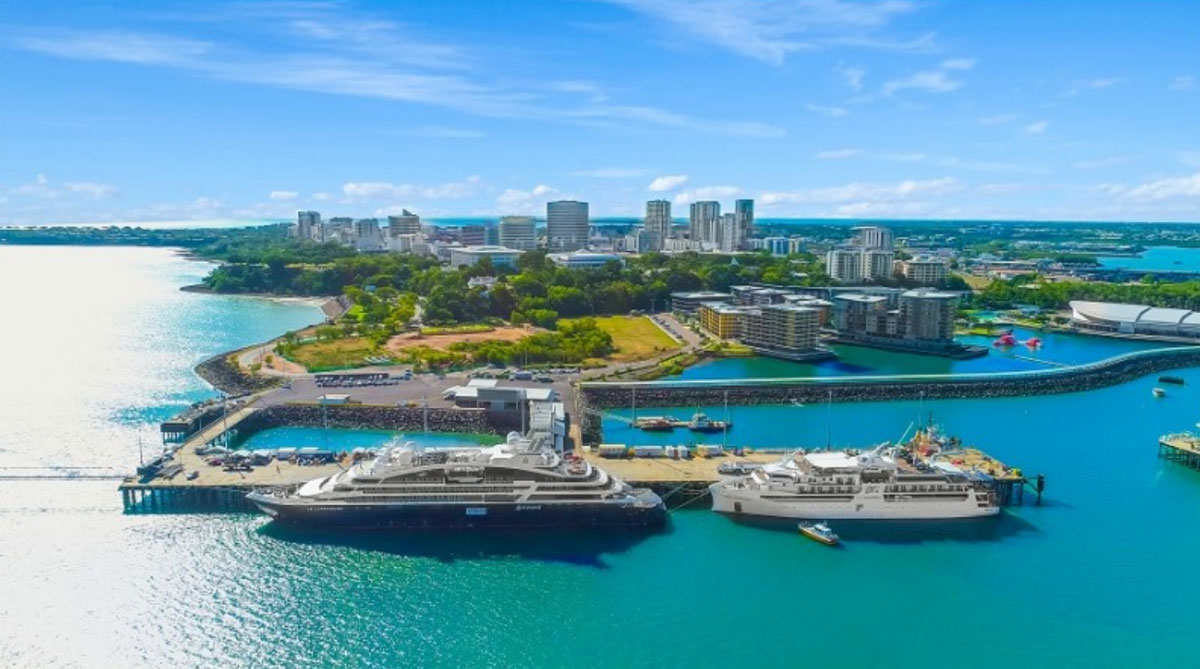
Program Status Update
UPDATE: NT General Skilled Migration (GSM) nomination applications for 2025-26
The NT Government has now received full allocations for the 2025-26 program year from the Australian Government.
The NT Nomination application portal is intended to be opened by 24 November 2025 to new applications for all onshore and offshore streams. Before applying, please ensure that you have reviewed the eligibility criteria. For information on how to submit an application, view how to apply.
Please note that the NT government cannot guarantee nominations before visa deadlines. Those who are onshore and have visas expiring should seek professional advice from a Registered Migration Agent or Legal Practitioner on their visa options and ensure that they remain lawful in Australia.
Once the above mentioned temporary suspension is lifted, you may be able to proceed with the NT’s usual skilled migration program. Program details below:
People residing offshore are eligible to be considered for Northern Territory (NT) nomination. Invitations to apply for Northern Territory nomination will be via the ranking system.
The ‘Northern Territory Offshore Migration Occupation List’ identifies the occupations in current demand in the Northern Territory. This List is important if you want to apply for Northern Territory nomination for either a:
The ‘Northern Territory Offshore Migration Occupation List’ is only applicable for those applying for NT nomination from outside Australia, under the Priority Occupation stream.
Please note: The Northern Territory government has advised that offshore applicants will generally only be offered a Northern Territory nomination for a subclass 491 visa. Subclass 190 nominations will only be offered in exceptional circumstances, such as cases where the applicant has strong connections to the NT.
The NT advises eligible applicants to apply as soon as they meet the eligibility criteria. To receive a nomination from the NT Government, you must:
Before submitting an EOI for The Northern Territory, applicants should check that they meet all eligibility requirements.
For a further explanation, see the Frequently Asked Questions page on the Northern Territory Government website.
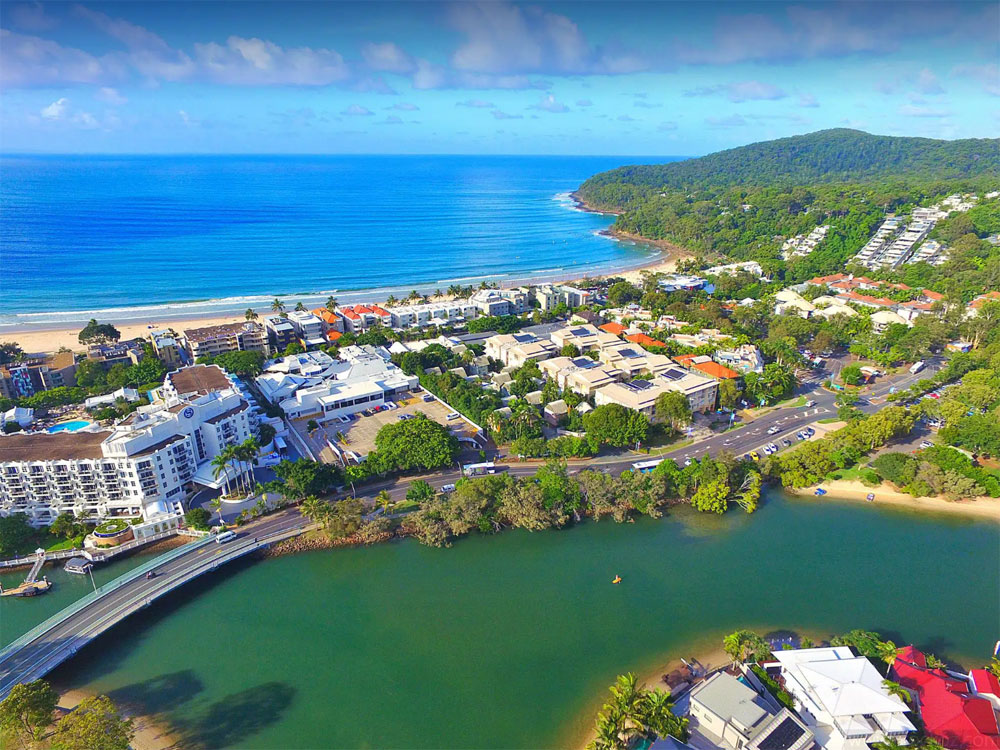
Program Status Update
Program Status Update: Important Announcement
On 2 September 2025, the Australian Government announced the total number of places in its 2025-26 Migration Program. But it is still finalising state and territory allocations.
Queensland will not open the 2025-26 State Nominated Migration Program until our final program allocation is confirmed.
You can however submit your Registration of Interest (ROI) for Queensland nomination from 19 September 2025, in preparation for the program opening.
In the meantime, take a look here at which skilled visas and pathways might best suit you, including instructions for how to apply for Queensland nomination.
Once the above mentioned temporary suspension is lifted, you may be able to proceed with Queensland’s usual skilled migration program. Program details below:
Depending on your occupation and situation, there are two state nomination options available for skilled migrants through Queensland.
For Queensland state nomination, prospective applicants must meet the Department of Home Affairs requirements, state-specific occupation requirements and have skills in an occupation that is available on the Queensland Skilled Occupation List.
You may undertake employment once onshore in Queensland through:
Offshore applicants meeting the minimum published requirements are eligible to lodge an Expression of Interest (EOI) on Skill Select and then a Registration of Interest (ROI) on the Migration Queensland portal.
Migration Queensland has closed the 2024-25 State Nominated Migration Program. For more information, please see here.
Migration Queensland criteria requires you to:
The 2024-25 Skilled Migration Program is open to both onshore and offshore applicants and provides pathways for skilled workers, graduates, and small business owners.
Before submitting a Registration of Interest (ROI) for Queensland, applicants should check that they meet all eligibility requirements.
Note: In the EOI, select ‘Queensland’ as the only state of interest in the EOI, if you wish to be considered for an invitation to apply for Queensland nomination.
For a further explanation, see the Frequently Asked Questions page on the Queensland Government website.
 Program Status Update
Victoria’s 2025-26 skilled visa nomination program (subclass 190 and subclass 491) is now open.
Open to offshore applicants, the program provides skilled migrants with a pathway to permanent residency in Victoria. The skills that successful applicants bring to Victoria benefits employers and the broader Victorian economy.
The program provides two visa pathways:
As with previous years, applicants will first need to submit a Registration of Interest (ROI) and then be selected on competitive merit to apply for visa nomination.
*Please note: Invitation rounds occur frequently throughout the financial year with no set date.
To be invited to apply for Victorian skilled visa nomination, you must firstly make or update an Expression of Interest (EOI) via the Australian Government’s SkillSelect and then submit a Registration of Interest (ROI).
Both onshore and offshore applicants are eligible to submit a Registration of Interest (ROI) for both the subclass 190 and subclass 491 visas.
If you previously submitted an ROI in the 2024-25 and wish to be considered for invitation in the 2025-26 program, your ROI is still valid. You do not need to withdraw your ROI unless the information in the ROI has changed.
Your ROI will remain in our system for selection until it is withdrawn or selected.
You can check if your ROI is active via the Live in Melbourne portal. Login to your account > Applications > Click into the relevant NFR number > If active, the status will show ‘Submitted’ or ‘Received’.
Before submitting an ROI for Victoria, applicants should check that they meet all eligibility requirements.
For a further explanation, see the Frequently Asked Questions page on the Victoria Government website.

Program Status Update
Western Australia’s 2025-26 skilled visa nomination program (subclass 190 and subclass 491) is now open.
People residing offshore are eligible to be considered for Western Australia (WA) State nomination. Invitations to apply for WA State nomination will be via the ranking system.
The Western Australian Skilled Migration Occupation List identifies the occupations in current demand in Western Australia. This List is important if you want to apply for Western Australia nomination for either a:
Please note that to be eligible for an invitation in the WA State Nominated Migration Program, you must meet both:
Before starting your application, you will need to check whether your occupation is available on either the WA Skilled migration occupation list (WASMOL) Schedule 1 or 2, or the Graduate occupation list. You can search for your occupation here. (The occupation list search bar is located under the heading ‘Eligible Occupations’.)
Features of the 2025—26 program:
Before submitting an EOI for Western Australia, applicants should check that they meet all eligibility requirements.
For a further explanation, see the Frequently Asked Questions page on the Western Australia Government website.

Program Status Update
Australian Capital Territory’s (ACT) 2025-26 skilled visa nomination program (subclass 190 and subclass 491) is now open.
2025-26 Nomination Allocation: The ACT has received a final nomination allocation of 1,600 places for the 2025-26 program year.
The ACT Critical Skills List identifies the occupations in current demand in the ACT. This List is important if you want to apply for ACT nomination for either a:
The ACT Government will update this list every four months to make sure that the ACT Skilled Migration Program adapts and responds to the evolving critical skills needs of the ACT economy.
The Canberra Matrix is weighted to ensure that applicants who will make a positive economic contribution to the Territory and/or have demonstrated a genuine commitment to the ACT are more likely to be ranked and invited to apply for ACT nomination.
*ACT nomination does not guarantee a migration outcome. You must still meet the Department of Home Affairs criteria.
Every month, a certain number of nomination invitations are available (prorated on the annual allocation) to those working in the highest ranked Matrix in each occupation.
You can view the ACT’s most in-demand skills for skilled migration by consulting the ACT Nominated Migration Program Occupation List.
Before submitting an EOI for The Australian Capital Territory, applicants should check that they meet all eligibility requirements.
Once you’ve submitted a valid Department of Home Affairs Skill Select EOI, follow the ACT Government Process to apply for ACT nomination.
For a further explanation, see the Resources page on the ACT Government website.
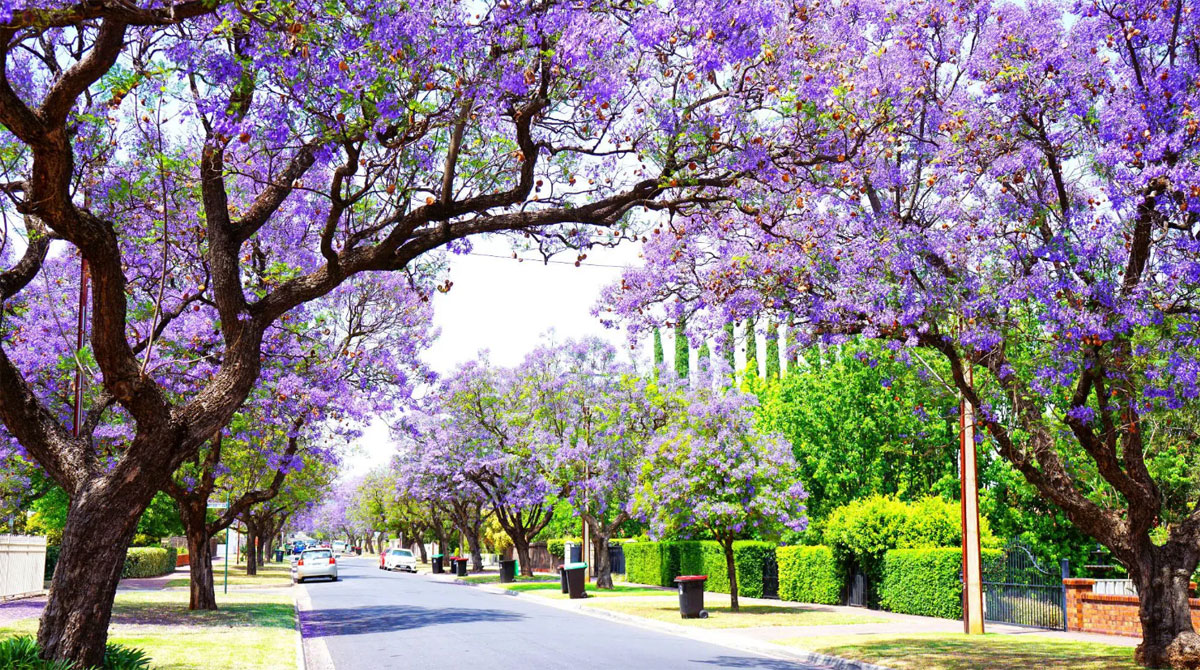
Program Status Update
South Australia’s 2025-26 skilled visa nomination program (subclass 190 and subclass 491) is now open.
Depending on your occupation and situation, there are two state nomination options available for skilled migrants through South Australia.
For South Australian state nomination, prospective applicants must meet the Department of Home Affairs requirements, state-specific occupation requirements and have skills in an occupation that is available on the South Australian Skilled Occupation List. Offshore applicants meeting the minimum published requirements can now lodge an Expression of Interest (EOI).
There is an enormous range of occupations on South Australia’s Skilled Migration Occupation List in a range of industries – search for your occupation here.
South Australia will select offshore applicants to apply for state nomination from those who have submitted an Expression of Interest (EOI) through SkillSelect. Offshore applicants will not need to lodge a Registration of Interest (ROI) for this year’s program. South Australia will be nominating offshore applicants from over 250 occupations on South Australia’s Skilled Migration Occupation List.
If you are currently residing offshore and seeking to move to South Australia, the first step is to create an Expression of Interest (EOI) in SkillSelect ensuring you select South Australia as your first preferred State or Territory.
The South Australian Government can then review your EOI for consideration under the Skilled Nominated (Permanent) visa (subclass 190) or Skilled Work Regional (Provisional) visa (Subclass 491).
For most occupations, applicants must have a minimum of three years of skilled employment in their nominated or related occupation within the last 5 years to secure an invitation to apply for SA nomination.
South Australia will be assessing candidates on merit by the following factors:
For occupations in the construction trades (as listed here) applicants must have a minimum of one year of skilled employment in their nominated or related occupation within the last 3 years.
Applicants in the construction trades will be assessed on merit by the following factors:
Before submitting an EOI for South Australia, applicants should check that they meet all eligibility requirements.
For a further explanation, see the Frequently Asked Questions page on the South Australia Government website.
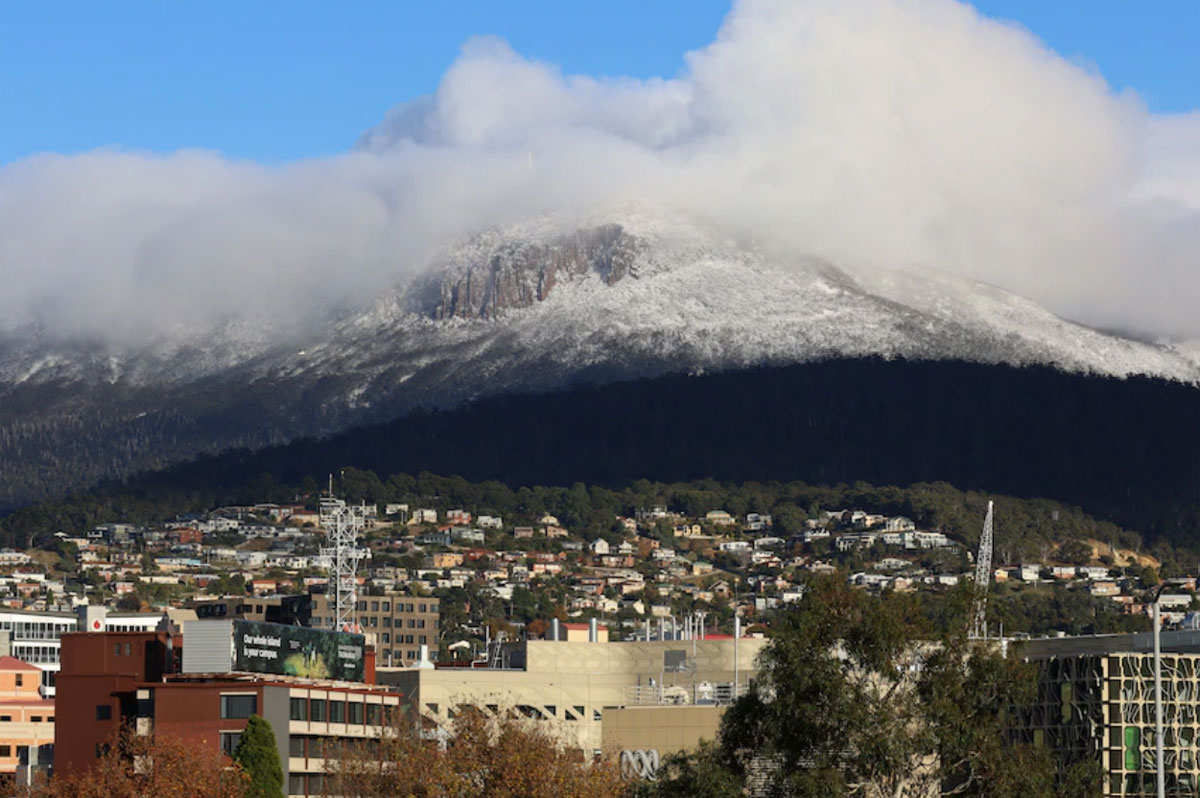
Program Status Update
Tasmania’s 2025-26 skilled visa nomination program (subclass 190 and subclass 491) is now open.
Migration Tasmania has received our full allocation from the Australian Government and has commenced inviting ROIs on a weekly basis.
Tasmania has now received its full nomination allocation for the 2025-26 program year.
In total, including interim allocations, this comprises:
Migration Tasmania has now commenced weekly invitations to apply for nomination.
Information will be posted on the Migration Tasmania website every week detailing:
Program Changes and New Features
Following analysis of program outcomes and stakeholder feedback, updates have been made to improve the application process, clarify requirements and priorities, and manage program risks.
Key changes include:
Detailed information about the changes can be found HERE
Candidates who have submitted an ROI in the last six months may wish to withdraw it and submit a new one, as the changes to priority attribute ranking criteria may significantly improve chances of selection.
Processing times and remaining nomination quota are updated every week on the Migration Tasmania website HERE
Working in Tasmania
The two state nomination options available for skilled migrants through Tasmania are:
The Tasmanian State Nomination Skilled Migration Program supports Tasmanian businesses and increases the state’s working age population. It does this by attracting and retaining migrants with skills genuinely in need by employers, or with the capacity to settle in Tasmania through skilled employment in the long-term, and business activities that will increase employment opportunities.
Tasmania’s skilled migration program is for people wanting to move to the state who have skills that Tasmania need. Skilled migrants are attracted to Tasmania because of the state’s enviable lifestyle, career opportunities, affordable housing, reputable schools and a globally recognised university.
The Migration Tasmania Application Gateway is now available for registrations of interest (ROI) and applications for skilled visa nomination from Tasmania.
Anyone seeking Tasmanian nomination for a Subclass 190 Skilled Nominated Visa or Subclass 491 Skilled Work Regional Visa must first register in the Migration Tasmania Application Gateway .
Before submitting an ROI for Tasmania, applicants should check that they meet all eligibility requirements for either;
For a further explanation, see the Frequently Asked Questions page on the Tasmania Government website.
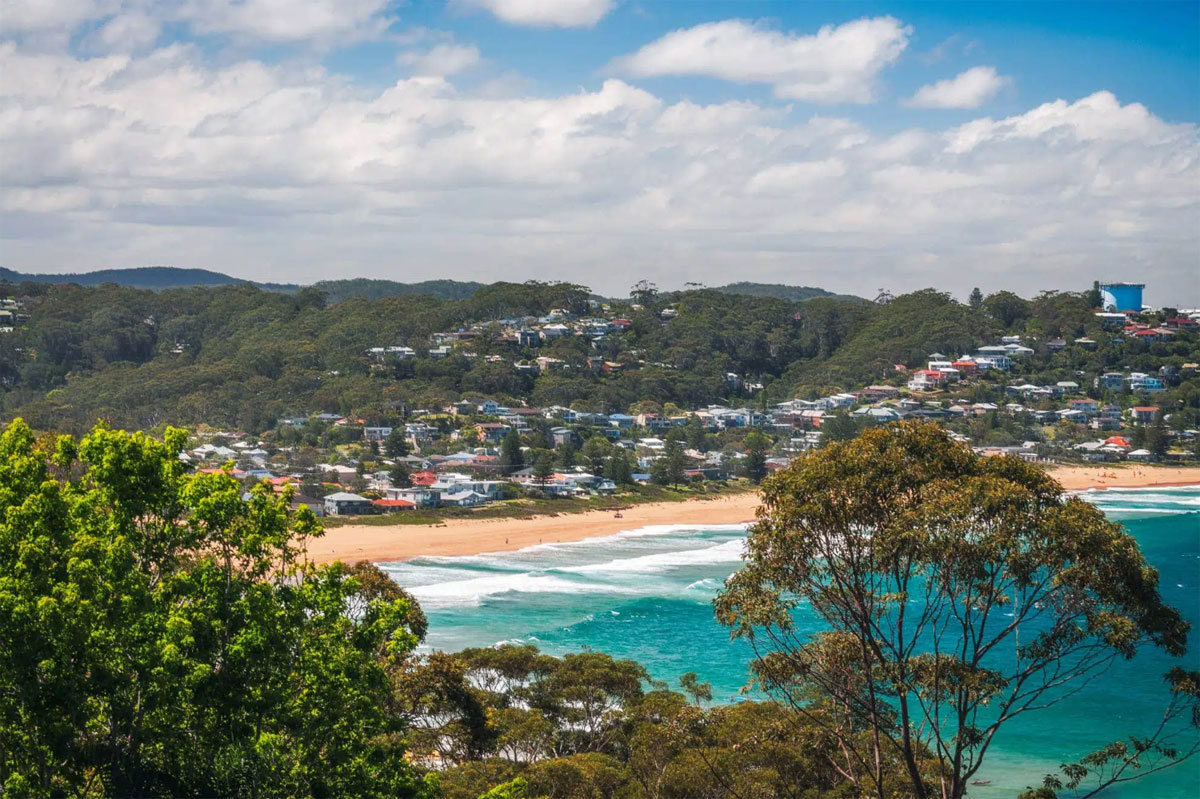
Program Status Update
NSW 2025-26 skilled visa nomination program (subclass 190 and subclass 491) is now open.
The New South Wales government has invited applications from offshore migrants under the following nomination streams:
The NSW State Government announced that offshore applicants skilled in certain ANZSCO unit groups are eligible for NSW nomination.
*Please note: Invitation rounds occur frequently throughout the financial year with no set date.
NSW invites and nominates SkillSelect EOIs at the ANZSCO unit group level. To be eligible for NSW nomination (for either Subclass 190 or Subclass 491), your occupation must fall within an ANZSCO unit group identified on the NSW Skills List which reflects skills in high demand across the state, and be eligible for the visa.
Before submitting an EOI for New South Wales, applicants should check that they meet all eligibility requirements for either;
For a further explanation of how the skills list works, see the Common questions about skilled visas page on the NSW Government website.

M Albanese and Treasurer Chalmers are setting Australia’s economic record straight.
Last week’s national accounts confirm Australia is back on a sound economic path.
WE NOW HAVE the September quarter growth numbers for gross domestic product (GDP) for 35 developed OECD members. Only three have had annual GDP growth increase steadily over each of the last four quarters: Austria, the Czech Republic and Australia.
Only three have had uninterrupted quarterly growth for the last four years: Belgium, Spain and Australia. Australia is still the only economy in the world with triple-A credit ratings, its jobless rate below 4.5% and median wealth per person above $250,000.
Australia’s economy grew 0.39% over the September quarter and 2.05% over the full year. That annual rate now ranks 13th in the OECD, up from 30th four years ago. Australia is not at the top just yet, as it was under the Kevin Rudd government, but it is getting there.
Global situation continues to deteriorate
Examining the fortunes of the other 34 comparable Western democracies shows that times are tougher for economic growth than Australian commentators are acknowledging.
Some obvious causes of this are the war in Ukraine, and the impact of U.S. tariffs on global trade.
Traditionally strong economies Japan, Ireland, Chile and Switzerland all recorded negative GDP growth in September, ending a strong period of robust growth for all of them.
Ireland has been the world’s stand-out economic success since the Global Financial Crisis, being the only OECD member to sail through the COVID downturn without one quarter of negative annual GDP growth. Australia copped three; most OECD members copped four or five. So to see Ireland go backwards is a bit of a jolt.
Germany recorded zero growth following a negative March quarter. Hungary and Lithuania both registered zero growth. Finland and Iceland recorded their second consecutive contractions, confirming they are in full recession.
Productivity? No problem
Australia’s productivity continues to advance steadily, as proven by ever-increasing wages and profits. Neither would be expanding if productivity were stagnant or declining.
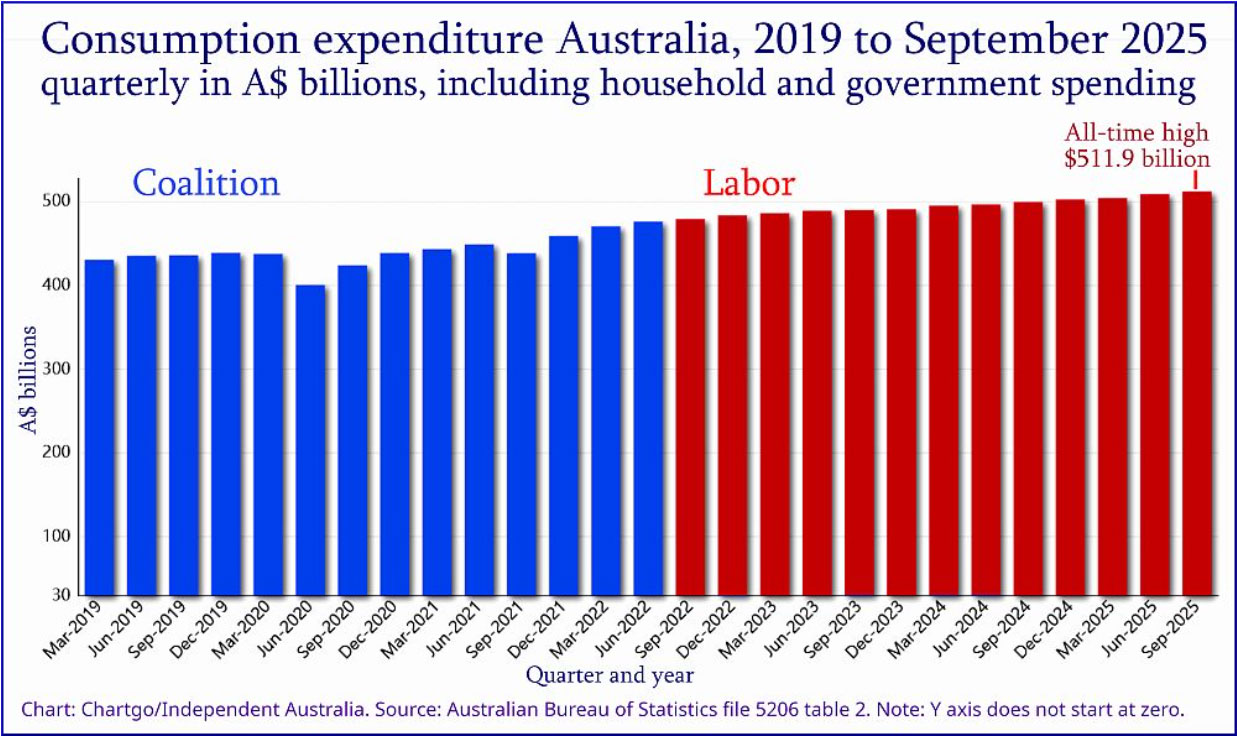
The actual measure of productivity in the national accounts continues to show stagnation, but that line no longer measures productivity accurately. The closest proxy is overall consumption expenditure, including households and corporations, shown in table 2 of last week’s national accounts. This has steadily increased since September 2021, reaching a new all-time high every quarter. See chart below.
How do the Australian government do it?
Australia’s economic trajectories since the 2022 change of government confirm the analysis of multiple authorities going back to the early days of recorded history — that looking after the disadvantaged first and foremost is the key to building a strong economy for everyone, not just the bottom end.
IA now has six real-time indicators of reducing hardship across the nation:
More importantly, the Albanese Government has ensured that an ever-increasing proportion of this goes to wage and salary earners.
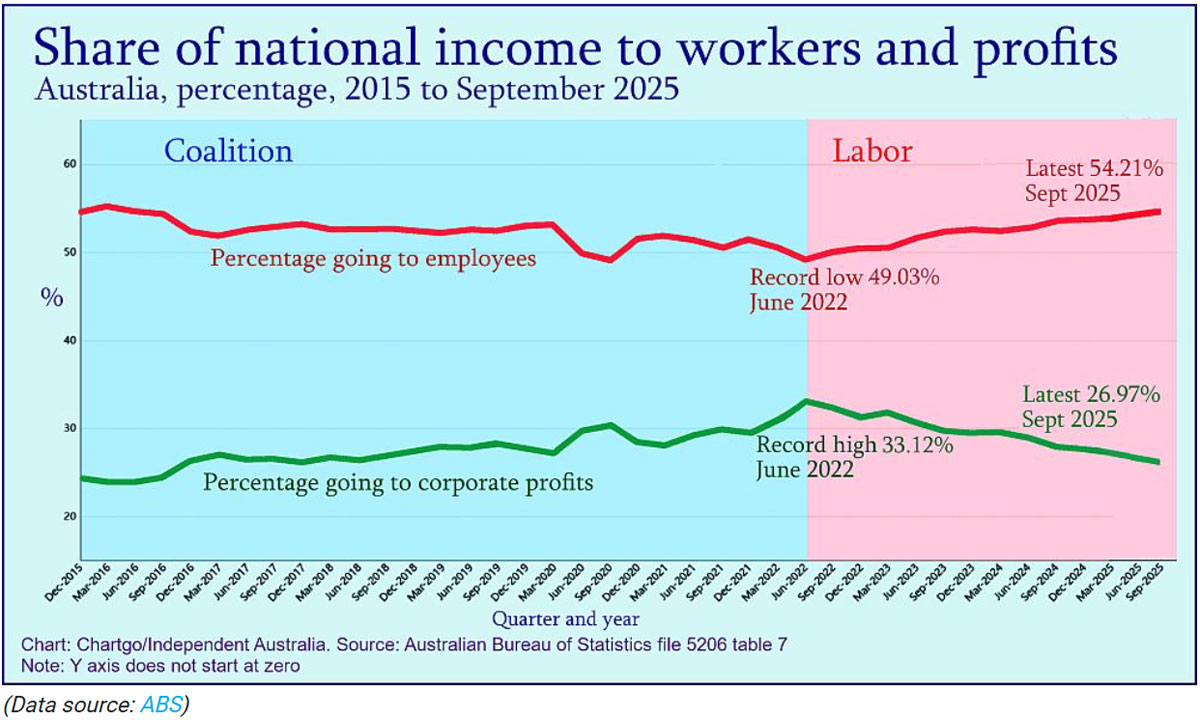
The share of total national income going to wage and salary earners rose to 54.2%, the highest in more than nine years. That’s up from 49% at the time since May 2022. See chart below.
Treasurer Jim Chalmers is increasingly being emulated by other treasurers and finance ministers. We can see why.

AS MOST PUBLISHED outcomes prove, Australia has experienced several years of surging productivity.
How we know productivity has accelerated: wage rises
Business leaders, politicians and economists have told us for decades that businesses can increase salaries only if productivity rises. They are correct.
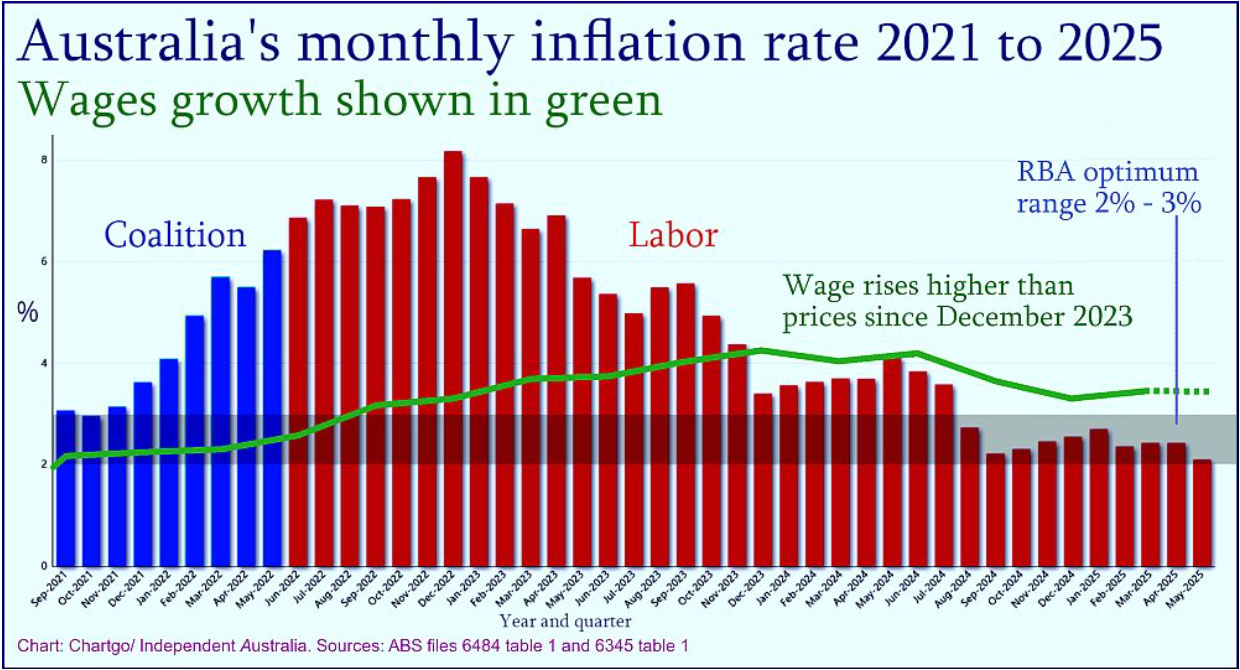
Australia has enjoyed a remarkable surge in real wages – rising higher than inflation – for the last 18 months. Wages paid in March 2025 were up 5.8% from $99 billion the year before, to a series high $104.8 billion. See chart below:
Consumer spending boom
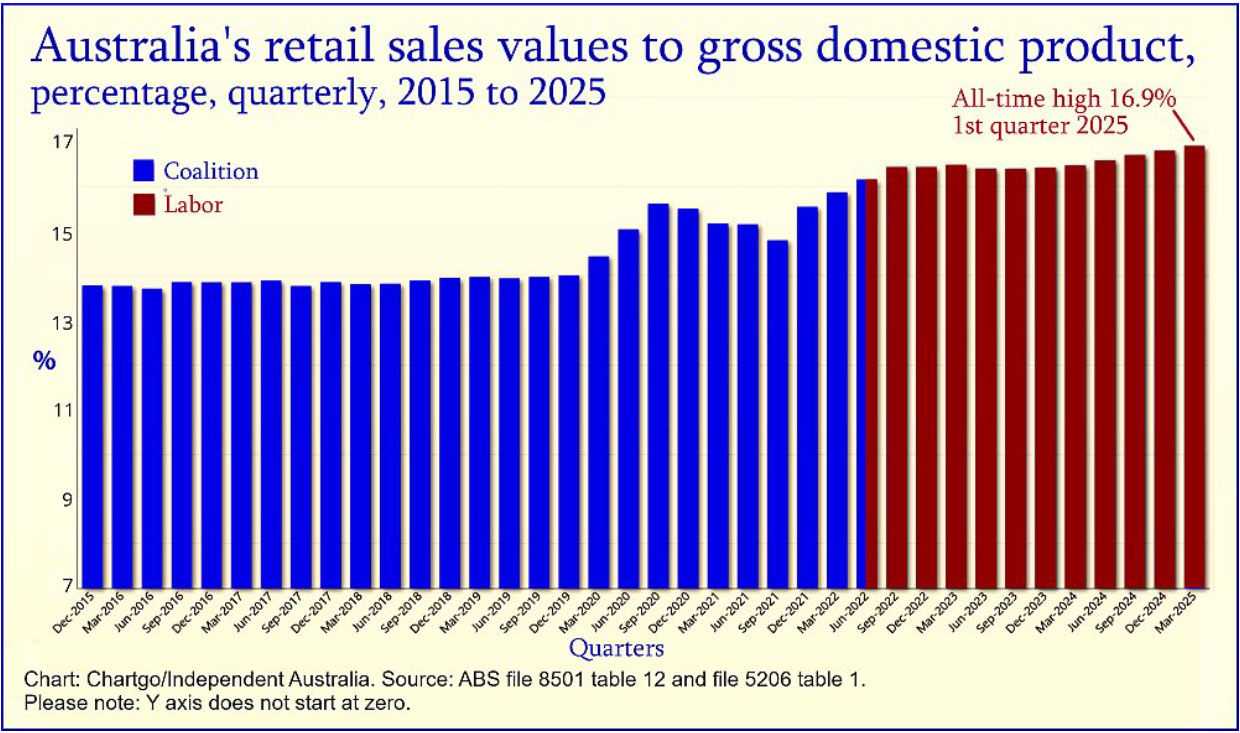
Retail spending in May was $37.29 billion, the highest for any month on record. The total for the first quarter this year was $111.48 billion, an all-time quarterly high.
This is not just normal retail sales growth with population. The last three years have also seen fresh all-time highs for retail spending relative to gross domestic product (GDP). See chart below.
More spending on luxuries
Spending on dining out, cosmetics, jewellery, overseas flights and other luxuries have surged to all-time records — in dollars, as a percentage of all retail sales and relative to GDP.
Imports of perfumes, watches, clocks, artworks, antiques, gold, silver and private light aircraft are at all-time highs in dollars and as a percentage of all imports.
Record profits
The authorities also insist that productivity must rise for company profits to increase. They are correct again.
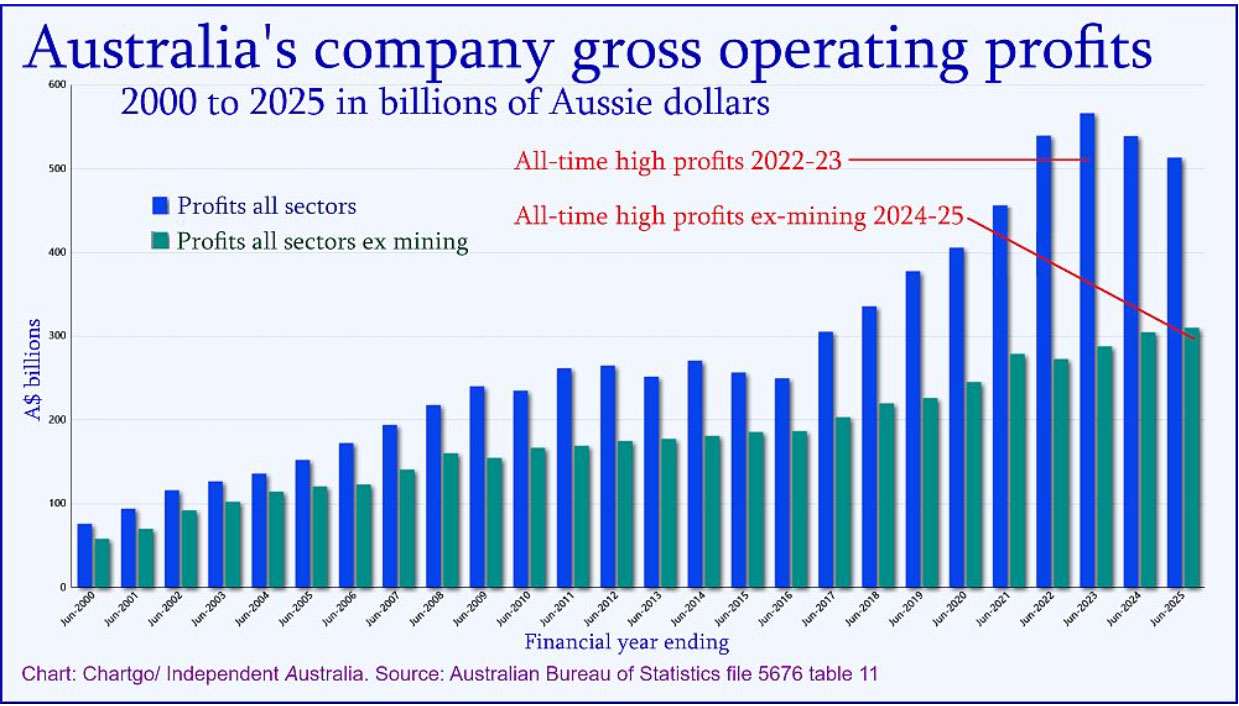
According to the Australian Bureau of Statistics (ABS), company gross operating profits have surged since 2017. Total profits in 2022-23 were $566.1 billion, well over double the $249.7 billion in 2016. In 2024-25, profits in all sectors except mining reached a fresh record $304.8 billion. See chart below.
Budget surpluses and debt reduction
Australia is one of only six OECD members to have generated budget surpluses in 2023 and 2024, along with Ireland, Portugal, Denmark, Norway and Switzerland.
Between the 2013 and 2022 elections, net debt deepened by $379.7 billion. Since the 2022 election, $17.4 billion of Australia’s net debt has been repaid.
Conclusion: Productivity is excellent but no longer measured accurately
All the above data suggests that if Australia ever had an actual productivity problem, it was pre-COVID. Since 2022, however, all areas of the economy have surged.
Never before since records have been kept has inflation been below 3% and the jobless rate below 4.5% for ten months straight. Australia is now the world’s only economy with its jobless rate below 5% and median wealth per person above $400,000. It is the only economy with triple-A credit ratings, inflation below 2.5% and continual GDP growth for the last three years.
Such wage growth, surges in consumer spending, record profits, budget surpluses and debt reduction would be impossible if productivity has fallen off a cliff. In fact, Australians are more productive than ever, but the productivity formula no longer measures this.
The problematic productivity fraction
Since 1978, the Australia Bureau of Statistics has calculated Australia’s productivity index numbers by dividing GDP by hours worked in the economy.
For decades now, GDP has been challenged as failing to measure total output adequately. Similarly, the number of hours worked per year is considered an imprecise estimate, especially since COVID necessitated more work being done remotely. Additionally, the National Disability Insurance Scheme (NDIS) has made productive hours caring for individuals with disabilities in the home higher than in the past, making them harder to measure.
This is where it gets interesting: Comparing economies
Australia’s productivity index numbers show a flat trajectory from 2015 to 2020, then spikes during COVID, then a decline since 2022. Parallel patterns are observed in Italy, Canada, France and the United Kingdom. See chart below.
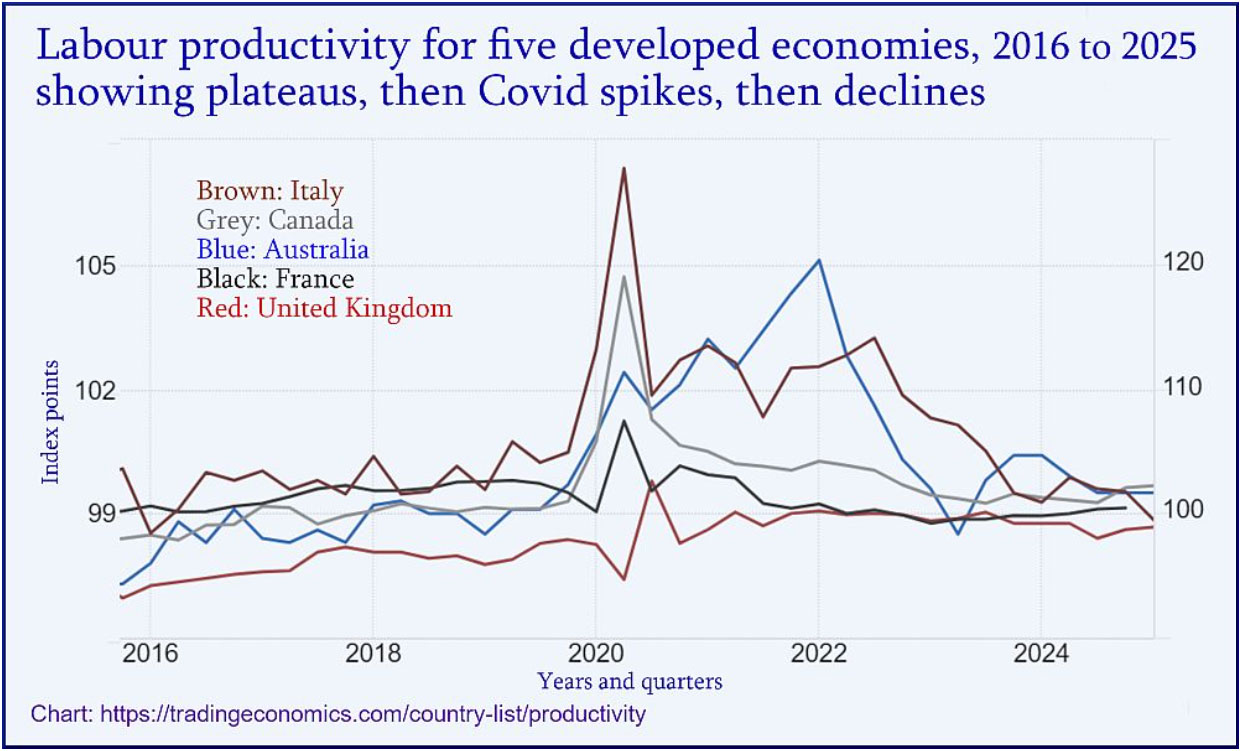
Similar trajectories are also evident in New Zealand, Luxembourg, Germany and Greece.
Only a minority of OECD members still show productivity steadily improving over time, despite worldwide advances in technology, AI and business innovation.
This confirms that the weakness of the old productivity formula is not confined to Australia.
Confirmation from consumer spending worldwide
In many developed economies, the official productivity index numbers correlate closely with consumer spending. This should not surprise, as surges in productivity should enable increased profits to flow through to wages and household spending power. And vice versa. Denmark exemplifies this well. See chart below.
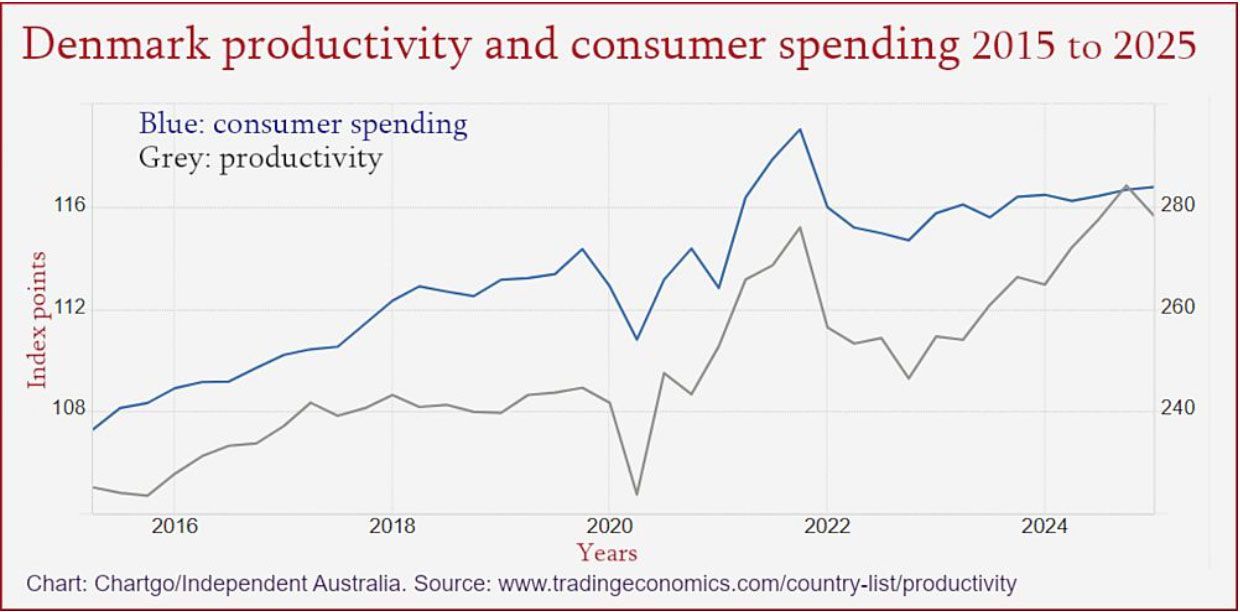
The same parallel tracking of productivity with consumer spending is evident in the Netherlands, Poland, Sweden, Austria, the Czech Republic, Finland, Germany, New Zealand, Slovakia and Slovenia.
Here is the Netherlands:
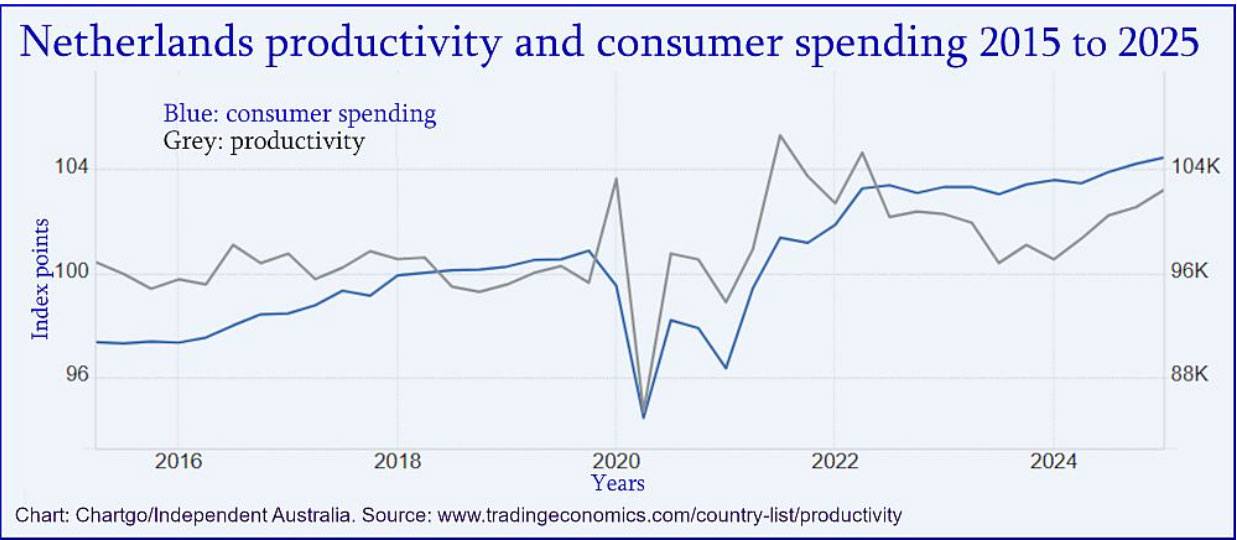
Australia, in contrast, has a bizarre non-correlation since the COVID-19 recession in 2020. See chart below.
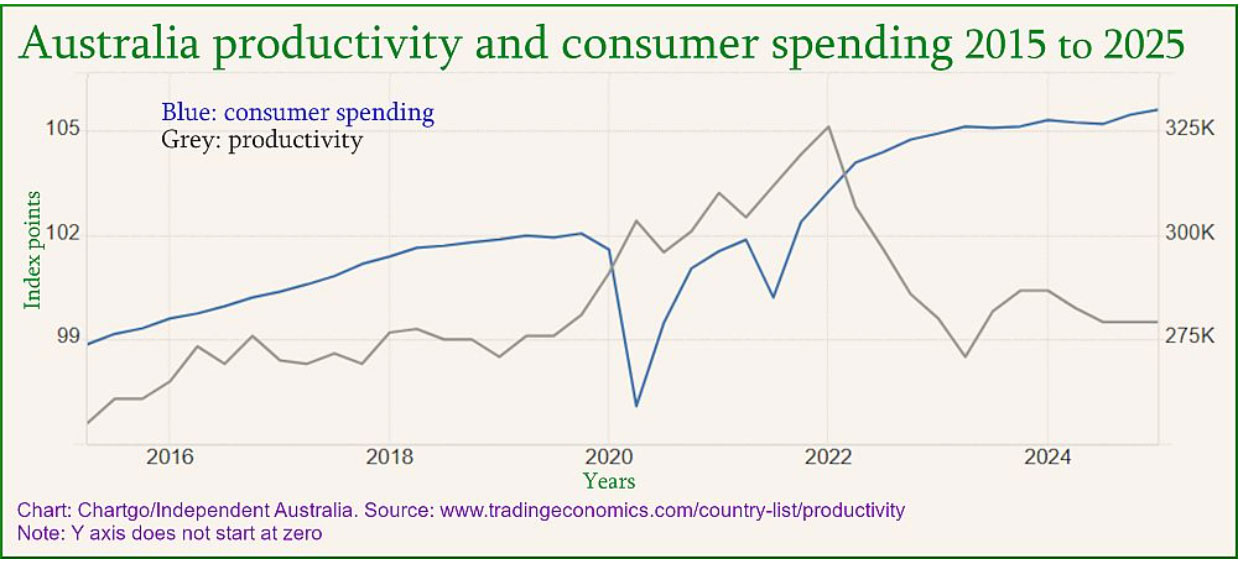
The blue line is a reliable indicator that, historically in Australia and most comparable economies, closely tracks the grey productivity index numbers. The observed divergence since 2020 further undermines the validity of official productivity numbers.
This opposite tracking of productivity against consumer spending is evident also in Canada, Luxembourg, Ireland and elsewhere.

Driven by US policy tailwinds announced since April, the fund manager has argued both global and US economies are on a growth pathway heading into next year.
According to Ausbil, the 2026 outlook is much stronger, boosted by US tax cuts, industrial investment incentives, and US Federal Reserve (Fed) rate cuts announced since 2 April.
In its outlook for the coming year, the firm added that deregulation, lower oil prices, reduced core inflation, tariff exemptions, and the Fed’s careful balancing of unemployment and inflation are making US business conditions easier.
Ausbil chief economist Jim Chronis said these factors are creating especially strong conditions for Australia.
“Looking ahead, we see a supportive macroeconomic environment for the Australian economy, driving earnings growth and favouring investment in equities,” Chronis said.
He said Ausbil sees US growth rising to 2.1 per cent in 2026, while Europe stays at 1.4 per cent and China at 4.5 per cent. Meanwhile, the firm forecast Australia’s growth to pick up to a “robust” 2.8 per cent.
According to the firm, this outlook is supported by Australia’s relative insulation from tariffs, strengthened by its favourable position under the bilateral critical minerals and rare earths framework reached with the US in October.
“The material risk of A$214 billion in direct exports to China is in resource raw material commodities which will be required as an input in additional Chinese stimulus measures,
“Fortunately, we continue to benefit from our growing export exposure of A$258 billion to the Indo-Pacific region of fourteen countries (which excludes China). This region is experiencing robust real growth rates in the range of 5 per cent to 6 per cent,” Chronis added.
Moreover, he noted that following the Fed’s final cash rate cut of the year, US and Australian rates are continuing to converge. In turn, he said Ausbil expects the dollar to hold near 65 cents with low volatility and a mild upward trend through 2026.
“The Australian trade weighted basket of currencies should continue to be range bound as commodity prices remain elevated and resilient,” Chronis said.
Meanwhile, he said the June quarter national accounts confirmed a continued, gradual shift in economic activity from the public to the private sector, a transition that began in the September quarter of 2024.
At a Senate hearing in October, Reserve Bank governor Michele Bullock also stated that she expects the private sector to increasingly take the lead in driving economic growth.
Longer term structural drivers
Ausbil also highlighted several global long-term structural drivers that could create growth opportunities and new value chains across sectors.
These included an increased commitment to military spending globally, increased investment in infrastructure to accommodate the growth in artificial intelligence (AI), ongoing investment to secure independent energy security, and increased demand for electricity over carbon-based energy.
“Carbon free energy sources, primarily from renewables, are expected to become the dominant force in global energy systems, reducing reliance on fossil fuels,” Chronis elaborated.
Betashares has also flagged the defence sector as a strong area going forward, similarly pointing to the rise in global defence spending – not just in Europe, but across markets worldwide.
Tom Wickenden, an investment strategist at the firm, pointed to regulatory approval for Korea’s major defence group Hanwha to lift its stake in Australian shipbuilder Austal as evidence that momentum is extending beyond the region.
“With defence spending targets often tied to rising GDP, we see global defence expenditure as a multi-decade trend that remains under-represented in many Australian portfolios,
“The growing activity in the sector presents a long-term growth opportunity, and we expect M&A to continue in various forms as spending expands,” Wickenden said.
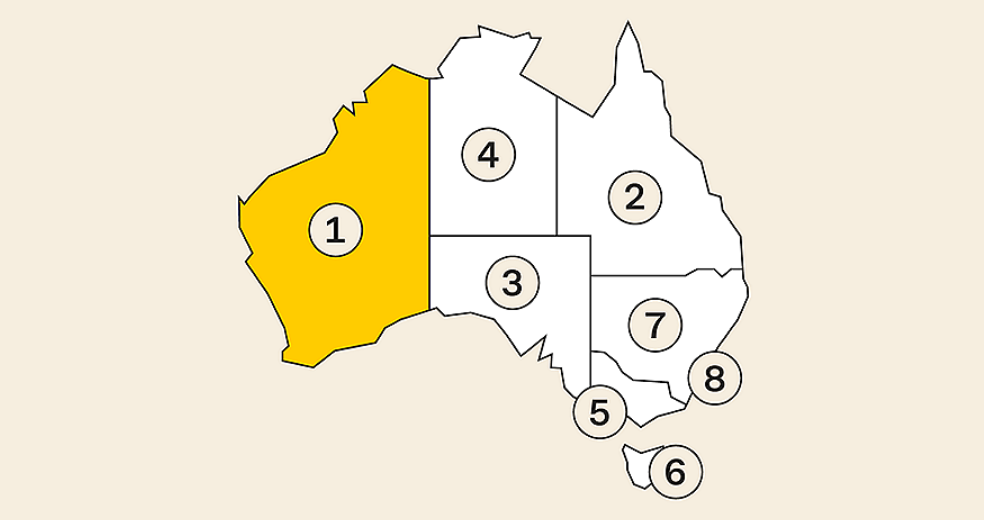
Queensland climbs to second as South Australia, Northern Territory show strongest momentum.
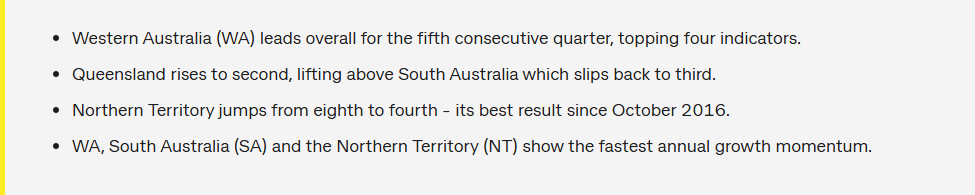
Western Australia has again claimed the title of Australia’s best-performing economy, taking top place in the latest State of the States report.
Now in its 17th year, the quarterly report compares each state and territory across eight key indicators: economic growth, household spending, equipment investment, unemployment, construction work, population growth, housing finance, and dwelling commencements.
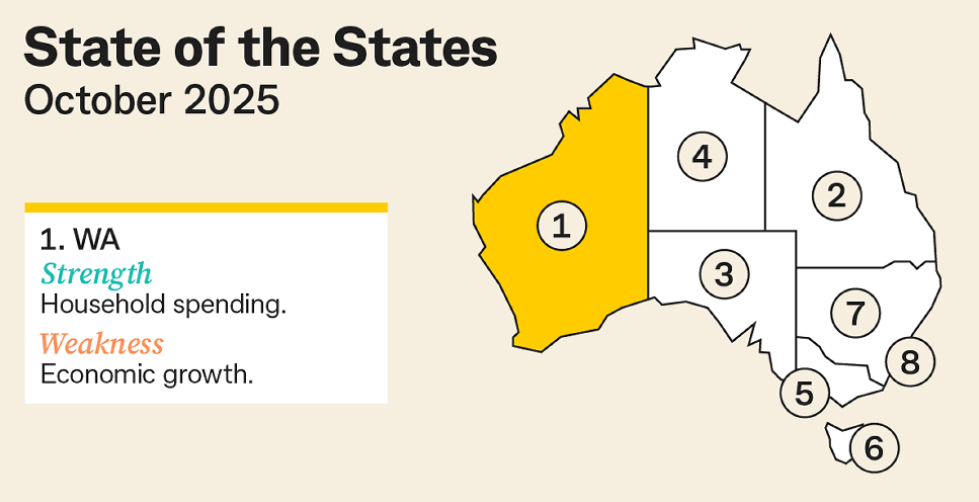
WA remains out in front
The overall rankings measure how each economy is performing relative to its own decade average or “normal” level of activity.
Western Australia leads for the fifth straight quarter, ranking first on household spending, housing finance, dwelling starts and equipment investment.
Queensland has climbed to second, supported by consumer spending and housing strength. South Australia holds third, leading in economic growth and construction activity.
The Northern Territory was the standout improver, jumping from eighth to fourth on the back of strong population growth. Interest-rate sensitive Victoria, Tasmania, NSW and the ACT follow as public demand moderates and private investment gathers pace.
Western Australia continues to perform strongly, underpinned by strong population inflows, resilient household spending and ongoing government support.
Queensland’s economy is rebounding following weather-related disruptions earlier in the year with exports stabilising, while the public investment outlook is promising in the Sunshine State due to planned Olympic infrastructure projects.
Lower borrowing costs will eventually support the transition from public-to-private sector-led economic activity in Australia’s south-eastern states and territories.
Growth accelerates in SA and NT
Tracking recent economic momentum, the pace of annual growth across the same eight indicators.
On this measure, Western Australia again leads, closely followed by South Australia and the Northern Territory. These states are showing the strongest acceleration in private sector activity and spending growth.
Outlook
Looking ahead, resource-driven states are expected to maintain their advantage into 2026 as easing inflation, lower borrowing costs and rising real wages support demand.
Western Australia, Queensland and the Northern Territory are best positioned heading into 2026. The key question now is whether the private sector can sustain the recovery as public investment tapers off.
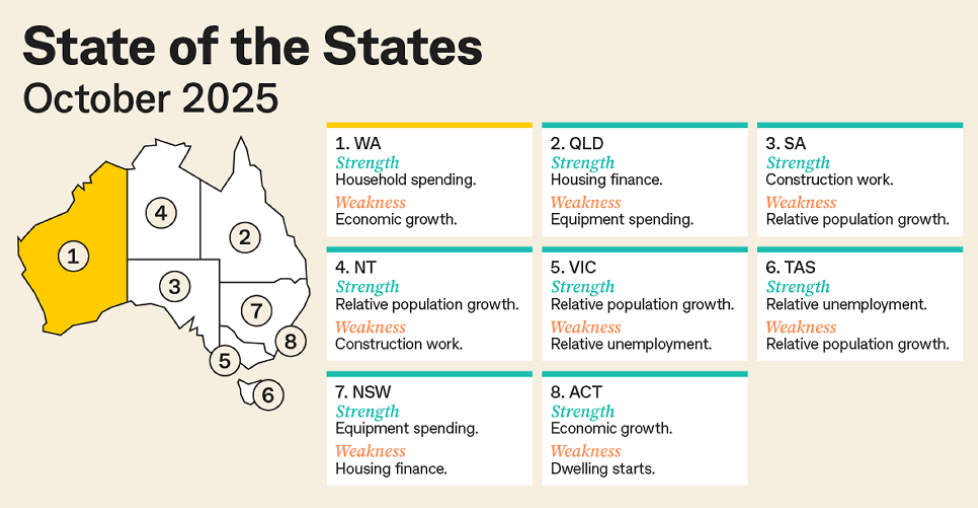
Snapshot of Key Indicators
A cardiac sonographer said she had no trouble finding a job in the industry and explained why she loves the work.

A Sydney worker has revealed the little-known medical job that pays extremely well that is facing a “huge shortage”. The woman was stopped in Sydney and said most people think it’s only doctors and nurses that are needed in hospitals at the moment.
But the cardiac sonographer said she could earn upwards of $95 per hour at her job, which is $3,800 per week, or close to $200,000 per year, based on an eight-hour shift. But she explained that her work comes with an odd type of stress.
“You’re dealing with people’s lives so if you have a bad day at work, it can be a really bad day because you might lose someone, but you’re there to help,” she said.
“And nine times out of 10, you’re making people’s lives more positive.”
How do you get into this job and how much can you make?
The woman revealed that it took five years of studying to get into her field.
According to SEEK, you usually have to complete an undergraduate degree in a field like medical radiation science or medical imaging.
This can take three to four years to complete.
After that, you then need to do a graduate diploma in medical ultrasound, which takes roughly two years part-time.
Alternatively, you could do a masters in medical sonography and then specialise in general, cardiac or vascular sonography.
“Not enough people know it, because we only had eight people in my degree,” the cardiac sonographer said.
“Everyone just thinks doctors and nurses exist in the hospital. There’s a huge shortage, I literally had no trouble finding a job out here.”
Jobs site Talent revealed an entry-level salary for a cardiac sonographer in Australia can earn around $103,019 per year, which is roughly $1,981 per week or just below $50 per hour.
The woman in Sydney said after working in the field for the last 10 years, she’s now able to command a salary of $85 to $95 per hour depending on the day.
“I love it, wouldn’t change jobs. Everyone’s aware of someone with something cardiac. It is so prevalent,” she added.

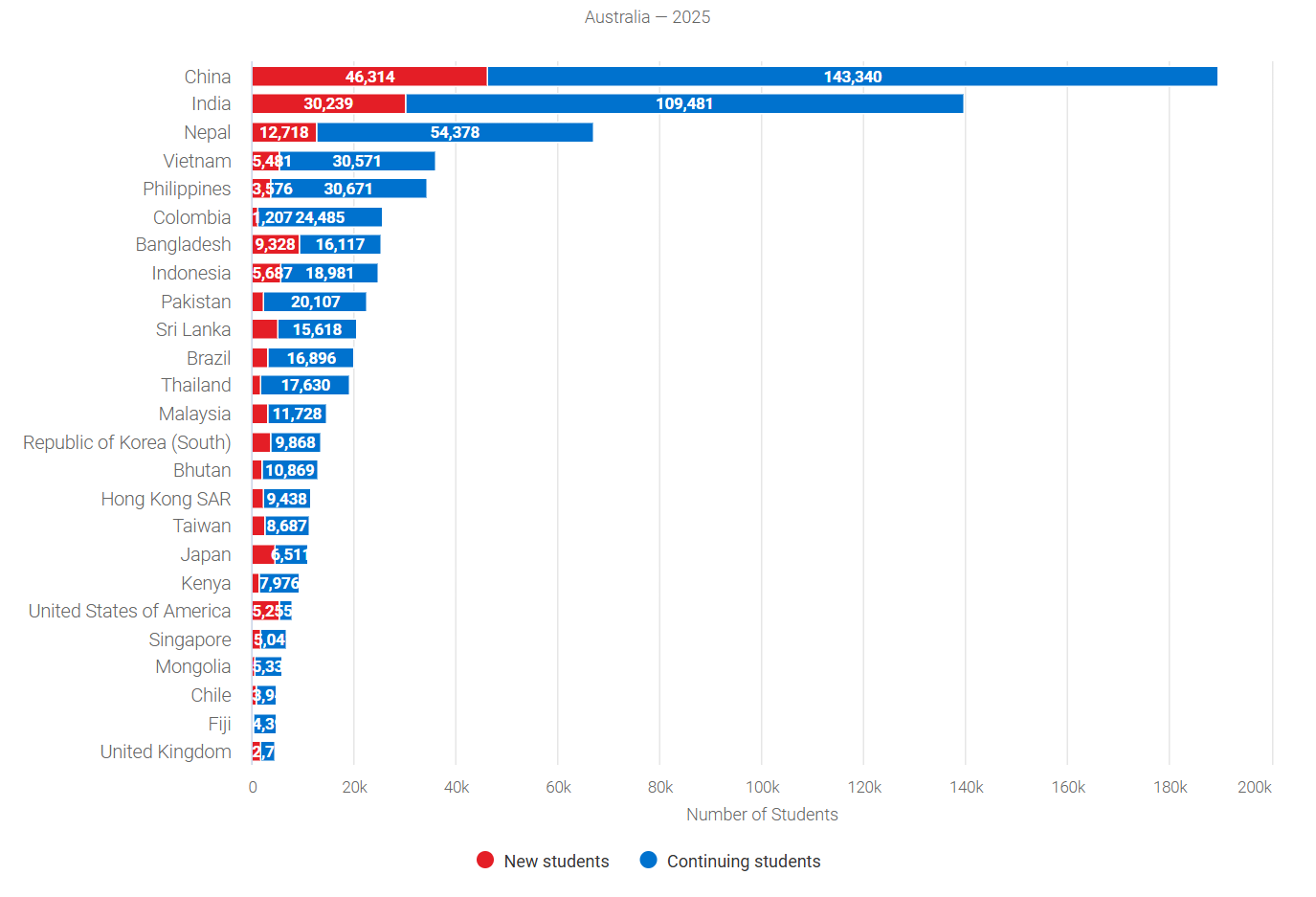
International student head count for students studying on a student visa. International student numbers can be disaggregated by nationality.
The number of international students studying in Australia totalled 821,553 for the January-September 2025 period. There was a change of 0% compared to the same period last year.

The number of temporary visa holders in Australia has surged to a record 2.9 million, including an “astonishing” number among one group.
The number of temporary visa holders in Australia has surged to a record 2.925 million.
International students, Kiwis, an “astonishing” number of people on bridging visas, and failed asylum seekers now make up 10 per cent of the population, Home Affairs figures show.
The total number of temporary visa holders in the country has increased by around 1.2 million since 2019, a nearly 70 per cent rise, to 2,925,604 at the end of October.
That figure includes 731,234 New Zealand citizens, 638,166 students, 240,332 temporary graduates, 402,652 bridging visa holders, 238,322 temporary skilled workers, 226,962 working holiday makers and 360,214 tourists.
“Just about everything is up — there’s nothing that’s fallen over the last decade,” said Dr Abul Rizvi, former deputy secretary of the Immigration Department. “The only one that hasn’t really gone up is visitors. We’re not getting the tourism numbers we did pre-Covid.”
Under the universal visa system introduced in 1994, all non-citizens in the country were required to have a visa. That meant a solution was needed to avoid making “unlawful non-citizens” out of migrants who were awaiting a decision but whose current visa was no longer valid.
There are now nearly eight times as many people on bridging visas as 10 years ago.
Much of that was driven by a surge in asylum applications by Chinese and Malaysian nationals between 2015 and 2020, who were simply seeking a backdoor work visa for a few years while waiting to be processed.
Of the 3864 study visa finalisations between July and September, 45 per cent resulted in a changed decision, according to the latest ART figures.
In September, Home Affairs Minister Tony Burke confirmed the 2025-26 permanent migration figure would remain at 185,000.
The latest figures from the Australian Bureau of Statistics (ABS), published in September, show Australia’s population grew 1.6 per cent in the 12 months to March 31, reaching 27,536,874 people.
Of that, net overseas migration accounted for 315,900 people, while natural increase — births minus deaths — was just 107,400.
Net permanent and long-term migrant arrivals — which differ slightly from net overseas migration — hit a record-breaking 415,760 in the first three quarters of 2025, ABS data last month showed.
The Institute of Public Affairs (IPA), a conservative think tank, said the figures showed “the federal government’s ‘Big Australia’ policy is well and truly in full flight”.
A Home Affairs spokesman said the government’s “implementation of various migration measures has ensured migration delivers for the nation.”