
 EXCLUSIVE MEMBERS ONLY ACCESS
To access this month’s edition & Member’s only resources, enter your registered email address.




Manly – Sydney, New South Wales
The Results of the August 2021 census were made public on 12th July 2022, and revealed that Australia has become a majority migrant nation, as the census data shows for the first time that more than 50 per cent of residents were born overseas or have an immigrant parent.
Australia’s 2026 Migration Program has been carefully designed to boost the social and economic outcomes that meet Australia’s needs. In fact, the migration programme was first launched in 1945 following the aftermath of World War 2. Given this long history, it is worth understanding how it works. The Australian Immigration Bulletin exists to help explain this in more detail.
As we’ve entered the 2nd month of the year, join us for a look at the latest news and developments in the world of Australian Immigration!


The latest ABS data reveals that the Albanese government has welcomed in almost 1.3 million migrants on a net basis over the past three financial years – equivalent to 1,160 per day – blowing all previous records out of the water.
Today, the Australian Bureau of Statistics updated its National state and territory population database for the reference period June 2025, which shows:
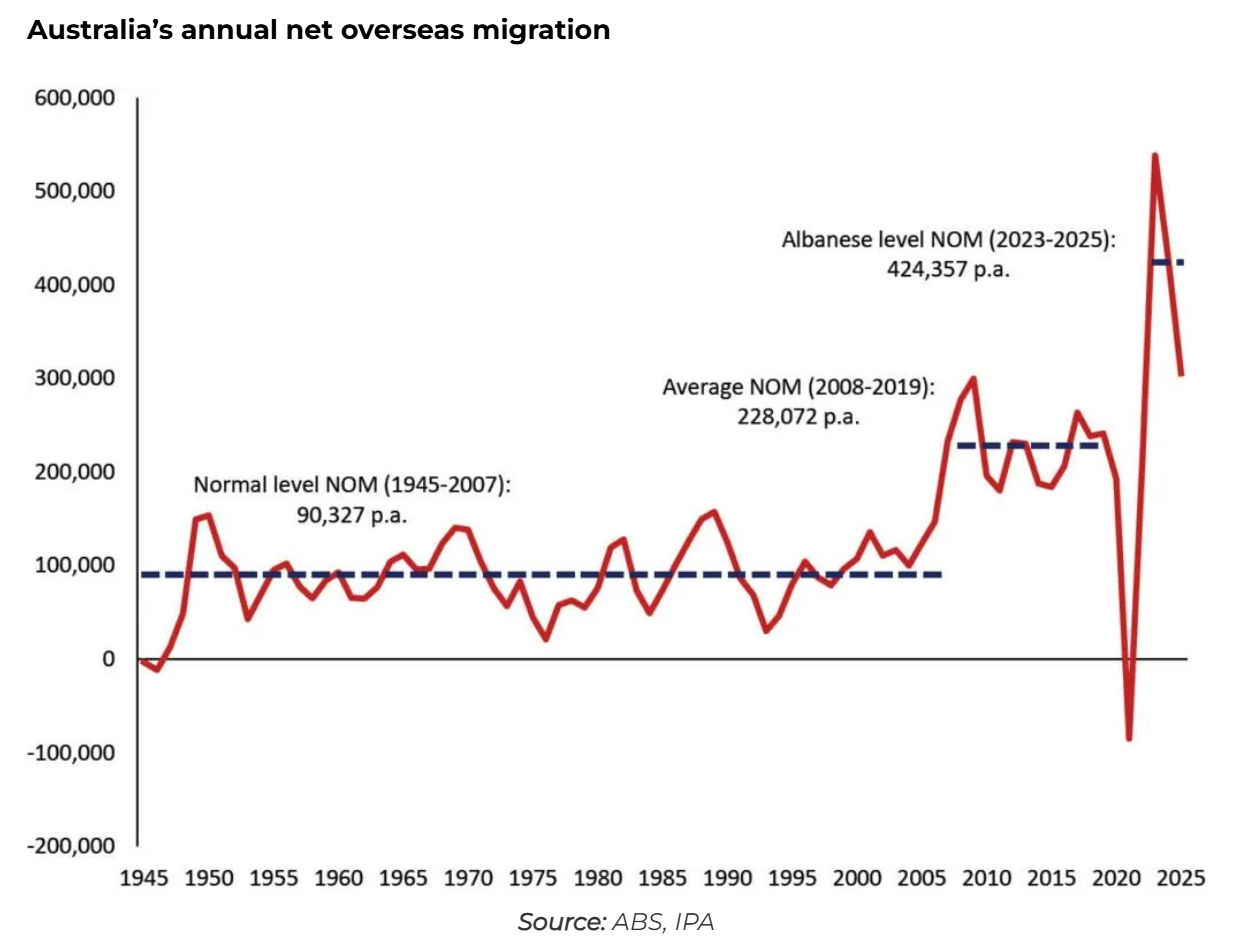 Net overseas migration in the financial year ending 2025 was responsible for 73 per cent of Australia’s population growth, helping to meet Australia’s current workforce skill shortage.
Statistics about the population and components of change (births, deaths, migration) for Australia and its states and territories

Key statistics
Statistics in this release are commonly known as Estimated Resident Population (ERP).
National
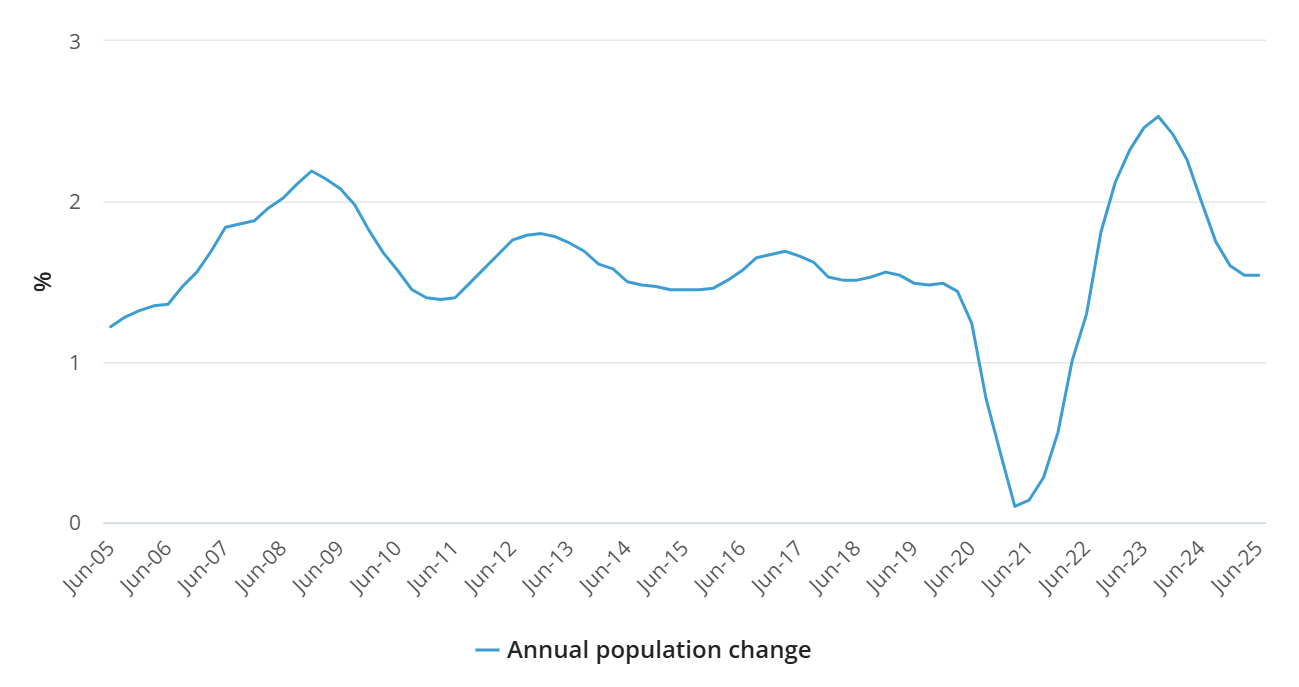
Annual population change
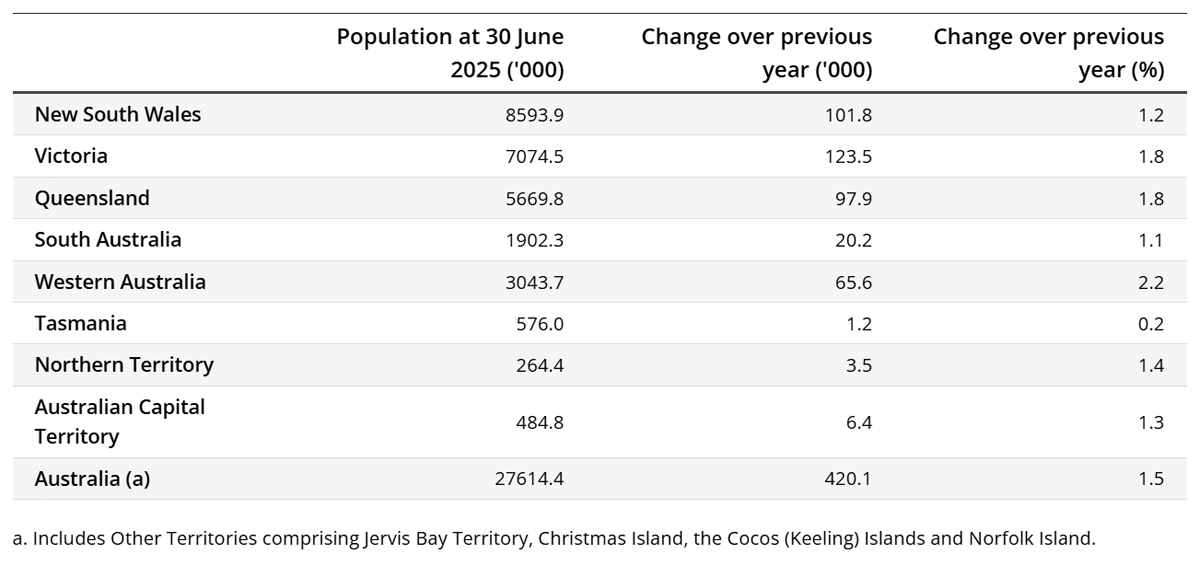
In the year ending 30 June 2025, Australia’s population grew by 420,100 people (1.5%).
Annual population growth rate

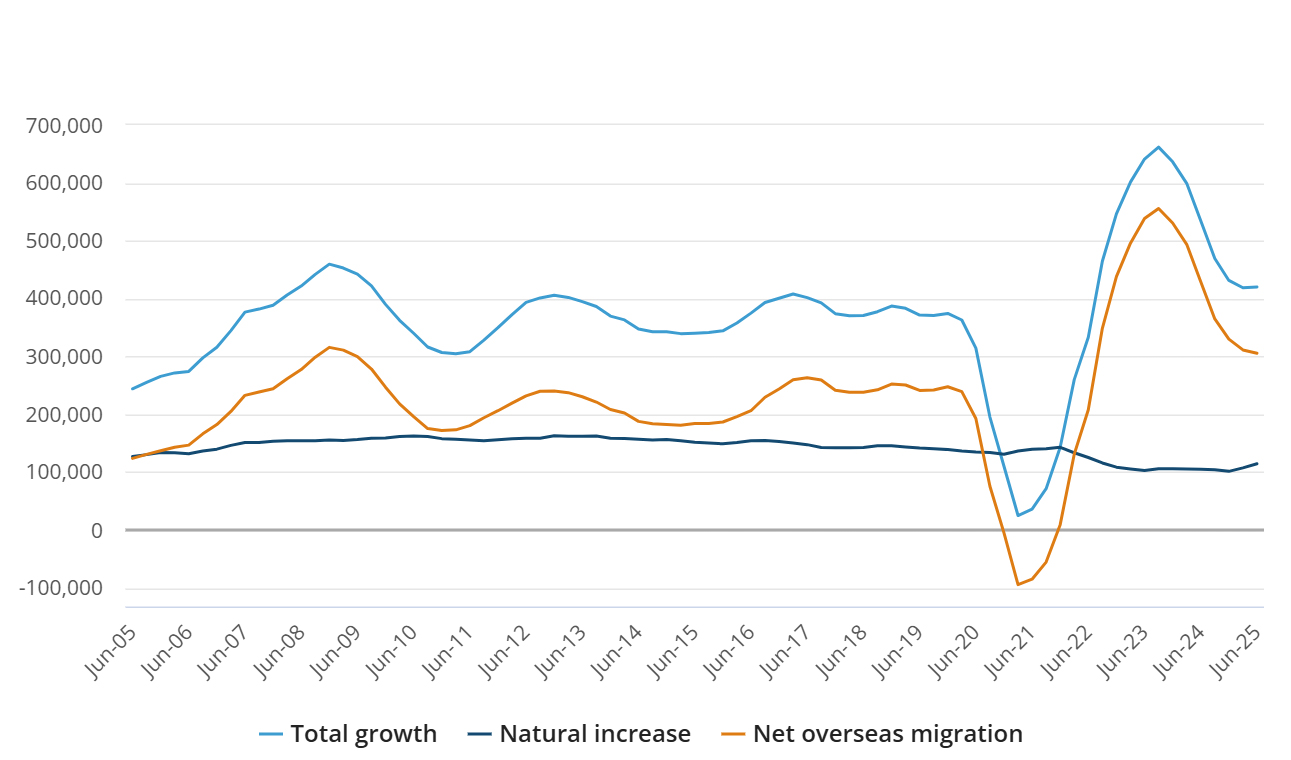
Components of annual population change
In the year ending 30 June 2025, natural increase:
In the year ending 30 June 2025, net overseas migration:
Components of annual population change
Overseas migration arrivals and departures
Overseas migration arrivals
In the year ending 30 June 2025:
Overseas migration departures
In the year ending 30 June 2025:
States and territories
Annual population change
Annual population change at 30 June 2025


Population growth, state migration planning, and local advocacy highlight the central role of councils in shaping Australia’s migration future.
Our population reached 27.3 million in September 2024, growing by 484,000 people over the year. Although growth has slowed from the pandemic rebound peak of 2.5 per cent to 1.8 per cent, net overseas migration remains the main driver, adding 380,000 people in the past year.
With fertility at a record low of 1.49 babies per woman, migration will remain central to meeting workforce and community needs, making population management a critical policy issue for all tiers of government.
State-level trends highlight the opportunities and challenges. Victoria and Queensland recorded growth above the national average, driven primarily by migration, while Tasmania and the Northern Territory saw very low growth.
New South Wales released its first State Migration Plan for 2024–2028, which sets strategic priorities to address critical skills shortages in housing, renewables, the care economy, digital industries, and agriculture. Importantly, the plan emphasises the need for collaboration between the Commonwealth and states, with a focus on aligning migration to economic and workforce strategies.
Local governments sit at the intersection of these national and state priorities. Councils are directly responsible for housing, infrastructure, and community services, which are the first to feel the impacts of both humanitarian and skilled migration flows.
The NSW State Migration Plan underscores the structural role migration will play in workforce and regional development. Ensuring local government perspectives are embedded in these frameworks is essential to creating sustainable migration and settlement policies that work for communities across Australia.

Becoming an Australian citizen requires a four-year residency, including one year as a permanent resident, and meeting good character requirements. Permanent residency offers indefinite living and working rights, access to services, and is the primary route to citizenship. Applicants must maintain eligibility throughout the process, including during application processing.
Getting Australian citizenship after permanent residency is a common goal for many migrants, but the process follows a clear timeline and set rules. In most cases, applicants need to live in Australia for four years, including at least one year as a permanent resident, before they can apply for citizenship.
Who is eligible for Australian citizenship
To qualify, applicants must meet the four-year residence requirement. This includes holding a permanent visa or an eligible Special Category Visa and being physically present in Australia for at least three of those four years. At least 12 months must be spent as a permanent resident. Applicants must also meet the good character requirement, which involves checks on criminal history and compliance with Australian laws.
What Permanent Residency offers
Permanent residency allows migrants to live, work and study in Australia indefinitely. It also provides access to Medicare, eligibility for bank loans, and the ability to sponsor certain family members. For many, PR is the main pathway to citizenship, which brings additional rights such as voting and holding an Australian passport.
How the citizenship application works
Citizenship applications are made using Form 1300t. Applicants must submit identity documents, proof of residence, character documents and, where required, evidence of English proficiency. An application fee applies. Most applicants aged between 18 and 59 must also pass a citizenship test that checks knowledge of Australian values, history, government, and civic responsibilities.
Staying eligible while waiting
Applicants must continue to meet residence and character requirements while their application is being processed. Long absences from Australia or legal issues during this period can affect the outcome. Authorities must be informed of any changes in personal circumstances.
While the process takes time, permanent residency offers stability and access to essential services, making the wait manageable for many applicants. By meeting residence rules, maintaining good character and preparing for the citizenship test, permanent residents can move steadily towards becoming Australian citizens.
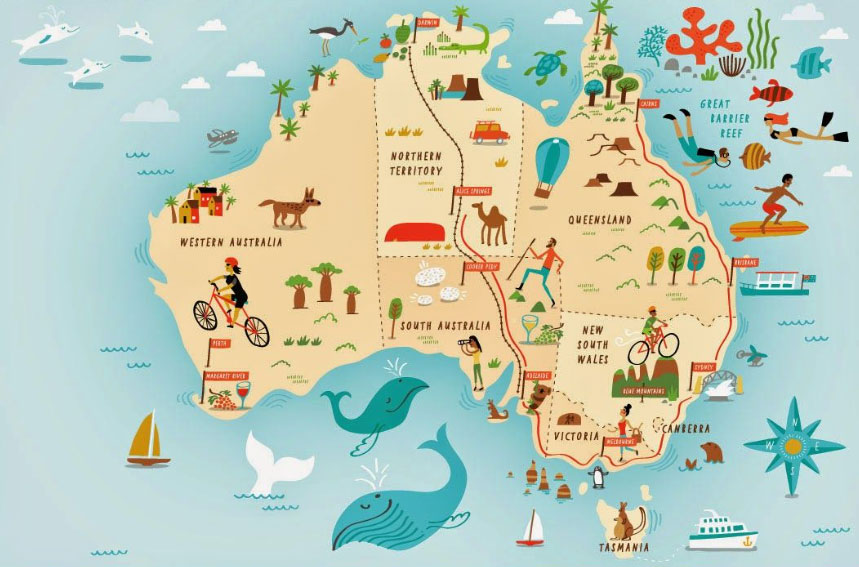
If you are interested in applying for a general skilled migration visa to Australia, it is important to have a good understanding of the skilled visa options and how the migration points test works, so that you can maximise your chances of being eligible to apply for a skilled visa.
A general skilled migration visa is an option available to skilled workers who are seeking to qualify for a skilled visa independently, or under a state or family sponsorship. It is an alternative to an employer sponsored visa.
One of the key criteria to qualify for a general skilled migration visa is the points test (a criterion that does not apply to employer sponsored visas). This is often the most challenging aspect for prospective skilled visa applicants to overcome when seeking an invitation to apply for the relevant skilled visa.
If you are considering applying for a general skilled migration program visa, an important concept to understand is the Expression Of Interest (EOI).
If you are considering applying for a general skilled migration visa, it is important to be aware that for certain visas in this visa class, you will first be required to lodge an EOI with the Department of Home Affairs (the Department) through SkillSelect. The EOI is not a visa application, but rather, it is the process by which you can express your interest in applying for the relevant skilled visa (It’s important to note, that there is NO fee to submit an EOI).
This requirement applies to the following skilled visa subclasses:
Let’s take a brief look at each of these visas below:
The ‘subclass 189’ is a federal sponsored visa that grants automatic permanent residence in Australia. It is subject to nil visa conditions or obligations. For this reason, it is often considered to be the most flexible of the skilled visa options available.
A subclass 189 points-based visa allows you to live and work in any state or territory permanently.
The ‘subclass 190’ is a state/ territory sponsored permanent residence visa. It is another points-based visa for which invitations are issued throughout each month by individual states and territories. One of the benefits of applying for state nomination is that you will be granted an additional 5 points.
An important aspect to consider, which does not apply to the subclass 189 visa is that there is an added step in the application process. In this case, you must also apply for nomination approval to a state or territory government. Only upon receipt of an invitation from the relevant state or territory to which you apply can you then apply to the Department for the visa itself.
Your obligations as a subclass 190 visa holder are that you must commit to your nominating jurisdiction’s obligations and commit to residing in your nominating State or Territory for two years from visa grant.
The ‘subclass 491’ is also a points-based state/ territory (or family) sponsored visa. It is a regional visa with a term of five years. The Department issues invitations for family sponsored EOI applications only (in invitation rounds). Invitations for state sponsorship are issued by individual states and territories throughout each month. This will grant you an additional 15 points for the nomination.
Being a provisional visa, this means it provides a pathway to permanent residence in Australia with the Subclass 191 Permanent Residence (Skilled Regional) visa, subject to meeting specified requirements.
Be mindful that as a subclass 491 visa holder, you must abide by visa condition 8579, which requires you to live, work and study in a designated regional area of Australia. For migration purposes, most locations of Australia outside of major cities (Sydney, Melbourne, Brisbane, Perth, etc.) are classed as regional areas.
If your EOI is successful, you will receive an invitation to apply for the visa, as specified in the invitation letter. This then enables you to proceed with lodgement of your visa application (provided you meet all other visa lodgement and visa grant requirements).
Please note, the below State and Territory program updates is a general overview only. It does not take into account any of your personal circumstances. You must check the State/Territory information carefully to ensure you can meet all the requirements for nomination.
Australia is currently facing a shortage of skilled migrants to fill workforce demands. In response, states and territories have been easing the conditions of their visa programs to help attract skilled workers from overseas.
Below is the monthly update for some of the State and Territory opportunities available.
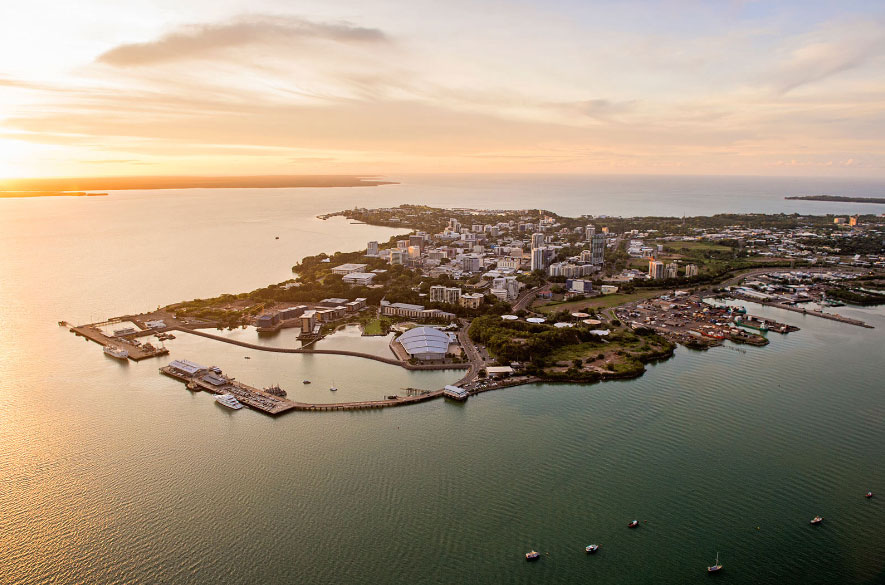
Program Status Update
Update on NT General Skilled Migration (GSM) nomination applications for 2025-26
The NT Government has now received sufficient applications to fill the nomination allocation for the 2025-26 program year.
The NT nomination portal is now closed to new applications. Applications lodged prior to the closure will continue to be assessed with outcomes to be provided by 30 June 2026.
New nomination applications will only be accepted by exception for applicants who meet the NT Graduate or NT Resident eligibility criteria and have one of the following visa deadlines falling before 31 December 2026:
Please note that the Northern Territory government cannot guarantee nominations before visa deadlines. Those who are onshore and have visas expiring should seek professional advice from a registered migration agent or legal practitioner on their visa options and ensure that they remain lawful in Australia.
People residing offshore are eligible to be considered for Northern Territory (NT) nomination. Invitations to apply for Northern Territory nomination will be via the ranking system.
The ‘Northern Territory Offshore Migration Occupation List’ identifies the occupations in current demand in the Northern Territory. This List is important if you want to apply for Northern Territory nomination for either a:
The ‘Northern Territory Offshore Migration Occupation List’ is only applicable for those applying for NT nomination from outside Australia, under the Priority Occupation stream.
Please note: The Northern Territory government has advised that offshore applicants will generally only be offered a Northern Territory nomination for a subclass 491 visa. Subclass 190 nominations will only be offered in exceptional circumstances, such as cases where the applicant has strong connections to the NT.
The NT advises eligible applicants to apply as soon as they meet the eligibility criteria. To receive a nomination from the NT Government, you must:
Before submitting an EOI for The Northern Territory, applicants should check that they meet all eligibility requirements.
For information on how to submit an application, view how to apply.
For a further explanation, see the Frequently Asked Questions page on the Northern Territory Government website.

Program Status Update
Program Status Update: Important Announcement
On 2 September 2025, the Australian Government announced the total number of places in its 2025-26 Migration Program. But it is still finalising state and territory allocations.
Queensland will not open the 2025-26 State Nominated Migration Program until our final program allocation is confirmed.
You can however submit your Registration of Interest (ROI) for Queensland nomination from 19 September 2025, in preparation for the program opening.
In the meantime, take a look here at which skilled visas and pathways might best suit you, including instructions for how to apply for Queensland nomination.
Once the above mentioned temporary suspension is lifted, you may be able to proceed with Queensland’s usual skilled migration program. Program details below:
Depending on your occupation and situation, there are two state nomination options available for skilled migrants through Queensland.
For Queensland state nomination, prospective applicants must meet the Department of Home Affairs requirements, state-specific occupation requirements and have skills in an occupation that is available on the Queensland Skilled Occupation List.
You may undertake employment once onshore in Queensland through:
Offshore applicants meeting the minimum published requirements are eligible to lodge an Expression of Interest (EOI) on Skill Select and then a Registration of Interest (ROI) on the Migration Queensland portal.
Migration Queensland criteria requires you to:
The 2025-26 Skilled Migration Program is open to both onshore and offshore applicants and provides pathways for skilled workers, graduates, and small business owners.
Before submitting a Registration of Interest (ROI) for Queensland, applicants should check that they meet all eligibility requirements.
Note: In the EOI, select ‘Queensland’ as the only state of interest in the EOI, if you wish to be considered for an invitation to apply for Queensland nomination.
For information on how to submit an application, view how to apply.
For a further explanation, see the Frequently Asked Questions page on the Queensland Government website.
 Program Status Update
Victoria’s 2025-26 skilled visa nomination program (subclass 190 and subclass 491) is now open.
Open to offshore applicants, the program provides skilled migrants with a pathway to permanent residency in Victoria. The skills that successful applicants bring to Victoria benefits employers and the broader Victorian economy.
The program provides two visa pathways:
As with previous years, applicants will first need to submit a Registration of Interest (ROI) and then be selected on competitive merit to apply for visa nomination.
*Please note: Invitation rounds occur frequently throughout the financial year with no set date.
To be invited to apply for Victorian skilled visa nomination, you must firstly make or update an Expression of Interest (EOI) via the Australian Government’s SkillSelect and then submit a Registration of Interest (ROI).
Both onshore and offshore applicants are eligible to submit a Registration of Interest (ROI) for both the subclass 190 and subclass 491 visas.
If you previously submitted an ROI in the 2024-25 and wish to be considered for invitation in the 2025-26 program, your ROI is still valid. You do not need to withdraw your ROI unless the information in the ROI has changed.
Your ROI will remain in our system for selection until it is withdrawn or selected.
You can check if your ROI is active via the Live in Melbourne portal. Login to your account > Applications > Click into the relevant NFR number > If active, the status will show ‘Submitted’ or ‘Received’.
Before submitting an ROI for Victoria, applicants should check that they meet all eligibility requirements.
For a further explanation, see the Frequently Asked Questions page on the Victoria Government website.

Program Status Update
Western Australia’s 2025-26 skilled visa nomination program (subclass 190 and subclass 491) is now open.
People residing offshore are eligible to be considered for Western Australia (WA) State nomination. Invitations to apply for WA State nomination will be via the ranking system.
The Western Australian Skilled Migration Occupation List identifies the occupations in current demand in Western Australia. This List is important if you want to apply for Western Australia nomination for either a:
Please note that to be eligible for an invitation in the WA State Nominated Migration Program, you must meet both:
Before starting your application, you will need to check whether your occupation is available on either the WA Skilled migration occupation list (WASMOL) Schedule 1 or 2, or the Graduate occupation list. You can search for your occupation here. (The occupation list search bar is located under the heading ‘Eligible Occupations’.)
Features of the 2025—26 program:
Before submitting an EOI for Western Australia, applicants should check that they meet all eligibility requirements.
For a further explanation, see the Frequently Asked Questions page on the Western Australia Government website.

Program Status Update
Australian Capital Territory’s (ACT) 2025-26 skilled visa nomination program (subclass 190 and subclass 491) is now open.
2025-26 Nomination Allocation: The ACT has received a final nomination allocation of 1,600 places for the 2025-26 program year.
The ACT Critical Skills List identifies the occupations in current demand in the ACT. This List is important if you want to apply for ACT nomination for either a:
The ACT Government will update this list every four months to make sure that the ACT Skilled Migration Program adapts and responds to the evolving critical skills needs of the ACT economy.
The Canberra Matrix is weighted to ensure that applicants who will make a positive economic contribution to the Territory and/or have demonstrated a genuine commitment to the ACT are more likely to be ranked and invited to apply for ACT nomination.
*ACT nomination does not guarantee a migration outcome. You must still meet the Department of Home Affairs criteria.
Every month, a certain number of nomination invitations are available (prorated on the annual allocation) to those working in the highest ranked Matrix in each occupation.
You can view the ACT’s most in-demand skills for skilled migration by consulting the ACT Nominated Migration Program Occupation List.
Before submitting an EOI for The Australian Capital Territory, applicants should check that they meet all eligibility requirements.
Once you’ve submitted a valid Department of Home Affairs Skill Select EOI, follow the ACT Government Process to apply for ACT nomination.
For a further explanation, see the Resources page on the ACT Government website.

Program Status Update
South Australia’s 2025-26 skilled visa nomination program (subclass 190 and subclass 491) is now open.
Depending on your occupation and situation, there are two state nomination options available for skilled migrants through South Australia.
For South Australian state nomination, prospective applicants must meet the Department of Home Affairs requirements, state-specific occupation requirements and have skills in an occupation that is available on the South Australian Skilled Occupation List. Offshore applicants meeting the minimum published requirements can now lodge an Expression of Interest (EOI).
There is an enormous range of occupations on South Australia’s Skilled Migration Occupation List in a range of industries – search for your occupation here.
South Australia will select offshore applicants to apply for state nomination from those who have submitted an Expression of Interest (EOI) through SkillSelect. Offshore applicants will not need to lodge a Registration of Interest (ROI) for this year’s program. South Australia will be nominating offshore applicants from over 250 occupations on South Australia’s Skilled Migration Occupation List.
If you are currently residing offshore and seeking to move to South Australia, the first step is to create an Expression of Interest (EOI) in SkillSelect ensuring you select South Australia as your first preferred State or Territory.
The South Australian Government can then review your EOI for consideration under the Skilled Nominated (Permanent) visa (subclass 190) or Skilled Work Regional (Provisional) visa (Subclass 491).
For most occupations, applicants must have a minimum of three years of skilled employment in their nominated or related occupation within the last 5 years to secure an invitation to apply for SA nomination.
South Australia will be assessing candidates on merit by the following factors:
For occupations in the construction trades (as listed here) applicants must have a minimum of one year of skilled employment in their nominated or related occupation within the last 3 years.
Applicants in the construction trades will be assessed on merit by the following factors:
Before submitting an EOI for South Australia, applicants should check that they meet all eligibility requirements.
For a further explanation, see the Frequently Asked Questions page on the South Australia Government website.

Program Status Update
Tasmania’s 2025-26 skilled visa nomination program (subclass 190 and subclass 491) is now open.
Migration Tasmania has received our full allocation from the Australian Government and has commenced inviting ROIs on a weekly basis.
Tasmania has now received its full nomination allocation for the 2025-26 program year.
In total, including interim allocations, this comprises:
Migration Tasmania has now commenced weekly invitations to apply for nomination.
Information will be posted on the Migration Tasmania website every week detailing:
Program Changes and New Features
Following analysis of program outcomes and stakeholder feedback, updates have been made to improve the application process, clarify requirements and priorities, and manage program risks.
Key changes include:
Detailed information about the changes can be found HERE
Candidates who have submitted an ROI in the last six months may wish to withdraw it and submit a new one, as the changes to priority attribute ranking criteria may significantly improve chances of selection.
Processing times and remaining nomination quota are updated every week on the Migration Tasmania website HERE
Working in Tasmania
The two state nomination options available for skilled migrants through Tasmania are:
The Tasmanian State Nomination Skilled Migration Program supports Tasmanian businesses and increases the state’s working age population. It does this by attracting and retaining migrants with skills genuinely in need by employers, or with the capacity to settle in Tasmania through skilled employment in the long-term, and business activities that will increase employment opportunities.
Tasmania’s skilled migration program is for people wanting to move to the state who have skills that Tasmania need. Skilled migrants are attracted to Tasmania because of the state’s enviable lifestyle, career opportunities, affordable housing, reputable schools and a globally recognised university.
The Migration Tasmania Application Gateway is now available for registrations of interest (ROI) and applications for skilled visa nomination from Tasmania.
Anyone seeking Tasmanian nomination for a Subclass 190 Skilled Nominated Visa or Subclass 491 Skilled Work Regional Visa must first register in the Migration Tasmania Application Gateway .
Before submitting an ROI for Tasmania, applicants should check that they meet all eligibility requirements for either;
For a further explanation, see the Frequently Asked Questions page on the Tasmania Government website.

Program Status Update
NSW 2025-26 skilled visa nomination program (subclass 190 and subclass 491) is now open.
The New South Wales government has invited applications from offshore migrants under the following nomination streams:
The NSW State Government announced that offshore applicants skilled in certain ANZSCO unit groups are eligible for NSW nomination.
*Please note: Invitation rounds occur frequently throughout the financial year with no set date.
NSW invites and nominates SkillSelect EOIs at the ANZSCO unit group level. To be eligible for NSW nomination (for either Subclass 190 or Subclass 491), your occupation must fall within an ANZSCO unit group identified on the NSW Skills List which reflects skills in high demand across the state, and be eligible for the visa.
Before submitting an EOI for New South Wales, applicants should check that they meet all eligibility requirements for either;
For a further explanation of how the skills list works, see the Common questions about skilled visas page on the NSW Government website.

Westpac Bank economist says tighter labour market is behind changes in how the ‘economic pie’ is divided. A Westpac analysis has found workers are now receiving a 55% share of national income – more than the profit share.
Workers are now receiving more of the “economic pie” than before the pandemic, with the increase in labour’s share of national income delivering an extra $28bn into the pockets of Australians over the past year alone.
Pat Bustamante, a senior economist at Westpac, said his analysis suggested that the tighter post-Covid labour market was behind the greater share going to workers, from an average of 53.8% through the 2010s, to more than 55% now.
While the movement in the division of national income appears small, even fractional changes translate to tens of billions of dollars in an economy of about $2.8tn.
The ABS splits total national income between labour and capital.
The labour (or wage) share is the portion of total domestic income paid to workers in wages, salaries and other benefits. The capital share is the portion going to the owners of capital and land, including company profits.
Unions decried a surge in the profit share of national income in 2022, before Labor’s jobs and skills summit in September of that year, which the government used as a platform to push through reforms to workplace laws.
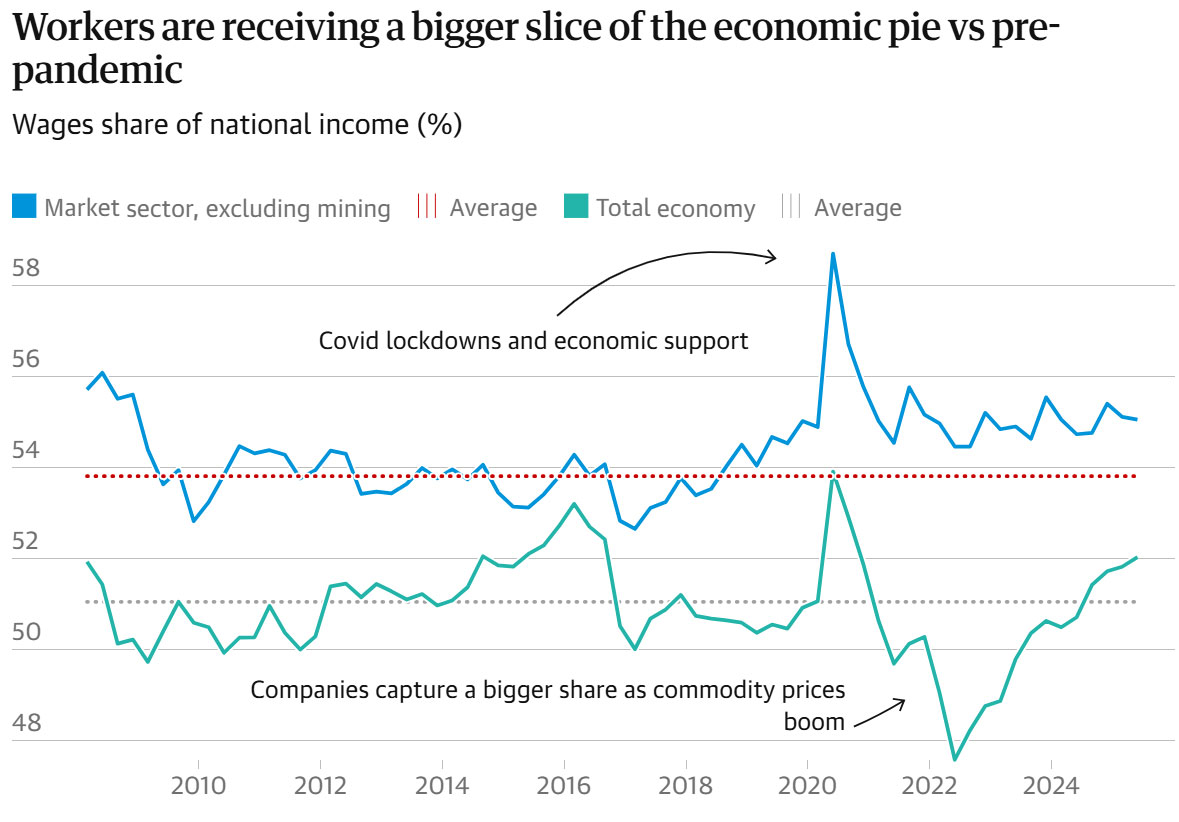
As surging inflation undermined workers’ real wages and mining companies’ revenues surged amid a spike in commodity prices into 2023, there were also accusations of companies’ profiteering from the cost of living crisis.
Bustamente said companies were now finding it harder to pass on higher wage costs to their customers, which was leaving more in the pockets of workers and also easing pressures on inflation.
Meaningful increases to the minimum wage over recent years had also played a role.
After a decade of stagnant wages through the 2010s, Bustamante said there was evidence in the national accounts figures released last week that a high labour share could prove to be a new “equilibrium”, mimicking earlier periods of low unemployment.
It was also a positive starting point as workplaces prepare for the potentially disruptive impact of artificial intelligence.
“If AI generates productivity improvements – which the IMF has estimated at an extra 1.5 percentage points of productivity a year – then if you can keep the labour market tight, there’s no reason the wages share needs to go down,” Bustamante said.
Gianni La Cava, research director at e61 Institute, said the profits versus labour share was often used as a proxy for whether “the capitalists are winners or the workers are winners”.
While these arguments were “mostly politics”, La Cava said, movements in the wages share of national income was still a “pretty good indicator of worker bargaining power”.
“If it is a sustained increase since Covid, say over a few years, that would be a meaningful thing and it would suggest sustained cost pressures for firms.”
La Cava agreed that “the post-Covid strength in the labour share is related to the hot and inclusive labour market”.

Analysts say national accounts figures show how far the economy has come, with annual GDP growth hitting 2.1% compared to 0.8% this time last year.
Surging investment in datacentres to fuel the AI tech boom and rising household spending on essentials like electricity and rents buoyed economic growth through the three months to September 2025.
National accounts figures showed real GDP expanded by 2.1% in the year, accelerating from 2% in June.
Despite positive signs that the private sector is starting to drive economic activity after a period of strong government support, the quarterly pace of growth was a disappointing 0.4% – well shy of the predicted 0.7% rate.
And after accounting for population growth, there was no rise in real GDP per capita in the quarter, and only a 0.4% increase over the year to September, highlighting the ongoing weak improvements in living standards.
Still, Belinda Allen, CBA’s head of Australian economics, said the national accounts showed how far the economy had come.
“It was just a year ago that [annual] growth was anaemic at just 0.8%,” Allen said.
“Fast forward a year and households are spending again thanks to strong income growth driving better sentiment, businesses are investing, residential construction is taking place and the public sector is placing a floor underneath growth.”
This welcome upswing, however, means the economy may now already be bumping up against its capacity to grow without sending inflation higher – a key risk that will be considered at next Monday’s meeting of the Reserve Bank’s monetary policy board.
Ahead of the release of the GDP figures, the RBA’s governor, Michele Bullock, said it was unclear how much more economic activity could pick up without adding to price pressures.
After inflation jumped to 3.8% in the year to October – well above the 2-3% target range – Bullock at Senate estimates said the board would be trying “to determine the extent to which it [the recent increase in inflation] is temporary, or the extent to which it’s giving us a signal that there’s some more permanent pressures in the economy”.
Analysts and investors have largely written off any further rate cuts, and are now foreshadowing the chance the next move will be a hike.
A major positive in the latest national accounts was a boom in business investment, which lifted by 2.9% in the three months and which the ABS attributed to “major data centre investment across NSW and Victoria”.
It was the fastest quarterly growth in private investment in four-and-a-half years, and contributed half a percentage point to overall economic growth in the quarter.
Analysts also noted a lift in productivity growth, although at 0.8% over the year remained relatively weak and a major challenge for the country’s growth prospects.
With home building also contributing in the quarter, Jim Chalmers in a statement highlighted that the economy was now expanding at its fastest annual pace in two years.
“The best way to improve living standards and continue to get more growth into the future is to make our economy more productive and resilient and our budget more sustainable, and that’s our focus,” the treasurer said.
Households in the three months to September were forced to pay more for power bills, as electricity rebates rolled off, and for other essentials such as rent, food and health – the last “due to a prolonged and severe flu season,” the ABS said.
While spending on essentials climbed by 1% in the latest quarter, against a 0.6% rise in the previous three-month period, discretionary spending fell 0.2%, after jumping by 1.5% in the quarter before.
A more cautious consumer was also reflected in a rise in households’ savings rate to 6.4% in the September quarter, from 6%.

A Sunshine Coast real estate agent shared he was earning nearly $300,000 in his second year in the job, but he said the work involved long hours.
An Australian real estate agent has shared how he is earning nearly $300,000 a year after only being in the job for a relatively short time. The man said he only needed to complete a three-day course to get started.
The Sunshine Coast man was stopped in the street and revealed he was in his second year on the job. The man said it was “pretty easy” to get the qualifications needed to become a real estate agent.
“It’s a six-month course or a three-day course, depending on which one you go with. I did mine in three days,” he said.
“The six-month course is a thing you do on your computer. The three-day course is just in with a person, and they basically give you the answers.”
According to the Real Estate Institute of Queensland, the minimum qualification you need in the state is a Real Estate Registration Certificate. With this qualification, you can work as a real estate agent under the supervision of a licensed agent.
This can be done face-to-face through a three-day course or done self-paced with up to six months to complete.
The man said he paid about $3,000 for the three-day course, while the longer courses could be cheaper at $500.
The training required to become a real estate agent will vary from state to state, but you’ll generally need to complete an approved real estate course, gain at least 12 months of full-time work experience, and then apply for your real estate agent’s licence.
Job can involve long hours
While the real estate agent said it was a lucrative industry to be in at the moment, the job can involve long hours.
He worked nearly non-stop during his first year, and he’s only just been able to take a bit of time off.
“[I earned] $291,000 in GIC [Gross Commission Income] so probably took home $130,000, but that was working six to seven days a week, 12-hour days, with no holidays,” he said.
“Literally right now I am on holidays for the first time in two years.”
The man admitted he “fell into” the real estate industry and joked he got into it for “all the wrong reasons” after seeing a mate working in real estate who had “the watch and the car”.
He said the hardest parts of the job were dealing with client emotions and getting knocked back by people.
“You’re the emotional sponge, you gotta take everything on and also talking to people that don’t want to talk to you,” he said.
“It’s prospecting. 80 per cent of it is, we’re glorified telemarketers basically.”
How much do real estate agents make?
The average real estate agent salary can be difficult to pinpoint because it’ll depend on the market, commission rate, and where you are selling.
According to SEEK, the average salary for a real estate agent in Australia is between $75,000 and $95,000 a year.
A significant portion of real estate earnings comes from commissions, which are usually calculated as a percentage of the final price of a property.
Commission rates will vary, with realestate.com.au noting the average rate for an agent can be between 2 and 4 per cent.
The Sunshine Coast real estate agent, for example, said the most expensive property he had sold was $1.302 million.
Based on average commission rates, that would translate to a commission of between $26,040 and $52,080 for the property.

From election outcomes and visa hikes to reform milestones and sector soul-searching, these are the stories that sum up the year for Australia’s international education sector.
1. Election result brings continuity – and questions – for the sector
Prime minister Anthony Albanese secured a second term for the Labor government in Australia’s federal election. While the outcome removed uncertainty around a change of government – particularly given the Coalition’s proposed international student caps and higher visa fees – it also left many in the sector assessing what continuity would mean in practice. The result sparked renewed discussion about policy direction, including commentary on whether stability would translate into greater certainty or restraint for international education.
2. Julian Hill steps into the international education brief
In July, Julian Hill was appointed assistant minister for international education, giving the sector a dedicated political lead. Since taking on the brief, Hill has repeatedly emphasised the need to protect the “integrity” of the sector, particularly in relation to visa settings and compliance. Hill has spent a lot of time at out and about at industry events and liaising with the sector.
3. Perth International College of English shuts its doors
Perth International College of English was not the only provider to close its doors in 2025. But its decision to shut down became a clear illustration of how rising visa fees and tightening settings were landing on the ground. For many in the ELICOS sector, it underscored the vulnerability of smaller providers operating with thin margins in a rapidly changing policy environment.
4. Student visa fees jump to AUD$2,000
One of the most talked-about changes of 2025 came when Australia lifted the cost of a student visa to AUD$2,000 – making it the most expensive in the world. The hike sparked debate across the sector about competitiveness and particular concerns came from the ELICOS sector with stakeholders arguing that yet another price hike would put off short-term students.
5. Australia moves toward a new tertiary education watchdog
Last year saw the Australian government introduce legislation to establish the Australian Tertiary Education Commission (ATEC). The ATEC began interim operations in July 2025, with plans to become fully operational by 2026. This new body is set to centralise the planning and regulation of post-school education, including international education, marking a significant shift in how the sector will be governed in the years to come.
6. International student enrolment limit lifted to 295,000
Australia raised its de facto international student enrolment cap to 295,000 places. The decision provided some breathing room for universities and providers, even as questions remained about how limits would be managed long term and who would benefit most.
7. The PIE Live Asia Pacific 2025 puts the spotlight on sector leaders
The PIE Live Asia Pacific 2025 offered a moment for the sector to come together – to unpack policy and trends, hear from across the industry, and recognise the people driving international education forward. Lifetime Impact Awards recognised long-standing leaders whose work has shaped international education across decades – a reminder of the human side of an industry often discussed in numbers.
8. Can Australia thrive in a “managed” era?
One of the year’s most widely read opinion pieces asked a question many were already grappling with: can Australia remain globally competitive while tightly managing international student numbers? The piece captured a growing tension between regulation, reputation, and market reality.
9. A new visa processing directive replaces MD 111
Later in the year, Australia confirmed that Ministerial Direction 111 would be replaced with a new student visa processing directive. While intended to improve integrity and efficiency, the new settings under Ministerial Direction 115 largely mirror its predecessor, with a handful of key changes – including the introduction of a third priority category for providers that exceed their new overseas student commencement (NOSC) allocations by more than 15%.
10. Education reforms are locked in after clearing parliament
Rounding out the year, Australia’s education reforms moved from proposal to reality in 2025 after clearing parliament in the nick of time. The changes include a broader legal definition of an education agent and expanded ministerial powers. While the measures were designed to improve integrity, parts of the sector raised concerns during consultation, with attention now turning to how the reforms will be applied in practice.

Australia has made a significant shift in its approach to student visas, with a new policy that rewrites the traditional student pathway to permanent residency. The introduction of the Temporary Graduate Visa (subclass 485) has been a game changer in the way international students can transition from temporary to permanent residency in Australia. Under the new framework, skills, rather than the mere possession of a degree, now play the central role in determining whether a graduate can stay and build a future in Australia. This shift aims to attract highly skilled individuals who can contribute to the country’s economy, particularly in sectors facing labor shortages.
Key Features of the New Temporary Graduate Visa Policy
1. Skills-Based Selection Over Academic Credentials
2. Expanded Eligibility Criteria
3. Opportunities for Skilled Workers
4. Impact on International Students
5. Focus on Economic Contribution
Advantages of the New Policy for Graduates
1. Faster Path to Permanent Residency
2. Increased Opportunities for Employment
3. More Flexibility for Students
Challenges and Considerations for Students
1. Competition in the Job Market
2. Adapting to Changing Immigration Rules
3. Potential for Limited Pathways for Some Degrees
Conclusion: The Future of International Students in Australia
Australia’s new Temporary Graduate Visa policy marks a shift towards a more skills-focused immigration system, offering international students the opportunity to stay, work, and eventually gain permanent residency based on their practical expertise rather than just academic qualifications. This new approach benefits both the Australian economy and skilled graduates, providing them with clearer pathways to long-term success in the country. By aligning educational goals with labor market needs, Australia continues to attract global talent, ensuring a dynamic and competitive workforce for the future.