
 EXCLUSIVE MEMBERS ONLY ACCESS
To access this month’s edition & Member’s only resources, enter your registered email address.





Sydney, NSW
The Results of the August 2021 census were made public on 12th July 2022, and revealed that Australia has become a majority migrant nation, as the census data shows for the first time that more than 50 per cent of residents were born overseas or have an immigrant parent. Last year’s census counted nearly 25.5 million people, including 1 million new residents.
Australia’s 2025 Migration Program has been carefully designed to boost the social and economic outcomes that meet Australia’s needs. In fact, the migration programme was first launched in 1945 following the aftermath of World War 2. Given this long history, it is worth understanding how it works. The Australian Immigration Bulletin exists to help explain this in more detail.
As we’ve entered the 11th month of the year, join us for a look at the latest news and developments in the world of Australian Immigration!


Queensland’s construction pipeline is expected to jump to $77 billion in 2026-2027 and the state desperately needs workers to meet increased demand.
Queensland is on the search for 50,000 construction workers to help build stadiums, roads and tackle housing demand. Tradies including carpenters, painters and electricians are among the most in-demand, with six-figure pay packages on the table for some jobs.
The state currently has $53 billion worth of construction activity in the pipeline, but that figure is set to jump to $77 billion in 2026-2027. That’s been driven by the state’s growing population, which is expected to surpass six million by 2027, the upcoming Olympic Games, and the net zero transition.
A new report by Construction Skills Queensland found meeting these demands will be harder than ever before due to a critical shortage of tradies.
“What we’re seeing is a shortfall of about 18,200 on average from now across the eight years, and that intensifies to about 50,000 shortfall in ’26, ’27,” Construction Skills Queensland director Kim Hetherington said.
The building pipeline is forecast to average $40.2 billion over the next eight years, with about 95,900 workers needed each year to meet labour demand.
The engineering pipeline is projected to average $21 billion over the eight years, with an average workforce demand of around 26,700.
What workers are most in demand?
The top five trades needed in Queensland right now are:
There’s also a shortage of earthmoving plant operators, structural steel workers and crane operators.
Other jobs needed include building and plumbing labourers, plumbers, miscellaneous labourers, civil engineers and construction managers.
Hetherington said there were good pay packages on offer for construction workers.
But the salary does depend on the job in question.
“The sky’s the limit if you want to go into construction management, you know, $300,000 and beyond,” Hetherington said.
“But certainly, the trades are being well paid in this environment.”
The average full-time worker made $1,975.80 per week in November 2024, or $102,741.60 per year.

Premier Roger Cook (pictured above) has defended a request to Prime Minister Anthony Albanese for WA to be exempt from a reduction in the national skilled migrant intake, saying the state needs the workers to feed its booming economy.
WA’s allocation of skilled migrants under the state nominated migration program will drop from 5000 to 3400 places from next year.
The state-nominated migration program allows each state to target certain occupations it needs, allowing easier access visas for migrants that meet those skill requirements.
Cook wrote to Albanese earlier this month urging the Commonwealth to reverse the reduction in the program, arguing the state needed it to bring in more workers to meet the demands of the housing and construction sector.
He said WA had specific needs.
“We need more workers. We need more skilled migrants coming to Western Australia, either from the East Coast or from overseas,” he said.
“Western Australia’s economy is the strongest in the nation, and we join the federal government in our ambitions to host the largest shipbuilding and maintenance hub in the southern hemisphere.
“So we need more workers, and that’s why we need the government to stand by us and continue to make sure that we’ve got a strong skilled migration program.”
Cook said in order for the Commonwealth to meet its housing target in WA the state needed workers.
“We believe and agree with the Prime Minister when he says he wants 25,000 homes in Western Australia built each year, and we’re getting somewhere around about 21,000, we’re getting very close to that target number,” he said.
“But to do that, we need the workforce, and we need the workers in droves, in our mining industry, in our construction industry, in our housing construction industry.”
Industry groups backed Cook with Property Council WA Executive Director Nicola Brischetto saying any boost to residential construction worker numbers was welcomed.
“Western Australia faces a unique challenge in meeting its residential construction workforce needs because of competition with the high-paying resources sector,” she said.
“There will be no shortage of demand for housing in WA for the foreseeable future.
“Any additional measures to boost capacity in state’s residential construction workforce should be considered and would be welcomed by industry.”
Chamber of Minerals and Energy WA director policy and advocacy Anita Logiudice said the reality was that holes in residential, resources and energy sectors could not be plugged through locally trained workers alone.
“Electricians, automotive trades and vocational trainers remain in particularly short supply and there are still not enough apprentices in training to meet forecast workforce requirements,” she said.
“The long lead time to develop skilled workers exacerbates the issue and the shortages are acting as a handbrake on both the resources and construction sectors.
“Access to global talent is also particularly important as WA seeks to grow and diversify its economy, with significant opportunities available to the state in minerals processing and manufacturing, low-emission fuels, carbon capture and storage and defence.”

Statistics New Zealand this week released migration data, which showed that only 13,066 net overseas migrants landed in New Zealand in the year to July. This was well below the decade average of 49,000 and more than 120,000 lower than the late 2023 peak.
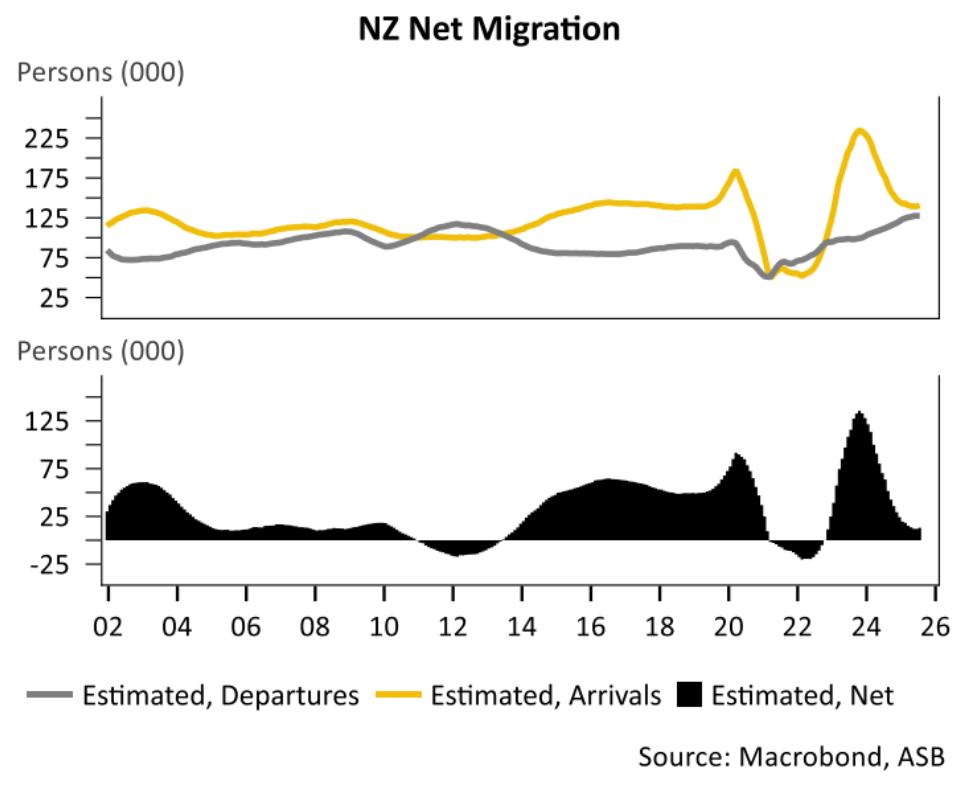
The decline in net overseas migration has been driven by the exodus of New Zealand citizens.
Annual net outflows of New Zealand citizens hit fresh record highs (47,600), driven by strengthening migration departures to a record high of 73,480.
By contrast, 60,200 net non-New Zealand citizens arrived in the year to July 2025, down from a net migration gain of 115,800 in the June 2024 year.
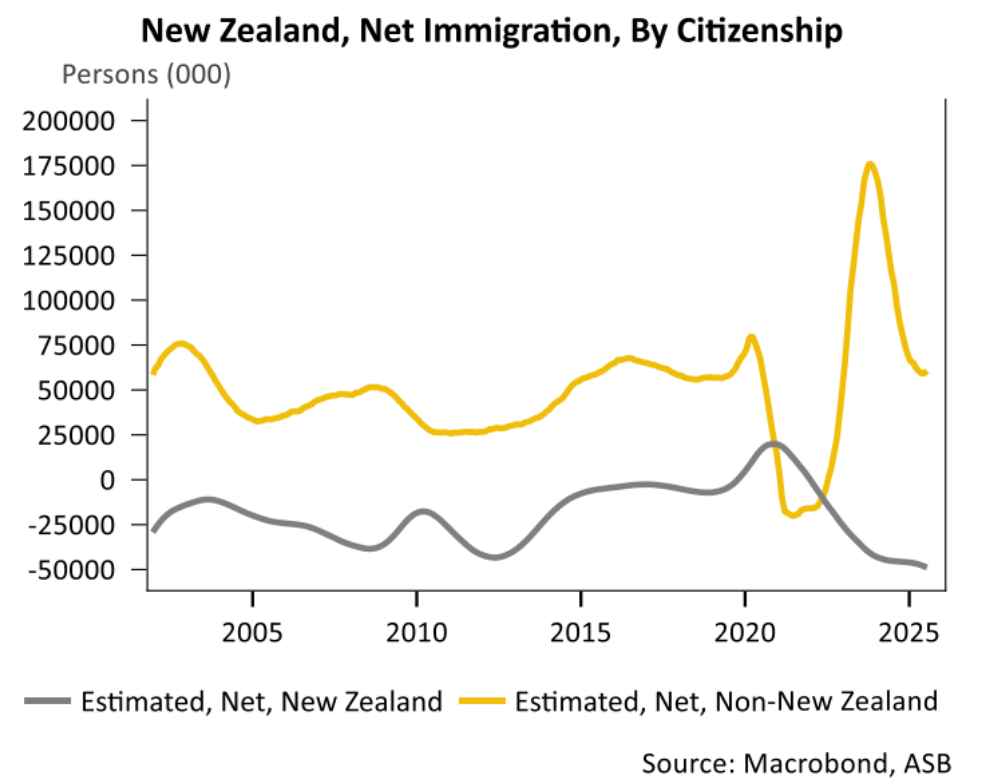
The following chart shows the net migration flow by country of origin:
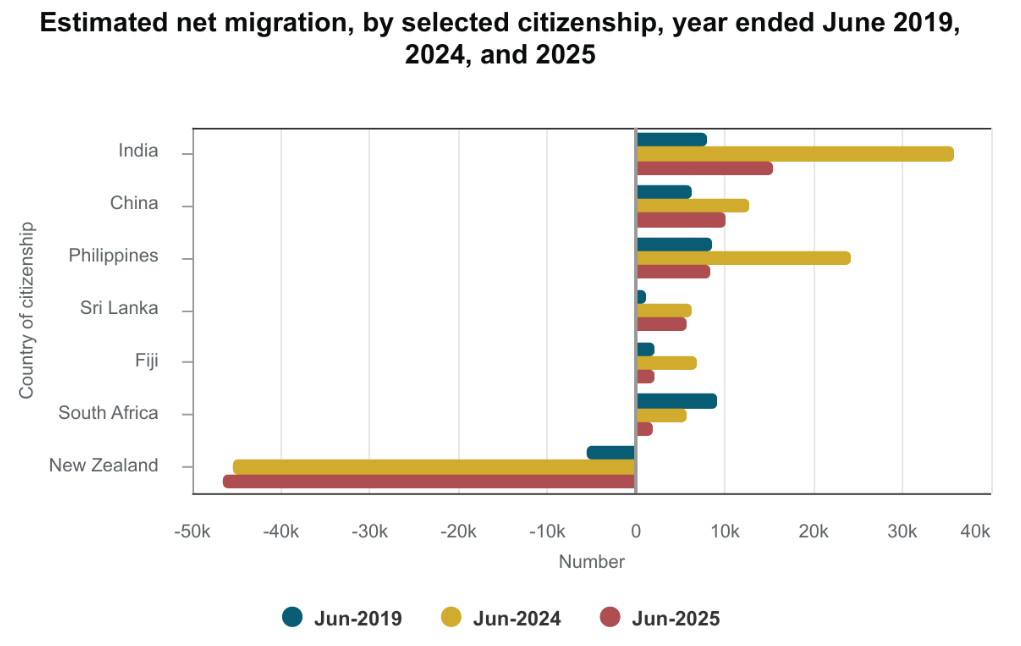
As you can see, India, China, and the Philippines dominated net migrant arrivals in the year to July 2025.
Of the 47,600 New Zealand citizens that departed in the year to July, most emigrated to Australia.
Bernard Hickey at The Kākā noted that “a record-high 201 New Zealanders emigrated each day on average in the year to the end of July, with 58% going to Australia”.
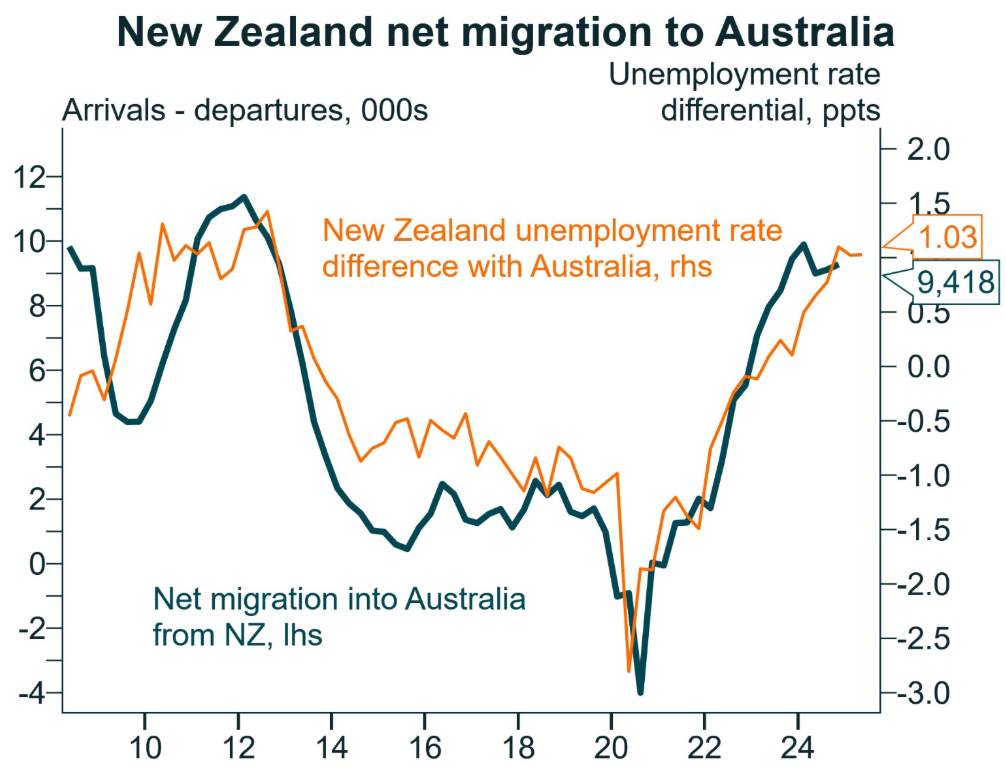
The exodus is primarily because “Australia’s labour market is now accelerating ahead of New Zealand’s”, according to Hickey.
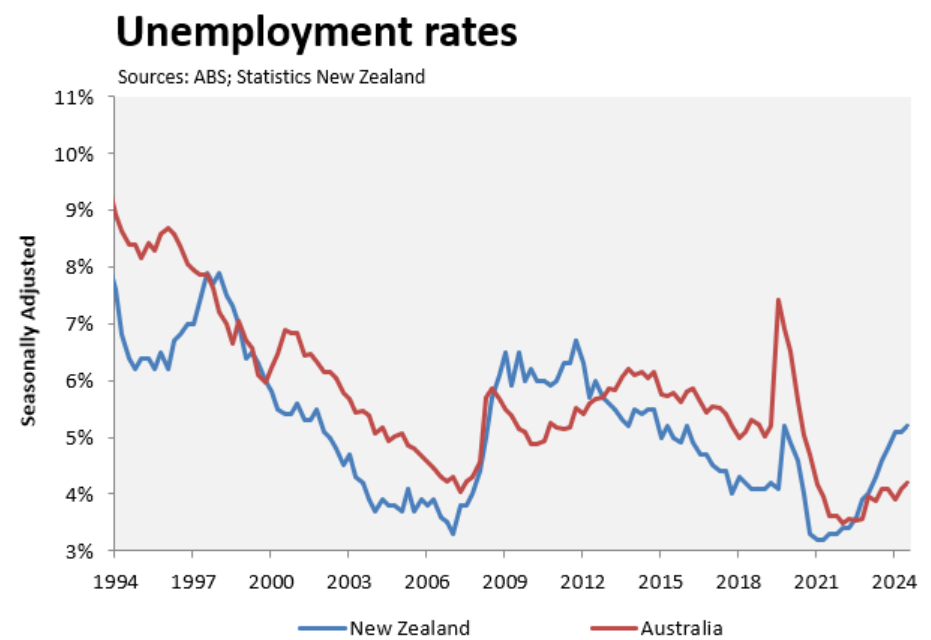
As illustrated by Alex Joiner from IFM Investors below, migration to Australia has historically tracked the differential unemployment rates between the two nations.
Australian wages are also growing at a much faster pace than in New Zealand.
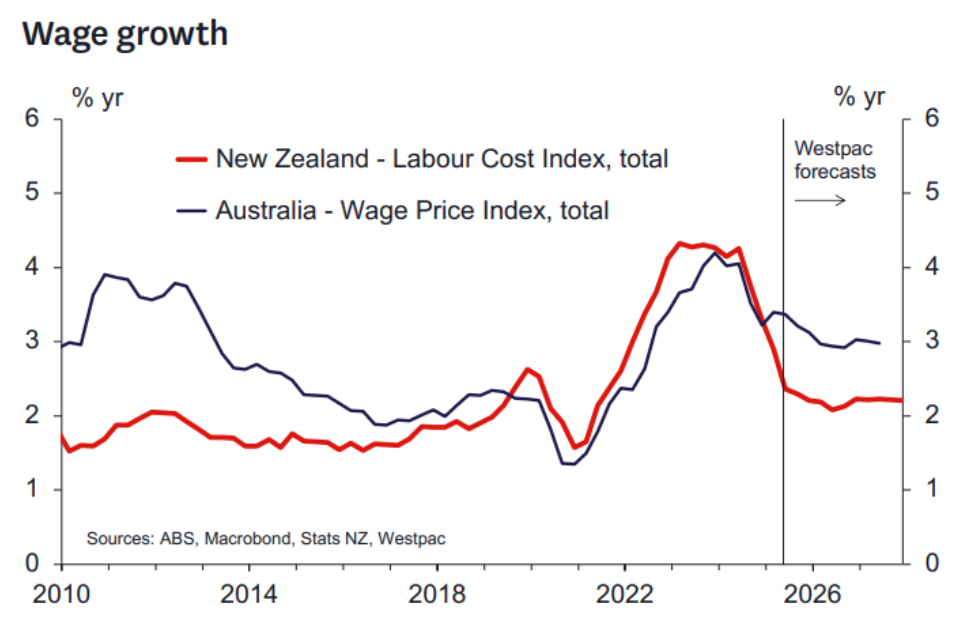
“Many of those who have departed our shores in recent years have headed to Australia. That reflects Australia’s stronger labour market and the relatively unrestricted ability to move between our countries”, noted Westpac NZ senior economist Satish Ranchhod.
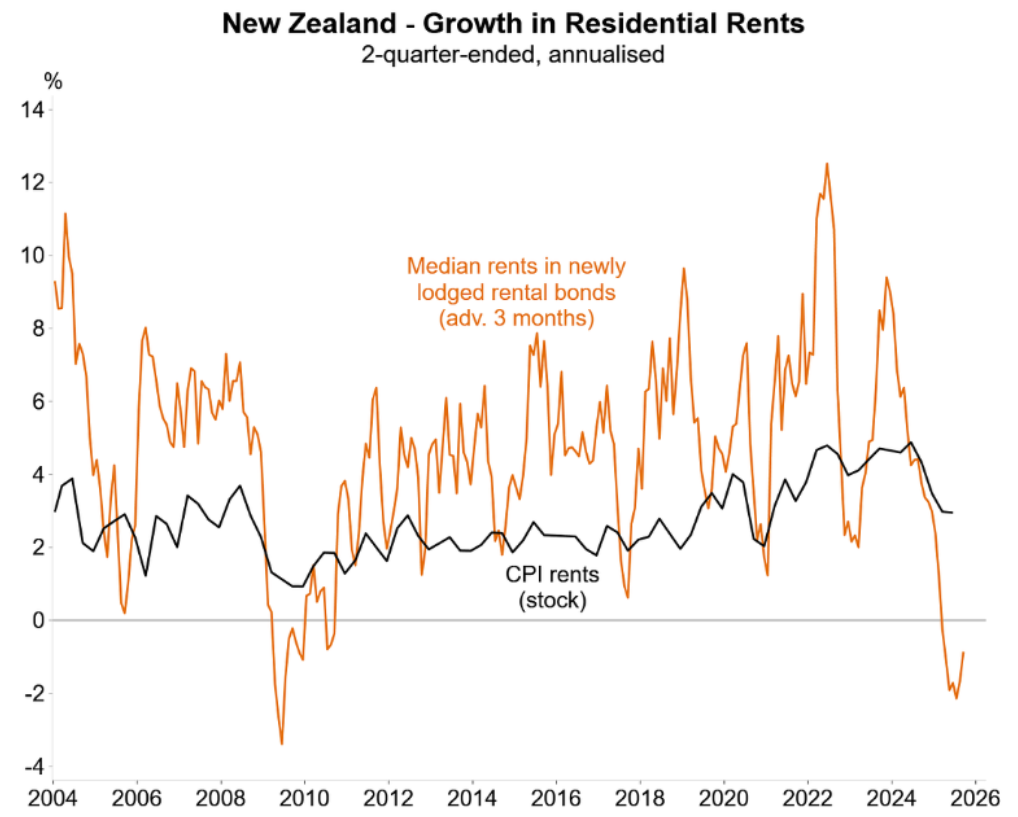
Unlike Australia, housing prices in New Zealand have declined significantly since their post-pandemic high and are tracking at late 2019 levels in real terms.

Rents, as measured by newly lodged rental bonds, have similarly declined in New Zealand.

Electrical trades are facing unprecedented skills shortages, with unions and employers demanding urgent action to avoid the need to delay key energy projects.
Unions and employers are demanding urgent action to address a significant shortage of electricians, warning that failure to act would risk the national electrical licensing regime and delay key energy projects.
Ahead of the upcoming productivity roundtable, Electrical Trades Union national secretary Michael Wright said there was a “massive and urgent need to train the next generation of energy workers”.
“We are heading into literally unprecedented skills shortages in the electrical trades,” Mr Wright said.
“Left unchecked, these skills shortages risk our electrical licensing regime, but are also emerging as a real handbrake on the pace of what we can build.
“The energy transition is placing unprecedented demand on TAFE and trade schools. More than new money, we need a new level of co-ordination between unions, business, and government.”
Australian Industry Group chief executive Innes Willox said an urgent concerted effort was needed to train the required workforce for the clean energy transition.
The ETU says the skills shortage is emerging as a handbrake on what we can build in Australia.
Mr Willox cited Jobs and Skills Australia research that identifies 38 occupations that form part of the clean energy workforce.
“Many of these occupations are already in shortage – and in demand in other industry sectors, such as manufacturing and other major infrastructure projects,” he said.
“The same Jobs and Skills Australia research shows Australia will need up to 42,000 electricians in the next few years, and close to two million workers in building and engineering trades by 2050.
“We need to act quickly to achieve these staggering numbers. We need to grow our own workforce, which includes ensuring that Australia’s apprenticeship and traineeship system is fit for purpose and provides enough employer engagement to build the pipeline of skilled workers.”
New data from the National Centre for Vocational Education and Research shows that apprenticeship completion are at a decade-long high, while the number of new apprentices continues to decline.
Master Builders Australia chief executive Denita Wawn said the drop in new apprentice starts was a “red flag for industry productivity”.
“We need better support for employers to take on and retain apprentices, particularly small businesses that carry the bulk of the training burden,” she said.
Skills Minister Andrew Giles said the new NCVER data showed there had been a three per cent increase in the number of electricians in-training “but there is more work to do”.
“The Productivity Roundtable is a chance for unions, business, civil society, economic experts and institutions to come together to work towards common goals for the Australian economy,” he said.
From July 1, new housing construction apprentices will be paid $10,000 in incentives to pick up the tools and become a tradie.
“The same program already operates for new energy apprentices, including electrical, which has seen about 9000 Australians paid $10,000 in incentives,” he said.
If you are interested in applying for a general skilled migration visa to Australia, it is important to have a good understanding of the skilled visa options and how the migration points test works, so that you can maximise your chances of being eligible to apply for a skilled visa.
A general skilled migration visa is an option available to skilled workers who are seeking to qualify for a skilled visa independently, or under a state or family sponsorship. It is an alternative to an employer sponsored visa.
One of the key criteria to qualify for a general skilled migration visa is the points test (a criterion that does not apply to employer sponsored visas). This is often the most challenging aspect for prospective skilled visa applicants to overcome when seeking an invitation to apply for the relevant skilled visa.
If you are considering applying for a general skilled migration program visa, an important concept to understand is the Expression Of Interest (EOI).
If you are considering applying for a general skilled migration visa, it is important to be aware that for certain visas in this visa class, you will first be required to lodge an EOI with the Department of Home Affairs (the Department) through SkillSelect. The EOI is not a visa application, but rather, it is the process by which you can express your interest in applying for the relevant skilled visa (It’s important to note, that there is NO fee to submit an EOI).
This requirement applies to the following skilled visa subclasses:
Let’s take a brief look at each of these visas below:
The ‘subclass 189’ is a federal sponsored visa that grants automatic permanent residence in Australia. It is subject to nil visa conditions or obligations. For this reason, it is often considered to be the most flexible of the skilled visa options available.
A subclass 189 points-based visa allows you to live and work in any state or territory permanently.
The ‘subclass 190’ is a state/ territory sponsored permanent residence visa. It is another points-based visa for which invitations are issued throughout each month by individual states and territories. One of the benefits of applying for state nomination is that you will be granted an additional 5 points.
An important aspect to consider, which does not apply to the subclass 189 visa is that there is an added step in the application process. In this case, you must also apply for nomination approval to a state or territory government. Only upon receipt of an invitation from the relevant state or territory to which you apply can you then apply to the Department for the visa itself.
Your obligations as a subclass 190 visa holder are that you must commit to your nominating jurisdiction’s obligations and commit to residing in your nominating State or Territory for two years from visa grant.
The ‘subclass 491’ is also a points-based state/ territory (or family) sponsored visa. It is a regional visa with a term of five years. The Department issues invitations for family sponsored EOI applications only (in invitation rounds). Invitations for state sponsorship are issued by individual states and territories throughout each month. This will grant you an additional 15 points for the nomination.
Being a provisional visa, this means it provides a pathway to permanent residence in Australia with the Subclass 191 Permanent Residence (Skilled Regional) visa, subject to meeting specified requirements.
Be mindful that as a subclass 491 visa holder, you must abide by visa condition 8579, which requires you to live, work and study in a designated regional area of Australia. For migration purposes, most locations of Australia outside of major cities (Sydney, Melbourne, Brisbane, Perth, etc.) are classed as regional areas.
If your EOI is successful, you will receive an invitation to apply for the visa, as specified in the invitation letter. This then enables you to proceed with lodgement of your visa application (provided you meet all other visa lodgement and visa grant requirements).
Please note, the below State and Territory program updates is a general overview only. It does not take into account any of your personal circumstances. You must check the State/Territory information carefully to ensure you can meet all the requirements for nomination.
Australia is currently facing a shortage of skilled migrants to fill workforce demands. In response, states and territories have been easing the conditions of their visa programs to help attract skilled workers from overseas.
Below is the monthly update for some of the State and Territory opportunities available.
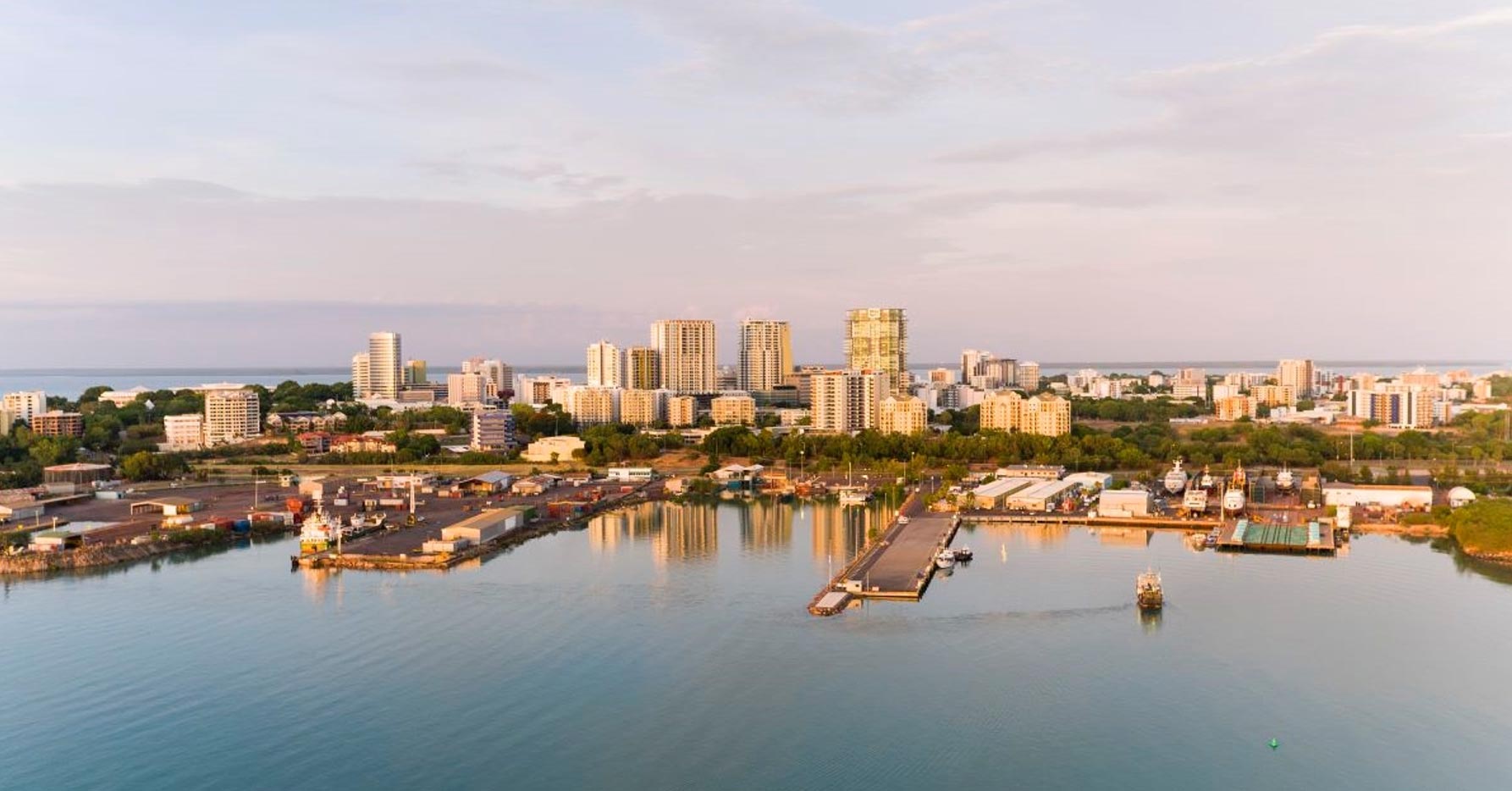
Program Status Update
UPDATE: Northern Territory General Skilled Migration (GSM) nomination applications for 2025-26
The NT Government is yet to receive its full nomination allocation for the 2025-26 program year from the Australian Government.
The Australian Government has released a small interim allocation while State and Territory governments await the full allocation for this program year. The NT Government has a limited number of subclass 491 nominations available for eligible onshore applicants with certain visa deadlines falling before 31 December 2025.
Until the interim allocation is exhausted, new subclass 491 nomination applications will be accepted by exception for onshore applicants who meet the NT Graduate or NT Resident eligibility criteria and have the following visa deadlines falling before 31 December 2025:
Onshore applicants with such visa deadlines should lodge subclass 491 nomination applications without delay and must also meet all relevant criteria for the stream they are applying for as published on N.T. website at present.
The 2025-26 program remains closed for other applicants at this time and will open once the full allocation is received from the Australian Government.
Once the above mentioned temporary suspension is lifted, you may be able to proceed with the NT’s usual skilled migration program. Program details below:
People residing offshore are eligible to be considered for Northern Territory (NT) nomination. Invitations to apply for Northern Territory nomination will be via the ranking system.
The ‘Northern Territory Offshore Migration Occupation List’ identifies the occupations in current demand in the Northern Territory. This List is important if you want to apply for Northern Territory nomination for either a:
The ‘Northern Territory Offshore Migration Occupation List’ is only applicable for those applying for NT nomination from outside Australia, under the Priority Occupation stream.
Please note: The Northern Territory government has advised that offshore applicants will generally only be offered a Northern Territory nomination for a subclass 491 visa. Subclass 190 nominations will only be offered in exceptional circumstances, such as cases where the applicant has strong connections to the NT.
The NT advises eligible applicants to apply as soon as they meet the eligibility criteria. To receive a nomination from the NT Government, you must:
Before submitting an EOI for The Northern Territory, applicants should check that they meet all eligibility requirements.
For a further explanation, see the Frequently Asked Questions page on the Northern Territory Government website.
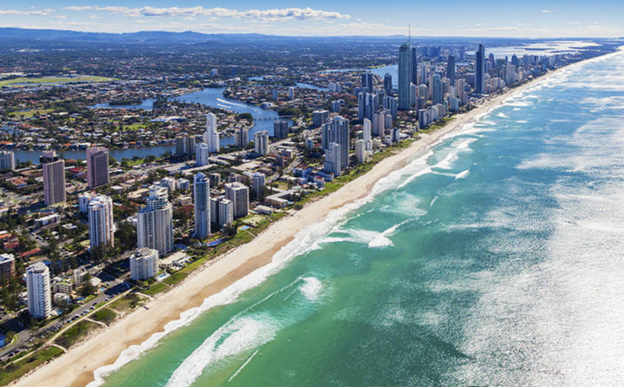
Program Status Update
Program Status Update: Important Announcement
On 2 September 2025, the Australian Government announced the total number of places in its 2025-26 Migration Program. But it is still finalising state and territory allocations.
Queensland will not open the 2025-26 State Nominated Migration Program until our final program allocation is confirmed.
You can however submit your Registration of Interest (ROI) for Queensland nomination from 19 September 2025, in preparation for the program opening.
In the meantime, take a look here at which skilled visas and pathways might best suit you, including instructions for how to apply for Queensland nomination.
Once the above mentioned temporary suspension is lifted, you may be able to proceed with Queensland’s usual skilled migration program. Program details below:
Depending on your occupation and situation, there are two state nomination options available for skilled migrants through Queensland.
For Queensland state nomination, prospective applicants must meet the Department of Home Affairs requirements, state-specific occupation requirements and have skills in an occupation that is available on the Queensland Skilled Occupation List.
You may undertake employment once onshore in Queensland through:
Offshore applicants meeting the minimum published requirements are eligible to lodge an Expression of Interest (EOI) on Skill Select and then a Registration of Interest (ROI) on the Migration Queensland portal.
Migration Queensland has closed the 2024-25 State Nominated Migration Program. For more information, please see here.
NOTE: To be eligible for Queensland’s 2024-25 program, your EOI must be submitted on or after 13 September 2024.
Migration Queensland criteria requires you to:
The 2024-25 Skilled Migration Program is open to both onshore and offshore applicants and provides pathways for skilled workers, graduates, and small business owners.
Before submitting a Registration of Interest (ROI) for Queensland, applicants should check that they meet all eligibility requirements.
Note: In the EOI, select ‘Queensland’ as the only state of interest in the EOI, if you wish to be considered for an invitation to apply for Queensland nomination.
For a further explanation, see the Frequently Asked Questions page on the Queensland Government website.
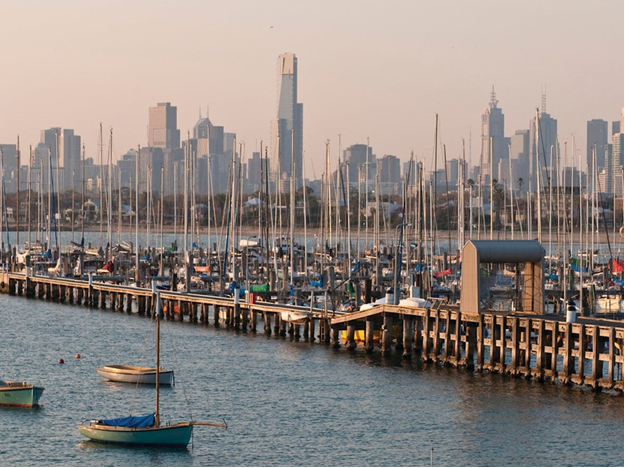 Program Status Update
The Australian Government’s Department of Home Affairs has provided Victoria a small interim allocation for the 2025-26 program year. Victoria’s full allocation for the 2025-26 program is expected to be confirmed by the Department of Home Affairs in the coming weeks.
Full details of Victoria’s 2025-26 program will be published once the Australian Government provides Victoria with its full visa allocation.
In the meantime, take a look here at which skilled visas and pathways might best suit you, including instructions for how to apply for Victoria nomination.
Once the above mentioned temporary interim allocation is lifted, you may be able to proceed with Victoria’s usual skilled migration program. Program details below:
Open to offshore applicants, the program provides skilled migrants with a pathway to permanent residency in Victoria. The skills that successful applicants bring to Victoria benefits employers and the broader Victorian economy.
The program provides two visa pathways:
As with previous years, applicants will first need to submit a Registration of Interest (ROI) and then be selected on competitive merit to apply for visa nomination.
*Please note: Invitation rounds occur frequently throughout the financial year with no set date.
To be invited to apply for Victorian skilled visa nomination, you must firstly make or update an Expression of Interest (EOI) via the Australian Government’s SkillSelect and then submit a Registration of Interest (ROI).
NOTE: If you previously submitted a ROI and wish to be considered for invitation in the 2024-25 program, you must submit a new ROI.
Both onshore and offshore applicants are eligible to submit a Registration of Interest (ROI) for both the subclass 190 and subclass 491 visas.
Your ROI will remain in the system for selection until it is withdrawn, selected or the program year ends.
Before submitting an ROI for Victoria, applicants should check that they meet all eligibility requirements.
For a further explanation, see the Frequently Asked Questions page on the Victoria Government website.

Program Status Update
Update: 2025-26 State Nomination Migration Program Interim allocation
A small interim allocation has been issued for the 2025–26 Western Australia State Nominated Migration Program (SNMP). This allocation will be used to clear the remaining 2024–25 applications.
Given the limited number of places, the 2025–26 program year will not open until the formal allocation is issued by the Commonwealth Government.
Please continue to monitor the State Nominated Migration Program page and other official channels for further updates.
Once the above mentioned temporary suspension is lifted, you may be able to proceed with WA’s usual skilled migration program. Program details below:
People residing offshore are eligible to be considered for Western Australia (WA) State nomination. Invitations to apply for WA State nomination will be via the ranking system.
The Western Australian Skilled Migration Occupation List identifies the occupations in current demand in Western Australia. This List is important if you want to apply for Western Australia nomination for either a:
Please note that to be eligible for an invitation in the WA State Nominated Migration Program, you must meet both:
Before starting your application, you will need to check whether your occupation is available on either the WA Skilled migration occupation list (WASMOL) Schedule 1 or 2, or the Graduate occupation list. You can search for your occupation here. (The occupation list search bar is located under the heading ‘Eligible Occupations’.)
Features of the WA 2024-25 State Nominated Migration Program:
Before submitting an EOI for Western Australia, applicants should check that they meet all eligibility requirements.
For a further explanation, see the Frequently Asked Questions page on the Western Australia Government website.

Program Status Update
2025-26 Nomination Allocation: The ACT received an interim allocation of 165 places for 2025-26 until a final allocation is determined.
The Australian Capital Territory (ACT) Government has the flexibility to address skills shortages and labour market needs in the Territory through the state/territory nominated stream of the Australian Migration Program. The Australian Government allocates the ACT a fixed number of nomination places each financial year.
The 2025-26 interim allocation is 165 nomination places:
ACT nomination triggers the visa invitation from the Department of Home Affairs. ACT nomination does not guarantee a migration outcome. You must still meet the Department of Home Affairs visa criteria.
Once the above mentioned temporary interim allocation is lifted, you may be able to proceed with ACT’s usual skilled migration program. Program details below:
The ACT Critical Skills List identifies the occupations in current demand in the ACT. This List is important if you want to apply for ACT nomination for either a:
The ACT Government will update this list every four months to make sure that the ACT Skilled Migration Program adapts and responds to the evolving critical skills needs of the ACT economy.
The Canberra Matrix is weighted to ensure that applicants who will make a positive economic contribution to the Territory and/or have demonstrated a genuine commitment to the ACT are more likely to be ranked and invited to apply for ACT nomination.
*ACT nomination does not guarantee a migration outcome. You must still meet the Department of Home Affairs criteria.
Every month, a certain number of nomination invitations are available (prorated on the annual allocation) to those working in the highest ranked Matrix in each occupation.
You can view the ACT’s most in-demand skills for skilled migration by consulting the ACT Nominated Migration Program Occupation List.
Before submitting an EOI for The Australian Capital Territory, applicants should check that they meet all eligibility requirements.
Once you’ve submitted a valid Department of Home Affairs Skill Select EOI, follow the ACT Government Process to apply for ACT nomination.
For a further explanation, see the Resources page on the ACT Government website.
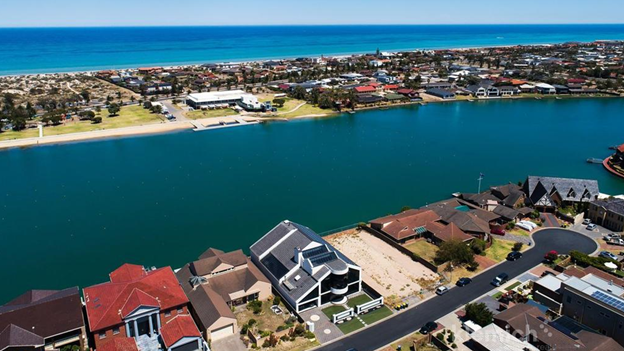
Program Status Update
An Update on Interim Allocations for the 2025-26 Program Year
The Commonwealth Government have provided South Australia with a small interim allocation for the 2025-26 program year.
Given the small number of interim allocations, Skilled and Business Migration (SBM) will not open for new Registration of Interest (ROI) applications and instead focus on inviting strong applicants contributing to the state’s workforce requirements, including from the ROI’s submitted in the 24-25 program year.
Once the Commonwealth Government provides South Australia with its full allocation, SBM will release its full policy settings for the upcoming program year.
Please keep an eye out on the News & Events section of their website to keep up to date with all the announcements.
Once the above mentioned temporary suspension is lifted, you may be able to proceed with SA’s usual skilled migration program. Program details below:
Depending on your occupation and situation, there are two state nomination options available for skilled migrants through South Australia.
For South Australian state nomination, prospective applicants must meet the Department of Home Affairs requirements, state-specific occupation requirements and have skills in an occupation that is available on the South Australian Skilled Occupation List. Offshore applicants meeting the minimum published requirements can now lodge an Expression of Interest (EOI).
There is an enormous range of occupations on South Australia’s Skilled Migration Occupation List in a range of industries – search for your occupation here.
South Australia will select offshore applicants to apply for state nomination from those who have submitted an Expression of Interest (EOI) through SkillSelect. Offshore applicants will not need to lodge a Registration of Interest (ROI) for this year’s program. South Australia will be nominating offshore applicants from over 250 occupations on South Australia’s Skilled Migration Occupation List.
If you are currently residing offshore and seeking to move to South Australia, the first step is to create an Expression of Interest (EOI) in SkillSelect ensuring you select South Australia as your first preferred State or Territory.
The South Australian Government can then review your EOI for consideration under the Skilled Nominated (Permanent) visa (subclass 190) or Skilled Work Regional (Provisional) visa (Subclass 491).
For most occupations, applicants must have a minimum of three years of skilled employment in their nominated or related occupation within the last 5 years to secure an invitation to apply for SA nomination.
South Australia will be assessing candidates on merit by the following factors:
For occupations in the construction trades (as listed here) applicants must have a minimum of one year of skilled employment in their nominated or related occupation within the last 3 years.
Applicants in the construction trades will be assessed on merit by the following factors:
Before submitting an EOI for South Australia, applicants should check that they meet all eligibility requirements.
For a further explanation, see the Frequently Asked Questions page on the South Australia Government website.

Program Status Update
Program Status Update: Application Gateway now open to new Registrations of Interest
Registrations of Interest are now being accepted for the 2025-26 Tasmanian Skilled Migration State Nomination Program
The Australian Government has not yet finalised state and territory nomination allocations.
However, in anticipation of receiving an allocation, the Tasmanian Skilled Migration State Nomination Program will open on 6 October 2025.
New settings and processing arrangements will apply. Details are on their website HERE.
The Migration Tasmania Application Gateway is undergoing maintenance and updates. They expect that it will be open to new Registrations of Interest by close of business 10 October 2025.
Program Changes and New Features
Following analysis of program outcomes and stakeholder feedback, updates have been made to improve the application process, clarify requirements and priorities, and manage program risks.
Key changes include:
Detailed information about the changes can be found HERE
Candidates who have submitted an ROI in the last six months may wish to withdraw it and submit a new one, as the changes to priority attribute ranking criteria may significantly improve chances of selection.
Processing times and remaining nomination quota are updated every week on the Migration Tasmania website HERE
Once the above mentioned temporary interim allocation is lifted, you may be able to proceed with Tasmania’s usual skilled migration program. Program details below:
Working in Tasmania
The two state nomination options available for skilled migrants through Tasmania are:
The Tasmanian State Nomination Skilled Migration Program supports Tasmanian businesses and increases the state’s working age population. It does this by attracting and retaining migrants with skills genuinely in need by employers, or with the capacity to settle in Tasmania through skilled employment in the long-term, and business activities that will increase employment opportunities.
Tasmania’s skilled migration program is for people wanting to move to the state who have skills that Tasmania need. Skilled migrants are attracted to Tasmania because of the state’s enviable lifestyle, career opportunities, affordable housing, reputable schools and a globally recognised university.
The Migration Tasmania Application Gateway is now available for registrations of interest (ROI) and applications for skilled visa nomination from Tasmania.
Anyone seeking Tasmanian nomination for a Subclass 190 Skilled Nominated Visa or Subclass 491 Skilled Work Regional Visa must first register in the Migration Tasmania Application Gateway .
Before submitting an ROI for Tasmania, applicants should check that they meet all eligibility requirements for either;
For a further explanation, see the Frequently Asked Questions page on the Tasmania Government website.

Program Status Update
The New South Wales government has invited applications from offshore migrants under the following nomination streams:
The NSW State Government announced that offshore applicants skilled in certain ANZSCO unit groups are eligible for NSW nomination.
*Please note: Invitation rounds occur frequently throughout the financial year with no set date.
NSW invites and nominates SkillSelect EOIs at the ANZSCO unit group level. To be eligible for NSW nomination (for either Subclass 190 or Subclass 491), your occupation must fall within an ANZSCO unit group identified on the NSW Skills List which reflects skills in high demand across the state, and be eligible for the visa.
Before submitting an EOI for New South Wales, applicants should check that they meet all eligibility requirements for either;
For a further explanation of how the skills list works, see the Common questions about skilled visas page on the NSW Government website.

Aussie tradies have candidly revealed how much they are being paid and whether they think it is enough.
Several tradies have candidly revealed how much they are getting paid and whether or not they think it is enough. Sharing how much you earn has historically been considered taboo, but more workers are now openly sharing their wages and the realities of the labour-intensive jobs.
Australia is facing a huge trade shortage with thousands of apprentices dropping out of the industry in recent years. This has sparked concerns about how Australia will reach its target of building 1.2 million new homes by 2029.
The government has announced plans to give apprentices $10,000 to incentivise them to stay in the industry, but some tradies have argued their pay when they become qualified still isn’t enough.
Several tradies were stopped in the streets on the Gold Coast and Brisbane to ask them about their pay and whether they think their wages are “fair”.
Here’s what five tradies shared:
Fibre optic splicer: $130,000 to $140,000 a year

A Gold Coast fibre optic splicer shared he was earning $130,000 to $140,000 a year with overtime.
He said he was fully qualified and had to complete a certificate III in telecommunications, get an open cables licence and go through a sign-off process to get into the job.
The man said he enjoyed the job because it involved “fiddly stuff” along with troubleshooting.
He admitted he was likely being paid as much as he could for the work.
He shared he was out of work for two months after rupturing a ligament in his left hand and said the job was “light enough” that he could still do it at 50.
“But eventually I’ve got to get off the tools,” he said.
Concrete cutting: $90,000 to $100,000 a year

Another Gold Coast man shared he was earning $90,000 to $100,000 a year doing concrete cutting and grinding in the construction industry.
He said he was “pretty well paid” for what he does.
He said he was passionate about the construction industry. But he said he wanted to take a backseat over the next couple of years and hoped he wouldn’t still be in the same job by the time he was 55.
“Getting into more sort of project management side of things, so definitely getting off the tools,” he said.
“It’s been a good career and learning a lot along the way. As you progress you don’t really want to rely on your body as much.”
Traffic control: Six figures

A Brisbane woman said she was earning six figures as the Head TC for traffic control.
She said she was fully qualified for the job and believed she was “underpaid”.
She shared that she left disability support work to do the job as it was what “pays the bills”.
Despite thinking she should earn more, she said she thinks she will still be working the job when she is 55.
“It’s pretty cruisy, it’s fun, I love it,” she said.
Refrigeration and air conditioning: $100,000 to $110,000 a year

A Gold Coast man shared he was earning $100,00 to $110,000 as a fully qualified tradie working in refrigeration and air conditioning.
“To be honest, regardless of what I’m on, I’d probably want more,” he shared.
“Yeah I don’t think it’s too bad, it’s about $49 an hour. I’d like to crack to $50 but yeah it’s not too bad of a pay.”
The man said he enjoyed the job and thought it was “better than a lot of other trades”.
However, he said he wouldn’t be able to continue the job if his body gave out but hoped he would still be in the job by the time he is 55.
“Hopefully not on the tools. Maybe hopefully own my own company and organise that or go into management,” he said.
Irrigation: $1,100 to $1,300 a week

A Brisbane irrigation worker said he was earning $1,100 to $1,300 a week, which works out to $57,200 to $67,600 a year.
He said he felt like he was fairly paid for what he did.
“It’s enough for my bills and enough to have fun on weekends. It’s something that gave me money straight out of school, so why not,” he said.
He said he would still be able to get an income if his body gave out.
“I’ve actually been in a car crash before, so they paid my work cover and all that over that time and paid for my rehabilitation. After two years I came straight back to work,” he said.
But he said he couldn’t see himself doing the job when he was in his 50s.
“I feel 55 already,” he said.

Demand for housing and big infrastructure projects is causing a surge in demand for skilled tradies across Australia. So if you’re thinking about jumping into trades, now’s a good time to do it!
All five of these roles are in shortage across every Australian state and territory, according to ‘Jobs and Skills Australia’:
1.Bricklayers and stonemasons
Enjoy working with your hands outdoors? Bricklayers and stonemasons top the list of the most in-demand tradies. Booming construction and infrastructure projects across the country are sapping the supply of skilled workers – help fill these gaps and enjoy consistent, secure work.
As a qualified bricklayer and stonemason, you’ll use brick, pre-cut stones and other building materials to construct and repair buildings, monuments and other structures.
2.Carpenters and joiners
Like problem-solving and hands-on work? As a carpenter or joiner, you’ll always be in high demand, putting your skills to use making a living.
As a carpenter, or chippy, you’ll typically work on-site on fixed structures like framing for houses and other buildings. As a joiner, you’re more likely to focus on crafting cabinetry, windows, doors and other wooden fixtures in a workshop setting.
3.Electricians
Got a knack for technical work? Switch on your career in electrotechnology and access diverse job opportunities, high job demand and great pay.
Being an electrician is a great hands-on job where you can flex your problem solving skills and work in a variety of settings. You can also specialise in specific industries or areas that interest you – whether that’s residential installations, renewable energy, telecommunications or events.
4.Plumbers
Ready to take the plunge and become a plumber? It’s a popular career path for those interested in a trade with great earning potential and high demand for your skills.
Choose from a variety of career paths depending on what kind of work you want to do, including gas fitting, drainage, roofing and water supply maintenance.
5.Builders and civil construction professionals
From building new homes to managing essential infrastructure projects, demand is huge for building and civil construction professionals.
Do your bit easing Australia’s housing demand or improving our towns and cities. Whether you’re keen on becoming a registered builder or want to dive into the fascinating world of civil construction projects, you’ll always be in high demand (and paid well for it!)
How serious is Australia’s trades shortage?
A 2024 national survey by Master Builders Australia (MBA) of their members found 85 per cent of respondents struggled to find qualified tradespeople. 73 per cent said this is because the workforce is simply not there.
They found the most difficult trades to source were bricklayers, stonemasons, carpenters and joiners. Another MBA report forecasted a shortfall of 130,000 workers in 2025.
According to MBA CEO Denita Wawn, the worker shortage is bad enough to worsen the housing demand issue and delay other urgent infrastructure projects across Australia.
“One of the biggest handbrakes on building homes, roads, hospitals and schools at the moment is a shortage of workers.”
Jumping into a career in trades isn’t just a great way to make a living – you’ll be doing important work fill crucial shortages.

The federal government has announced that it will increase the intake of international students by 25,000 next year while maintaining migration levels through 2026, with a particular focus on skilled migrants.
Australia’s 2025-26 Permanent Migration Program (PMP) will maintain “the same level and settings” as this year’s program, an uncharacteristically terse announcement by Minister for Immigration and Citizenship Tony Burke said, allowing 185,000 migrants next year.
The choice to hold PMP levels at their 2024-25 level – down from 190,000 the year before and 195,000 in 2022-23 – comes after state and territories “recommended maintaining the size and composition of the program, with a focus on skilled migration,” Burke added.
The re-elected Albanese government faced difficult choices as the public continued to link high migration numbers – ABS figures placed net migration at 446,000 people during fiscal 2023-24, down from 536,000 the year earlier – with a range of economic woes.
Migration and skills development bodies welcomed the announcement, with Migration Institute of Australia CEO Peter van Vliet calling it “sensible” and “a good sign for employers and businesses who are facing skills shortages.”
“Maintaining the current permanent migration planning level enhances business confidence in addressing skills shortages via Employer Sponsored visas, and contributes to our economy and tax base,” he said.
Boosting international student numbers
The simultaneous announcement increasing the National Planning Level (NPL) target for overseas student places, from 270,000 this year to 295,000 in 2026, reflects efforts to put student numbers on what Education Minister Jason Clare called “a more sustainable path.”
After last year’s controversial cap, international student commencements in May declined by 15 per cent year on year to 240,659, recent figures confirmed, with VET enrolments down by 20 per cent, school enrolments down 11 per cent, and English Language Intensive Courses for Overseas Students (ELICOS) down 43 per cent.
International students transitioning from Australian secondary schools, or vocational uni pathways, will be exempted from the NPL and universities must apply to the government to increase the number of places they can offer – with decisions to be published in October.
To be eligible, universities will be required to show “increased engagement with Southeast Asia” and, in a nod to concerns about housing pressures, demonstrate progress to provide “access to safe and secure housing” for domestic and international students.
Ministerial Direction 111 – which was introduced last December as a way to fast-track the processing of student visa applications for certain uni and VET courses – will be replaced with an updated policy to reflect the changes.
“This is about backing providers who do the right things,” Clare said, “and giving them the certainty they need to grow sustainably.”
Reforming the education sector
Clare also announced a review of university overseer the Tertiary Education Quality and Standards Agency (TEQSA), launching a consultation paper for feedback by 17 October as he moves to update the agency’s regulatory powers for the first time since it was created.
TEQSA “needs better tools to act when there are issues at our unis,” he said, adding that “at the moment TEQSA has a sledgehammer and a feather, and not much in-between.”
Reform will update the regulator’s work with universities and the way they work with each other, Clare said, flagging outer suburban unis as “capable of doing a lot of the heavy lifting here in boosting the number of people from disadvantaged backgrounds in unis.”
From 2027, Clare said, new legislation is expected to see the mooted Australian Tertiary Education Commission (ATEC) managing higher education growth arrangements while the international VET sector will be shaped by “visa processing and integrity reforms”.
ATEC wants to “build a system rather than have universities constantly competing against each other,” Clare said, noting that steady ongoing change should mean that “in 10 years’ time the system doesn’t look as homogenous then as it does now.”

Australia’s international education sector is more than a collection of universities and classrooms—it is a cornerstone of the nation’s economic, cultural, and social vitality.
According to the JSA 2025 report, international students contributed over $50 billion to the economy in 2023-24, with tuition fees alone funding $5.6 billion in university research.
The report adds that beyond dollars, these students enrich campuses and communities, sharing ideas, fostering cultural diversity, and building connections that link Australia to its region and the wider world.
Many students also carry skills and experience back home, benefiting their countries, while those who remain help address workforce needs and contribute to Australia’s permanent migration program.
The report notes that international students who eventually gain permanent residency could deliver a fiscal dividend of up to $12 billion over their lifetimes (Coates et al., 2023). Yet, despite their promise, the report observes that many graduates find themselves working below their skill level and outside their field, which limits their potential contribution and risks Australia’s reputation for high-quality education.
The report highlights that Australia’s rise as a top destination for global students is no accident. For three decades, policy and reputation have combined to create a thriving sector. Australia is celebrated for its high-quality offerings, while visa settings have historically supported pathways from study to work and eventual permanent residency.
Stakeholders consulted for the report—including government, higher education, vocational training, and industry representatives—affirmed strong support for the sector but acknowledged tensions between its different purposes.
The report adds that since the 1980s, policy shifts have moved international education from being considered “aid” to a trade-driven model, linking student enrolment with potential migration opportunities.
Reforms over the years, including the Knight Review and the Simplified Student Visa Framework, boosted enrolments again after periods of decline, particularly in postgraduate programs like accounting, IT, and engineering. By 2023, enrolments had largely recovered from the COVID-19-related dips.
Migration aspirations are a central factor shaping the choices of many students.
The report observes that in 2022,

The report adds that migration goals influence not just the choice of study destination, but also course and occupation selection. Many VET students enrol in Commercial Cookery courses, while higher education students pursue nursing, accounting, IT, and engineering—all pathways historically linked to permanent residency. According to the report, this often means students prioritise visa outcomes over industry experience.

The report observes that in 2022-23, 53% of graduates obtained a further visa after their Student visa, with 45% taking up a Temporary Graduate visa and 17% the now-closed Pandemic Event visa (subclass 408). The report adds that Temporary Graduate visas are the most common post-study option for higher education graduates, providing up to four years of work in any job, while VET graduates face shorter post-study periods linked to skills shortage occupations.
Visa settings, the report notes, can “funnel” students into courses and occupations outside their genuine interests. Structural visa requirements, such as employer or state sponsorship, are linked to better labour market outcomes and higher rates of permanent residency.
Despite constraints, the report observes that international students remain a critical pipeline for Australia’s skilled migration program. While permanent visa places are limited, successive temporary visas allow graduates to remain, gain work experience, and compete for permanent residency in future years. The report adds that median times to permanent residence are around 4.7 years for higher education graduates and six years for VET graduates, often requiring multiple consecutive visas.
The JSA 2025 report concludes that international students provide enormous economic, social, and cultural benefits. Migration aspirations heavily shape course and career choices, and visa pathways continue to influence outcomes.
The report adds that reforms are needed to ensure international graduates can fully contribute, including strengthening visa integrity, supporting relevant work experience, and aligning education pathways with labour market needs.
By addressing these challenges, Australia can maximise the value of its international students—for the economy, for communities, and for the students themselves.