
 EXCLUSIVE MEMBERS ONLY ACCESS
To access this month’s edition & Member’s only resources, enter your registered email address.




Surfers Paradise, Queensland
The Results of the August 2021 census were made public on 12th July 2022, and revealed that Australia has become a majority migrant nation, as the census data shows for the first time that more than 50 per cent of residents were born overseas or have an immigrant parent. Last year’s census counted nearly 25.5 million people, including 1 million new residents.
Australia’s 2025 Migration Program has been carefully designed to boost the social and economic outcomes that meet Australia’s needs. In fact, the migration programme was first launched in 1945 following the aftermath of World War 2. Given this long history, it is worth understanding how it works. The Australian Immigration Bulletin exists to help explain this in more detail.
As we’ve entered the 10th month of the year, join us for a look at the latest news and developments in the world of Australian Immigration!


Australia’s permanent migration figures will remain at 185,000 over the ‘(June) 2025 – (June) 26’ financial year, Home Affairs Minister Tony Burke has confirmed.
Unlike overseas net migration, which accounts for visitors who remain in Australia for more than 12 months in a 16-month period, permanent migration includes the number of skilled, family and humanitarian visas authorised by the government.
Mr Burke said the steady 185,000 figure would allow Australia to control migration growth.
“It follows consultation with the states and territories, which recommended maintaining the size and composition of the program, with a focus on skilled migration,” he said.
“The Department of Home Affairs has been processing visas based on last year’s level, so there has been no disruption to the delivery of the program.”

Australia’s construction industry is under pressure without enough workers.
Construction industry bodies are now warning that they’re facing the serious problem of not enough skilled workers to build the numbers of homes Australia needs.
“We simply have not had enough skilled migrants coming into this country to help us build what we need to build.”
“There is a migration crisis for housing, it’s a crisis relating to not enough migrant workers.”
Ms Wawn estimated a quarter of the country’s construction workforce were migrants. But she said that numbers were dwindling, with only 5 per cent of new entrants to the industry in the past five years having been from overseas.
Ms Wawn said the industry was also working hard to attract young Australians into the industry, but it wasn’t going to be enough without migrants, too.
“Every single building and construction trade is actually deemed in shortage at the moment,” she said.
“We’re looking at carpenters … plumbers, electricians, tilers, plasterers, roofers etc. … the list goes on.”
The federal government’s skilled occupation list includes a number of construction roles.
Brisbane-based carpenter George Thomas migrated to Australia from the UK a decade ago — mostly attracted by the warm weather — and remembers only too well the hoops he had to jump through.
Mr Thomas had worked as a builder in the UK for 10 years before he moved to Queensland on a skilled visa after falling in love with the country on his travels.
It took around 18 months for his visa to be processed and approved with the help of a migration agent.
“I had carpentry qualifications in the UK. They recognised them over here … I had to do a couple of tests and exams just to prove that,” he explained.
“And then I was transferred to a Certificate III in carpentry in Australia.”
These days, Mr Thomas runs his own business, which he estimates to be about 60 per cent reliant on contractors who have themselves migrated to Australia.
“I’ve got people from Ireland, other people from the UK.”
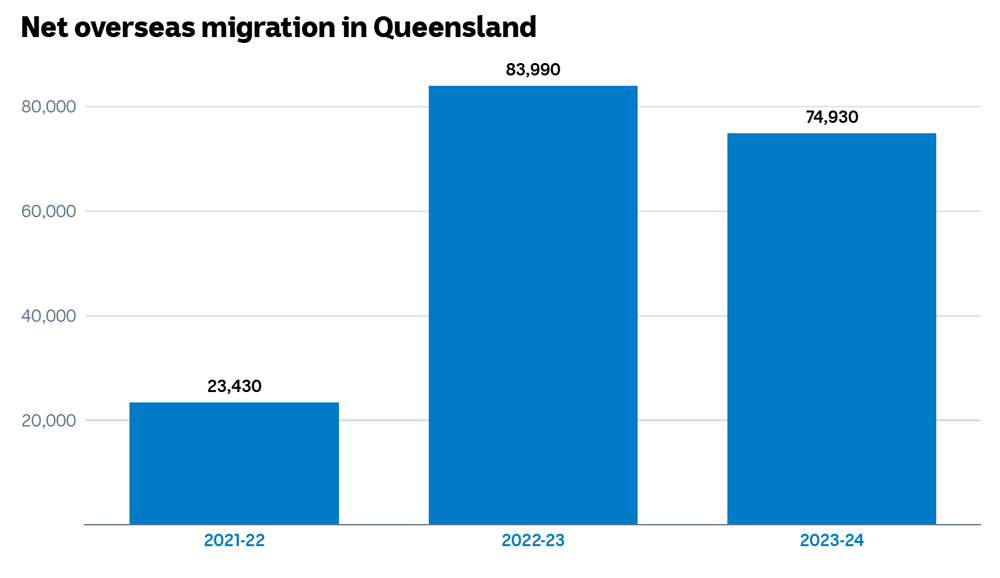
The latest Australian Bureau of Statistics (ABS) data showed Queensland had the largest increase in population in the five years to June 2024 of any state or territory — a factor attributed to the impact of COVID-19 border closures in New South Wales and Victoria.
In 2023-24, net overseas migration was the largest driver of population growth in the state, followed by interstate migration.
Almost 75,000 people moved from overseas to Queensland in that period, while almost 30,000 people shifted from interstate.
Immigration minister Tony Burke said that the government would again prioritise skilled migrants, who accounted for more than two-thirds of the 185,000 spots granted.
‘Short term solution’
In Queensland, the Housing Industry Association (HIA) agreed there simply weren’t enough workers to build not only the homes needed, but to support the impending major civil and Olympic Games infrastructure program.

Mike Roberts (Supplied: Housing Industry Association)
Mr Roberts said data indicated 2026-27 would coincide with a “peak demand” for skilled labour, meaning there simply wasn’t time to train new workers.
“That means we need a short term solution,” he said.
“And the obvious answer to that is to bring skilled labour in from overseas.”
Mr Roberts said.
“The government is committed to supporting the construction sector to fill skills shortages where no suitably qualified Australians are available,” they said.
The first thing that hit me when I landed in Melbourne from Kabul wasn’t the city’s famously unpredictable weather but the incredible diversity on the streets and in the food. It was nothing like the Australia I had imagined growing up: a cricket-mad nation led by white politicians in suits, in the headlines occasionally for either good or controversial reasons.
This vibrant reality surprised me in the best way.
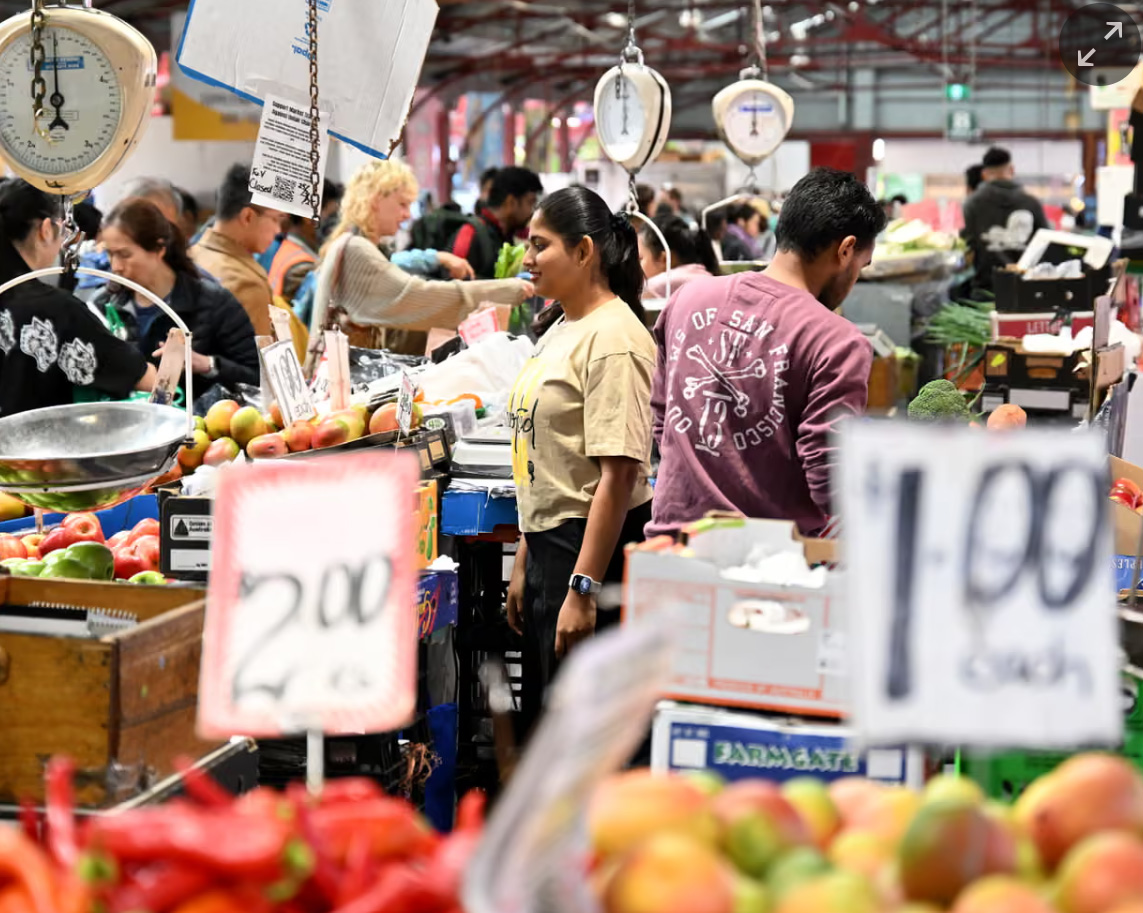
My curiosity turned into something deeper on my first weekend in the city, when I found myself at Queen Victoria market. I stood still, a little overwhelmed. The aromas – some familiar, some entirely new – drifted past me. Music played from different corners. People chatted in languages I half-recognised, others I couldn’t place at all. Korean barbecue sizzled next to an Ethiopian injera stall. A few weekends later, I saw a Croatian choir performing while a Vietnamese lion dance troupe practised next.
And then came Eid. On a crisp Melbourne day, hundreds of Muslims from a kaleidoscope of backgrounds gathered at the market for their annual festival. Sufi music from South Asia filled the air, mingling with the scents of Mediterranean and Middle Eastern cuisine. I thought to myself: how wonderful that a market named after a British queen is now joyfully hosting the world’s cultures.
As I started settling into life – juggling journalism, playing cricket, finding my feet in a new community – I couldn’t help but notice something else. Yes, multiculturalism in Australia is visible, celebrated, and often delicious.
During the recent election campaign, I saw politicians making the rounds in multicultural neighbourhoods, eager to be seen connecting. They turned up at community barbecues, temple and mosque open days and cultural festivals – smiling for photos with kebabs, samosas and spring rolls in hand.
Cricket, curiously, has been my constant in all of this. I joined a local club in inner-city Melbourne that looked and sounded like a mini United Nations. We laughed, competed and bonded across languages and backgrounds. It was beautiful.
So the recent launch of the Office for Multicultural Affairs is a nice step. Minister Anne Aly – a trailblazer herself – put it clearly: “For too long, multiculturalism has been about citizenship and immigration.” She’s right. In a nation where over 31% of the population was born overseas, this isn’t a minor oversight – it’s a structural blind spot.
The new office promises to focus on inclusion, belonging and giving diverse communities a real say. That’s encouraging.
As someone from Afghanistan, a place where identity can determine destiny, these things are hard to ignore. In many countries migrants came from, the dangers of speaking out or being in the wrong place for the sake of identity could be deadly dangerous. Here in Australia, the risks are different – more subtle, often institutional.
In many conversations with migrants, refugees and other diverse Australians, I’ve heard a common refrain: they don’t just want to be statistics in a census or smiling faces in government brochures. They want to be part of the decision-making. They want to be trusted with stories, with strategy, with steering the future.
To its credit, the Albanese government has moved multicultural affairs into cabinet. That matters. The last federal election did shift the needle. More women, more diverse MPs entered parliament. A powerful step in the right direction.

In 1996, on the verge of becoming prime minister, John Howard famously declared that he wanted Australians to feel “comfortable and relaxed” about their past, present and future.
Howard was derided at the time for setting such an unambitious goal for the nation. The truth is, the nation mostly embraced it and continued to even after Howard left office.
Yet, as Australia’s relative success at accommodating waves of immigration since World War II has shown, the discomfort is worth it. Immigration has repeatedly brought the raw labour, new skills, financial capital and social diversity that have underpinned our material and cultural prosperity.
The fact that recent waves of migrants have come from Asia – and India, in particular – those migrants will help establish yet more connective tissue between Australia and the region. They will also deepen our Asia literacy, leadership and capability, improving our ability to succeed in the world’s most important region, central to both our security and prosperity.
“In Prime minister Howard’s day, we could afford to be comfortable and relaxed. Maybe we even deserved to be. But that time has well and truly passed.”
We could certainly use the help.
As Asia has cemented its economic and geostrategic centrality, the rest of the world has scrambled for its markets, capital, economic and security partnerships – opportunities that are all finite. Here, too, we have suffered from being a little too comfortable and relaxed.
The current government deserves credit for building new security and economic partnerships in the region and for devising new strategies to grow and diversify Australia’s trade and investment in Asia.
Yet much of Australia’s business community is still ambivalent about the region. For too long, we have relied upon easy economic wins provided by a region hungry for our resources. Much of corporate Australia still prefers the more relaxed competition of the domestic market over sharper-elbowed contests in a region for markets, capital and economic partnerships.
Sure, the competition might be tougher, the risks higher, and the returns might take longer to realise. But you would think that region that contains the world’s fastest-growing economies and most of its middle classes might be worth some short-term discomfort.
Part of the problem is that we struggle to maintain a contemporary understanding of Asia and how rapidly it is changing. Our boardrooms and C-suites lack Asia knowledge and expertise. Our media still does a better job of covering royal weddings and American elections than economic, political and technological developments in Asia. Despite earning billions from training Asian students, our universities are turning out fewer Australian graduates with some form of Asia literacy or expertise.
It’s one of the key reasons Asia Society Australia has partnered with The Australian Financial Review on the Asia Summit: to help take the conversation on risks and opportunities in Asia from niche to mainstream.
And this task is now urgent.
Howard set out his credo at an incredibly favourable moment in Australia’s history. The country was at the start of a long period of economic growth, underpinned by the hard and uncomfortable work of opening Australia’s economy to the world undertaken by the Hawke-Keating governments.
It was a time when China paid handsomely for our resources and raised no immediate questions for our security. America was a sober, largely unassailed and competent (if not always wise) guarantor of the global order.
Few things seriously threatened the security and prosperity we enjoyed. A global financial crisis barely disrupted successive years of growth. Terrorism made us fearful for a while – including of each other – but claimed relatively few Australian lives.
Global trade was mostly an open and orderly business. Technology had enhanced jobs, rather than threatening to make them extinct. Immigration was an easy lever to economic growth, one that, for all the tough talk and policies, governments of both persuasions pulled regularly. Energy was cheap, reliable and yet largely untroubled by the hard decisions needed to tackle climate change.
As successive governments and countless experts have told us over the last decade or more, all of these pillars of our comfortable and relaxed lives have been crumbling – some faster than others. Yet, as a nation, we have been slow to respond to these new realities – mainly because of the discomfort, tough choices and hard work that this would entail.
In Howard’s day, we could afford to be comfortable and relaxed. Maybe we even deserved to be. But that time has well and truly passed.

Australia’s Skilled Independent visa (subclass 189) program continues to demonstrate resilience and strategic focus in the 2025–26 financial year, drawing skilled professionals to fill critical gaps in a dynamic economy. With subclass 189 invitations making up almost 98% of all invitations issued in the 21 August round, the stream—designed for points-tested applicants free from sponsorship requirements—maintained its strong trajectory. According to industry trackers, the 6,887 invitations represent around 41% of the reported annual planning level of 16,900 places for this visa.
As of September 30, visa invitations have been flowing steadily since July, with occupations in engineering, healthcare, and trades leading the way, per Department of Home Affairs data.
Sustained Surge: Percentage Allocations Fuel Ongoing Invitations
The SkillSelect system’s August 21 round distributed invitations across over 100 occupations with minimum points thresholds from 65 for vital trades to 110 for specialised electronics experts. This expansive coverage, aligned with the Medium and Long-term Strategic Skills List (MLTSSL), targets sectors essential for infrastructure and public welfare.
The round’s breakdown reveals a pronounced emphasis on core industries, with 97.9% of invitations channelled into the subclass 189 stream, underscoring the program’s dedication to independent skilled pathways. Processing times vary and are updated monthly by Home Affairs, with many applicants reporting 6–9 month outcomes depending on case complexity.
Analysts link this progress to Australia’s recovery dynamics, where industries securing the top invitation percentages—such as healthcare and construction—confront pronounced skill deficits. “The percentage allocations affirm the migration framework’s ability to onboard elite talent seamlessly,” observed migration expert Dr. Elena Vasquez of the University of Melbourne.
Sectoral Percentages: A Lens on Prevailing Demand Dynamics
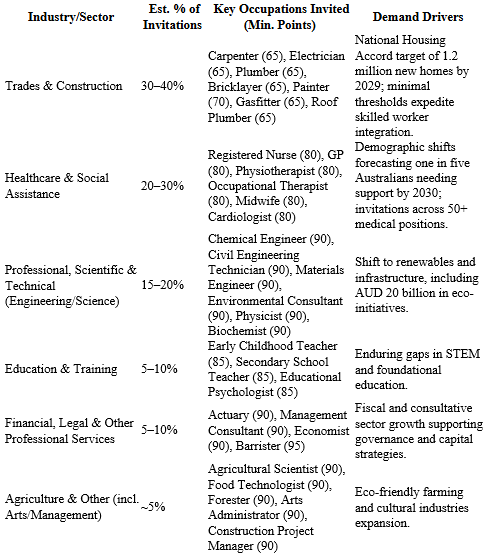
Examination of the August round’s structure discloses a distinct industry tilt, with invitation percentages skewed toward shortage-plagued areas. Derived from the occupation array (encompassing over 100 ANZSCO codes), trades and construction secured the foremost portion at 30–40%, trailed by healthcare at 20–30%. These percentages, inferred from invitation results and past grant trends, illuminate Australia’s drive to fortify vital services and infrastructure.
Notably, more than 70% of invitations concentrated in three pivotal sectors—trades, healthcare, and engineering—marking a rise in construction’s allocation compared to 2024–25.
The ensuing table outlines major sectors, their estimated invitation percentages, illustrative occupations, and propelling factors.
Evolving Landscape: Points Shifts and Supportive Measures
The International English Language Testing System (IELTS) remains the premier choice for skilled migrants, with its comprehensive format delivering reliable results that boost competitiveness in percentage-intensive fields.
Prospective View: Consistent Pathways Persist
With large allocations already issued and further invitation rounds expected later in the program year, subclass 189 continues to anchor Australia’s skilled migration strategy. Skilled migration endures as the bedrock of Australia’s fiscal durability.

If you are interested in applying for a general skilled migration visa to Australia, it is important to have a good understanding of the skilled visa options and how the migration points test works, so that you can maximise your chances of being eligible to apply for a skilled visa.
A general skilled migration visa is an option available to skilled workers who are seeking to qualify for a skilled visa independently, or under a state or family sponsorship. It is an alternative to an employer sponsored visa.
One of the key criteria to qualify for a general skilled migration visa is the points test (a criterion that does not apply to employer sponsored visas). This is often the most challenging aspect for prospective skilled visa applicants to overcome when seeking an invitation to apply for the relevant skilled visa.
If you are considering applying for a general skilled migration program visa, an important concept to understand is the Expression Of Interest (EOI).
If you are considering applying for a general skilled migration visa, it is important to be aware that for certain visas in this visa class, you will first be required to lodge an EOI with the Department of Home Affairs (the Department) through SkillSelect. The EOI is not a visa application, but rather, it is the process by which you can express your interest in applying for the relevant skilled visa (It’s important to note, that there is NO fee to submit an EOI).
This requirement applies to the following skilled visa subclasses:
Let’s take a brief look at each of these visas below:
The ‘subclass 189’ is a federal sponsored visa that grants automatic permanent residence in Australia. It is subject to nil visa conditions or obligations. For this reason, it is often considered to be the most flexible of the skilled visa options available.
A subclass 189 points-based visa allows you to live and work in any state or territory permanently.
The ‘subclass 190’ is a state/ territory sponsored permanent residence visa. It is another points-based visa for which invitations are issued throughout each month by individual states and territories. One of the benefits of applying for state nomination is that you will be granted an additional 5 points.
An important aspect to consider, which does not apply to the subclass 189 visa is that there is an added step in the application process. In this case, you must also apply for nomination approval to a state or territory government. Only upon receipt of an invitation from the relevant state or territory to which you apply can you then apply to the Department for the visa itself.
Your obligations as a subclass 190 visa holder are that you must commit to your nominating jurisdiction’s obligations and commit to residing in your nominating State or Territory for two years from visa grant.
The ‘subclass 491’ is also a points-based state/ territory (or family) sponsored visa. It is a regional visa with a term of five years. The Department issues invitations for family sponsored EOI applications only (in invitation rounds). Invitations for state sponsorship are issued by individual states and territories throughout each month. This will grant you an additional 15 points for the nomination.
Being a provisional visa, this means it provides a pathway to permanent residence in Australia with the Subclass 191 Permanent Residence (Skilled Regional) visa, subject to meeting specified requirements.
Be mindful that as a subclass 491 visa holder, you must abide by visa condition 8579, which requires you to live, work and study in a designated regional area of Australia. For migration purposes, most locations of Australia outside of major cities (Sydney, Melbourne, Brisbane, Perth, etc.) are classed as regional areas.
If your EOI is successful, you will receive an invitation to apply for the visa, as specified in the invitation letter. This then enables you to proceed with lodgement of your visa application (provided you meet all other visa lodgement and visa grant requirements).
Please note, the below State and Territory program updates is a general overview only. It does not take into account any of your personal circumstances. You must check the State/Territory information carefully to ensure you can meet all the requirements for nomination.
Australia is currently facing a shortage of skilled migrants to fill workforce demands. In response, states and territories have been easing the conditions of their visa programs to help attract skilled workers from overseas.
Below is the monthly update for some of the State and Territory opportunities available.
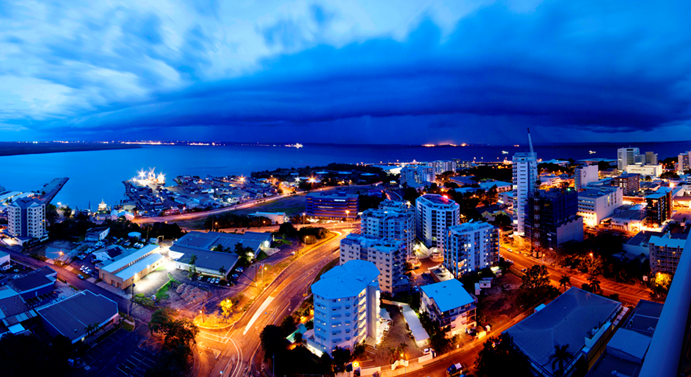
Program Status Update
UPDATE: Northern Territory General Skilled Migration (GSM) nomination applications for 2025-26
The NT Government is yet to receive its full nomination allocation for the 2025-26 program year from the Australian Government.
The Australian Government has released a small interim allocation while State and Territory governments await the full allocation for this program year. The NT Government has a limited number of subclass 491 nominations available for eligible onshore applicants with certain visa deadlines falling before 31 December 2025.
Until the interim allocation is exhausted, new subclass 491 nomination applications will be accepted by exception for onshore applicants who meet the NT Graduate or NT Resident eligibility criteria and have the following visa deadlines falling before 31 December 2025:
Onshore applicants with such visa deadlines should lodge subclass 491 nomination applications without delay and must also meet all relevant criteria for the stream they are applying for as published on N.T. website at present.
The 2025-26 program remains closed for other applicants at this time and will open once the full allocation is received from the Australian Government.
Once the above mentioned temporary suspension is lifted, you may be able to proceed with the NT’s usual skilled migration program. Program details below:
People residing offshore are eligible to be considered for Northern Territory (NT) nomination. Invitations to apply for Northern Territory nomination will be via the ranking system.
The ‘Northern Territory Offshore Migration Occupation List’ identifies the occupations in current demand in the Northern Territory. This List is important if you want to apply for Northern Territory nomination for either a:
The ‘Northern Territory Offshore Migration Occupation List’ is only applicable for those applying for NT nomination from outside Australia, under the Priority Occupation stream.
Please note: The Northern Territory government has advised that offshore applicants will generally only be offered a Northern Territory nomination for a subclass 491 visa. Subclass 190 nominations will only be offered in exceptional circumstances, such as cases where the applicant has strong connections to the NT.
The NT advises eligible applicants to apply as soon as they meet the eligibility criteria. To receive a nomination from the NT Government, you must:
Before submitting an EOI for The Northern Territory, applicants should check that they meet all eligibility requirements.
For a further explanation, see the Frequently Asked Questions page on the Northern Territory Government website.
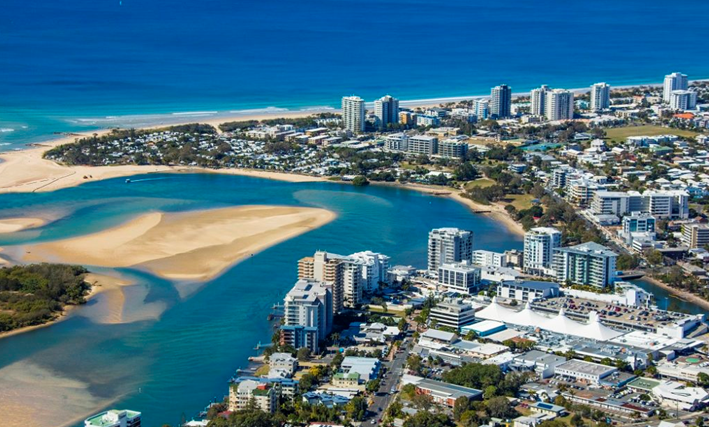
Program Status Update
Program Status Update: Important Announcement
Queensland closed its 2024-25 skilled State Nominated Migration Program (SNMP) on May 27 2025.
Migration Queensland will continue to assess the applications currently under assessment until all nominations are completed.
Migration Queensland will resume accepting new ROIs from all eligible candidates when the 2025-26 program commences. (The program year generally runs from Start of July 2025 – End of June 2026).
Migration Queensland will publish details of the 2025-26 program when available.
Once the above mentioned temporary suspension is lifted, you may be able to proceed with Queensland’s usual skilled migration program. Program details below:
Depending on your occupation and situation, there are two state nomination options available for skilled migrants through Queensland.
For Queensland state nomination, prospective applicants must meet the Department of Home Affairs requirements, state-specific occupation requirements and have skills in an occupation that is available on the Queensland Skilled Occupation List.
You may undertake employment once onshore in Queensland through:
Offshore applicants meeting the minimum published requirements are eligible to lodge an Expression of Interest (EOI) on Skill Select and then a Registration of Interest (ROI) on the Migration Queensland portal.
Migration Queensland has opened the 2024-25 State Nominated Migration Program. For more information, please see here.
NOTE: To be eligible for Queensland’s 2024-25 program, your EOI must be submitted on or after 13 September 2024.
Migration Queensland criteria requires you to:
The 2024-25 Skilled Migration Program is open to both onshore and offshore applicants and provides pathways for skilled workers, graduates, and small business owners.
Before submitting a Registration of Interest (ROI) for Queensland, applicants should check that they meet all eligibility requirements.
Note: In the EOI, select ‘Queensland’ as the only state of interest in the EOI, if you wish to be considered for an invitation to apply for Queensland nomination.
For a further explanation, see the Frequently Asked Questions page on the Queensland Government website.
 Program Status Update
UPDATE: Victoria’s 2025-26 state nominated skilled visa program is not yet open. More information on the program will be published soon.
Once the above mentioned temporary suspension is lifted, you may be able to proceed with Victoria’s usual skilled migration program. Program details below:
Open to offshore applicants, the program provides skilled migrants with a pathway to permanent residency in Victoria. The skills that successful applicants bring to Victoria benefits employers and the broader Victorian economy.
The program provides two visa pathways:
As with previous years, applicants will first need to submit a Registration of Interest (ROI) and then be selected on competitive merit to apply for visa nomination.
*Please note: Invitation rounds occur frequently throughout the financial year with no set date.
To be invited to apply for Victorian skilled visa nomination, you must firstly make or update an Expression of Interest (EOI) via the Australian Government’s SkillSelect and then submit a Registration of Interest (ROI).
NOTE: If you previously submitted a ROI and wish to be considered for invitation in the 2024-25 program, you must submit a new ROI.
Both onshore and offshore applicants are eligible to submit a Registration of Interest (ROI) for both the subclass 190 and subclass 491 visas.
Your ROI will remain in the system for selection until it is withdrawn, selected or the program year ends.
Before submitting an ROI for Victoria, applicants should check that they meet all eligibility requirements.
For a further explanation, see the Frequently Asked Questions page on the Victoria Government website.
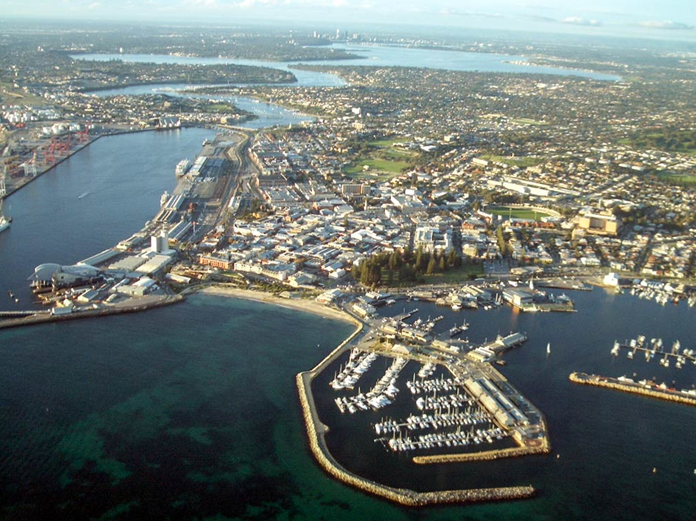
Program Status Update
Update: 2025-26 State Nomination Migration Program Interim allocation
A small interim allocation has been issued for the 2025–26 Western Australia State Nominated Migration Program (SNMP). This allocation will be used to clear the remaining 2024–25 applications.
Given the limited number of places, the 2025–26 program year will not open until the formal allocation is issued by the Commonwealth Government.
Please continue to monitor the State Nominated Migration Program page and other official channels for further updates.
Once the above mentioned temporary suspension is lifted, you may be able to proceed with WA’s usual skilled migration program. Program details below:
People residing offshore are eligible to be considered for Western Australia (WA) State nomination. Invitations to apply for WA State nomination will be via the ranking system.
The Western Australian Skilled Migration Occupation List identifies the occupations in current demand in Western Australia. This List is important if you want to apply for Western Australia nomination for either a:
Please note that to be eligible for an invitation in the WA State Nominated Migration Program, you must meet both:
Before starting your application, you will need to check whether your occupation is available on either the WA Skilled migration occupation list (WASMOL) Schedule 1 or 2, or the Graduate occupation list. You can search for your occupation here. (The occupation list search bar is located under the heading ‘Eligible Occupations’.)
Features of the WA 2024-25 State Nominated Migration Program:
Before submitting an EOI for Western Australia, applicants should check that they meet all eligibility requirements.
For a further explanation, see the Frequently Asked Questions page on the Western Australia Government website.
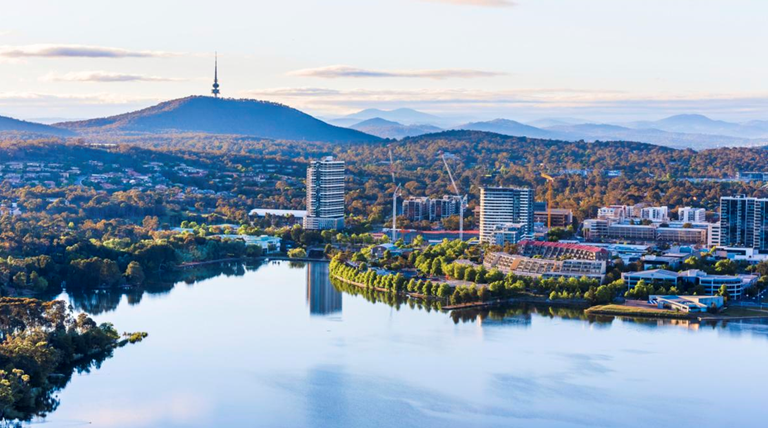
Program Status Update
2025-26 Nomination Allocation: The ACT received an interim allocation of 165 places for 2025-26 until a final allocation is determined.
The Australian Capital Territory (ACT) Government has the flexibility to address skills shortages and labour market needs in the Territory through the state/territory nominated stream of the Australian Migration Program. The Australian Government allocates the ACT a fixed number of nomination places each financial year.
The 2025-26 interim allocation is 165 nomination places:
ACT nomination triggers the visa invitation from the Department of Home Affairs. ACT nomination does not guarantee a migration outcome. You must still meet the Department of Home Affairs visa criteria.
Once the above mentioned temporary suspension is lifted, you may be able to proceed with ACT’s usual skilled migration program. Program details below:
The ACT Critical Skills List identifies the occupations in current demand in the ACT. This List is important if you want to apply for ACT nomination for either a:
The ACT Government will update this list every four months to make sure that the ACT Skilled Migration Program adapts and responds to the evolving critical skills needs of the ACT economy.
The Canberra Matrix is weighted to ensure that applicants who will make a positive economic contribution to the Territory and/or have demonstrated a genuine commitment to the ACT are more likely to be ranked and invited to apply for ACT nomination.
*ACT nomination does not guarantee a migration outcome. You must still meet the Department of Home Affairs criteria.
Every month, a certain number of nomination invitations are available (prorated on the annual allocation) to those working in the highest ranked Matrix in each occupation.
You can view the ACT’s most in-demand skills for skilled migration by consulting the ACT Critical Skills List.
Before submitting an EOI for The Australian Capital Territory, applicants should check that they meet all eligibility requirements.
Once you’ve submitted a valid Department of Home Affairs Skill Select EOI, follow the ACT Government Process to apply for ACT nomination.
For a further explanation, see the Resources page on the ACT Government website.
Program Status Update
An Update on Interim Allocations for the 2025-26 Program Year
The Commonwealth Government have provided South Australia with a small interim allocation for the 2025-26 program year.
Given the small number of interim allocations, Skilled and Business Migration (SBM) will not open for new Registration of Interest (ROI) applications and instead focus on inviting strong applicants contributing to the state’s workforce requirements, including from the ROI’s submitted in the 24-25 program year.
Once the Commonwealth Government provides South Australia with its full allocation, SBM will release its full policy settings for the upcoming program year.
Please keep an eye out on the News & Events section of their website to keep up to date with all the announcements.
Once the above mentioned temporary suspension is lifted, you may be able to proceed with SA’s usual skilled migration program. Program details below:
Depending on your occupation and situation, there are two state nomination options available for skilled migrants through South Australia.
For South Australian state nomination, prospective applicants must meet the Department of Home Affairs requirements, state-specific occupation requirements and have skills in an occupation that is available on the South Australian Skilled Occupation List. Offshore applicants meeting the minimum published requirements can now lodge an Expression of Interest (EOI).
There is an enormous range of occupations on South Australia’s Skilled Migration Occupation List in a range of industries – search for your occupation here.
South Australia will select offshore applicants to apply for state nomination from those who have submitted an Expression of Interest (EOI) through SkillSelect. Offshore applicants will not need to lodge a Registration of Interest (ROI) for this year’s program. South Australia will be nominating offshore applicants from over 250 occupations on South Australia’s Skilled Migration Occupation List.
If you are currently residing offshore and seeking to move to South Australia, the first step is to create an Expression of Interest (EOI) in SkillSelect ensuring you select South Australia as your first preferred State or Territory.
The South Australian Government can then review your EOI for consideration under the Skilled Nominated (Permanent) visa (subclass 190) or Skilled Work Regional (Provisional) visa (Subclass 491).
For most occupations, applicants must have a minimum of three years of skilled employment in their nominated or related occupation within the last 5 years to secure an invitation to apply for SA nomination.
South Australia will be assessing candidates on merit by the following factors:
For occupations in the construction trades (as listed here) applicants must have a minimum of one year of skilled employment in their nominated or related occupation within the last 3 years.
Applicants in the construction trades will be assessed on merit by the following factors:
Before submitting an EOI for South Australia, applicants should check that they meet all eligibility requirements.
For a further explanation, see the Frequently Asked Questions page on the South Australia Government website.

Program Status Update
Program Status Update: 27 June 2025 – Important Update – Gateway closed to new ROI submission
All nomination places have been used and no further ROIs being accepted.
With all nomination places now used no further ROIs accepted until the 2025-26 program commences. Further information regarding the 2025-26 program will be published on the Migration Tasmania website and in their newsletter when it becomes available.
Migration Tasmania will continue to assess applications for nomination that have been lodged but not yet decided. However any applications approved will be nominated after Tasmania receives its nomination allocation for the 2025-26 program year.
ROIs that are not invited to apply for nomination before the end of the program will continue to be held in the Application Gateway and considered for an invitation to apply for nomination when the 2025-26 program opens.
Processing times and remaining nomination quota are updated every week on the Migration Tasmania website HERE
Once the above mentioned temporary suspension is lifted, you may be able to proceed with Tasmania’s usual skilled migration program. Program details below:
Working in Tasmania
The two state nomination options available for skilled migrants through Tasmania are:
The Tasmanian State Nomination Skilled Migration Program supports Tasmanian businesses and increases the state’s working age population. It does this by attracting and retaining migrants with skills genuinely in need by employers, or with the capacity to settle in Tasmania through skilled employment in the long-term, and business activities that will increase employment opportunities.
Tasmania’s skilled migration program is for people wanting to move to the state who have skills that Tasmania need. Skilled migrants are attracted to Tasmania because of the state’s enviable lifestyle, career opportunities, affordable housing, reputable schools and a globally recognised university.
The Migration Tasmania Application Gateway is now available for registrations of interest (ROI) and applications for skilled visa nomination from Tasmania.
Anyone seeking Tasmanian nomination for a Subclass 190 Skilled Nominated Visa or Subclass 491 Skilled Work Regional Visa must first register in the Migration Tasmania Application Gateway .
Before submitting an ROI for Tasmania, applicants should check that they meet all eligibility requirements for either;
For a further explanation, see the Frequently Asked Questions page on the Tasmania Government website.
Program Status Update
The New South Wales government has invited applications from offshore migrants under the following nomination streams:
The NSW State Government announced that offshore applicants skilled in certain ANZSCO unit groups are eligible for NSW nomination.
*Please note: Invitation rounds occur frequently throughout the financial year with no set date.
NSW invites and nominates SkillSelect EOIs at the ANZSCO unit group level. To be eligible for NSW nomination (for either Subclass 190 or Subclass 491), your occupation must fall within an ANZSCO unit group identified on the NSW Skills List which reflects skills in high demand across the state, and be eligible for the visa.
Before submitting an EOI for New South Wales, applicants should check that they meet all eligibility requirements for either;
For a further explanation of how the skills list works, see the Common questions about skilled visas page on the NSW Government website.
Plumbers, electricians and bricklayers in Perth are earning as much $250,000 a year as shortages of skilled workers push up construction costs and make it harder to deliver desperately needed housing, says leading developer Nigel Satterley.
Construction tradespeople are being paid as much as 10 per cent to 15 per cent more in the western capital than in other parts of the country, due to a combination of the amount of work available, a large skills shortage and the pull of the resource sector, Satterley told the Financial Review Property Summit.
“There’s a huge skills shortage. They’re very well paid.,” he said. Satterley said that the lead tradie in a typical team of four could earn as much $500,000.
The veteran developer, whose company Satterley Group has projects in Western Australia, Victoria and Queensland, said the delivery of new homes in Perth’s growth areas has been falling well short of demand, but has improved over the last nine months due to the contribution of skilled workers from the Philippines.
“There’s a great shortage of tradespeople, and [federal treasurer] Mr Chalmers has done a great job with the immigration department, but now [the federal government needs to] make it easier,” Satterley said. “They’ve got to really target the skill shortages, or we’re never going to catch up. We’re never going to get inflation under control.”
Developers and builders at the summit highlighted the lack of construction workers, as well as slow approval times, red tape, and community opposition to increased housing density, as some of the major barriers to improving the supply of new homes.
“We don’t have enough supply [of tradies], and so they are demanding significant sums of money to ensure the work gets done,” said Denita Wawn, chief executive of industry lobby group Master Builders Australia.
“That’s part of the reason why costs have escalated so significantly – because of rising labour costs. It’s really important that they’re well paid, but certainly it’s exacerbated at the moment around [tradie] supply.”
Part of the problem historically had been a social stigma for young people entering trades rather than going to university. That was fading, according to Wawn, who used the example of her own year 11 son pursuing a school-based apprenticeship after estimating he could be earning $150,000 to $180,000 as a mechanical plumber before he turned 21.
“That’s pretty good for a 20-year-old,” said Wawn.
Adrian Pozzo, who heads Cbus Property, the development arm of superannuation giant Cbus, had also experienced the stigma and had been “directed” to go to university.
“I think everyone else has been directed to go to university and thought, ‘If I get a trade, I’m not going to make it.’ Well, we’ve lost that whole cohort of people that haven’t got a trade,” he said.
While high wages were now helping break down reluctance to pursue a career as a tradesperson, there was still a massive gender barrier to overcome, Wawn said.
“We’re also not good at promoting half the working population – otherwise known as women – in coming into our industry. It still astonishes me that in the 10 years I’ve been with Master Builders, we were having 2 per cent of our trade workforce who are women. We’ve doubled that to 4 per cent now. That’s outrageous.”
But both Satterley and Wawn were adamant that, along with encouraging more young people into trades, increasing the number of skilled migrants was critical to boosting the supply of workers in the short term.
The federal Labor government had controversially excluded tradespeople from a fast-track scheme before later including them in a core stream.

The Queensland mining city of Mount Isa is calling out for more migrant workers.
A mining town in Queensland’s outback says it is keen to welcome anyone wanting to migrate.
About 26 per cent of the Mount Isa population was born overseas, higher than the statewide average.
Its multicultural makeup is largely due to its mining roots, attracting workers from across the globe.
Mayor Peta MacRae said immigration was critical in helping found the mining town and was an important part of its future.
“This is what the city’s built on and without migrants we would not be standing here today,” Ms MacRae said.
“You just need to go into our local businesses around town, our pubs, our clubs, our cafes and you will see people from other cultures and countries here.”
While the underground copper mine that brought migrants to Mount Isa closed this year, Ms MacRae said there were still job opportunities for immigrants.
“It’s already so crowded down in the south-east corner, [but] we have all the opportunity in the world, we have the jobs, we have the space, we even have affordable housing,” she said.
“We are a proud multicultural city. Anyone looking to come to Australia, we will welcome you with open arms.”
‘I’m one of the examples’
Ajay Komkoon was born in Mauritius but moved to Mount Isa to work as a car mechanic 12 years ago.
Now, he has a wife and daughter and owns a small business running his own workshop.
“Mount Isa is a great city to live in,” he said.
Mr Komkoon said businesses struggled to fill vacant job positions, so he had turned to advertising overseas, sponsoring people to immigrate to Mount Isa.
“I think more people need to come to Australia to fill up the shortage of labour and to keep the ball rolling,” he said.
Mr Komkoon said he always advertised locally first, but when the positions went unfilled, the net was widened to job hunters from overseas.

Ajay Komkoon (third from left) and his team in his workshop.
His team is largely from the Philippines, including his wife who also works in the shop, plus a recent addition from the United States.
“They put in all this effort and dedication, they’re great people to work with,” he said.
“Business is growing, and we will probably be hiring more people from overseas.”
Mr Komoon said his story showed how migrants could grow from employee to employer.
“I stepped up and now I’m a business owner,” he said.
“I’m one of the examples.”
Celebrating cultures

Mick Lowcock has lived and worked in Mount Isa for almost 30 years.
Good Shepherd Catholic Parish hosts the Mount Isa Multicultural Festival each year.
Father Mick Lowcock said about 2,500 people attended the event this month.
He said the cultural makeup of Mount Isa was shifting, with increased immigration from Africa, South America and Asia.
“Mount Isa wouldn’t exist without the number of migrants, right up to today,” he said.
“They’re the ones who are filling so many jobs and whether you go to the hospital or a school or police or go in the mines, they’re the ones who are doing a lot of work.”


Short on time? Here are the highlights:
A joint 4 August 2025 media release from the Ministers for Education, Home Affairs, Immigration and Citizenship, and Skills and Training, and Assistant Minister for International Education sets out Australia’s National Planning Level (NPL) for the 2025/26 fiscal year.
The new NPL will be 295,000 new international student places, an increase of 25,000 over the 270,000 limit set for 2024/25 but, “still 8% below the immediate post-COVID peak.”
Assistant Minister for International Education Julian Hill said, “This Government remains committed to sensibly managing the size and shape of the on-shore student market and supporting sustainable growth, especially to welcome more students from Southeast Asia and where accompanied by new housing. We want students to see Australia as a premium destination where they can access high quality education and a great student experience.”
What is the National Planning Level?
The National Planning Level, or NPL, is a system of allocating new student spaces among some institutions in Australia. While not a hard cap, the NPL aims to control the flow of new students into Australia.
Under last year’s Ministerial Direction 111 (MD111), visa applications will be processed for a given institution up to 80% of the indicative cap allocation given in the NPL. Beyond that 80% threshold, that same institution will fall to the end of the processing queue, with greater priority given to universities or colleges that have not reached the 80% benchmark.
There are a number of student categories that are exempted from the NPL limits, including K-12 students, those pursuing stand-alone English language courses, students from the Pacific and Timor-Leste, research students, those with government scholarships, and some students who begin their studies offshore and then transition to study in Australia.
What this means in part is that the NPL limits are fully allocated across the higher education and vocational sectors, with the former receiving roughly two-thirds of all NPL spaces in 2024/25.
How will the NPL work this year?
The allocation between higher education and vocational sectors will be roughly the same in 2025/26, with higher education institutions (public and private) sharing 196,750 new student places. The remaining 98,250 NPL spots will be allocated across vocational training institutions.
The institutional limits specified by the Department of Education indicate that public universities will see their NPL spaces expand by up to 9% overall. In contrast, for-profit private universities will be limited to a 3% increase.
The joint release sets out that all providers will at least receive their allocation from 2024/25. Public universities (as well as private not-for-profits) can apply to have their NPL limits increased by “demonstrating delivery” on two government priorities:
The other notable change in the NPL model for this year is that, “international students transitioning to publicly funded universities from secondary school studies in Australia and from affiliated pathways providers or TAFE institutes will be exempt from the National Planning Level.”
Finally, the government has also indicated that MD111 will soon give way to a new directive which reflects the new NPL allocations for 2025/26.
Are those new limits within reach?
Full-year data from the Department of Home Affairs reveals that the number of visas granted to students applying from offshore to study in Australia came in considerably below the NPL limit for 2024/25.
Keeping in mind that the NPL limit for the year was 270,000 places, the total number of visas granted to offshore applicants totalled only 234,040 for the year. Further, that total includes applicant categories, such as ELICOS and K-12 studies, that are exempt from the NPL.
Just under 170,000 visas were granted to new students coming to Australia for higher education (against a NPL limit for the sector of 176,000). The real gap, however, appears in the vocational education and training (VET) sector, which saw only 11,572 visas granted against an NPL allocation of 94,000.
In terms of visa grants to primary applicants in 2024/25, only 8,887 visas were issued to new VET students. This compares to 38,415 in the recent-year peak of 2022/23 and the pre-pandemic level of 25,727 in 2018/19.
Independent ELICOS enrolments have been similarly, and severely, affected. The 15,020 visas granted to new ELICOS students last year is a significant decline from the 60,299 visas granted for language students in 2022/23 and the 29,090 visas issued in 2018/19.
The broad picture then is that higher education enrolments, while below the 2022/23 surge, have been much less affected by policy changes introduced over the last two years. In fact, visa grants to new higher education students in 2024/25 were comfortably above pre-pandemic levels.
In contrast, ELICOS and VET enrolments have been badly disrupted by the new policy settings, which reach well beyond the NPL to include changes in visa rejection rates, delays in processing, dramatic increases in visa application fees, and more. “A plunge in the issuance of student visas has largely bypassed Australian higher education, with overseas demand for university degrees remaining well above pre-pandemic levels while collapsing in other sectors,” summed up a recent item in Times Higher Education.
By extension, the main implication of the increased NPL settings for 2025/26 is that it will provide for stability and even growth for higher education enrolments while doing little to address the challenges that are roiling other key segments of Australia’s higher education sector.
What are people saying?
The reaction to the NPL announcement reflects that variable impact across the sector. “The additional 25,000 new overseas student places provides the sector with some certainty for 2026,” says IEAA CEO Phil Honeywood. “However, these new places are very much weighted to our public universities with private higher education providers being provided with only a 3% increase of their already restricted allocations. Until we achieve a significant discount on student visa application charges, then Australia’s private English Language providers are also facing an uphill battle to keep their doors open.”
“This is a sensible approach and will provide the stability and certainty universities desperately need,” added Universities Australia CEO Luke Sheehy. “We welcome the opportunity for universities to grow their international student intake by aligning with key national priorities.”
“This week’s announcement continues the government’s ‘picking winners’ approach to industry policy,” said Professor Andrew Norton of Monash University. “It limits large movements of student enrolments between education providers and offers public universities preferential treatment.”

International students play a significant role in the Australian economy. They contribute to demand through their spending on goods and services and are an important source of labour for some Australian businesses.
This article shows that international students tend to add more to demand in the economy than they do to supply in the short run, in large part reflecting their spending on tertiary education fees. In periods of large swings in international student numbers or when the economy has little spare capacity, this means that changing international student numbers can affect macroeconomic outcomes, particularly in sectors of the economy where supply cannot respond quickly. The rapid growth in international student numbers post-pandemic likely contributed to high inflation over this period, but was not a major driver.
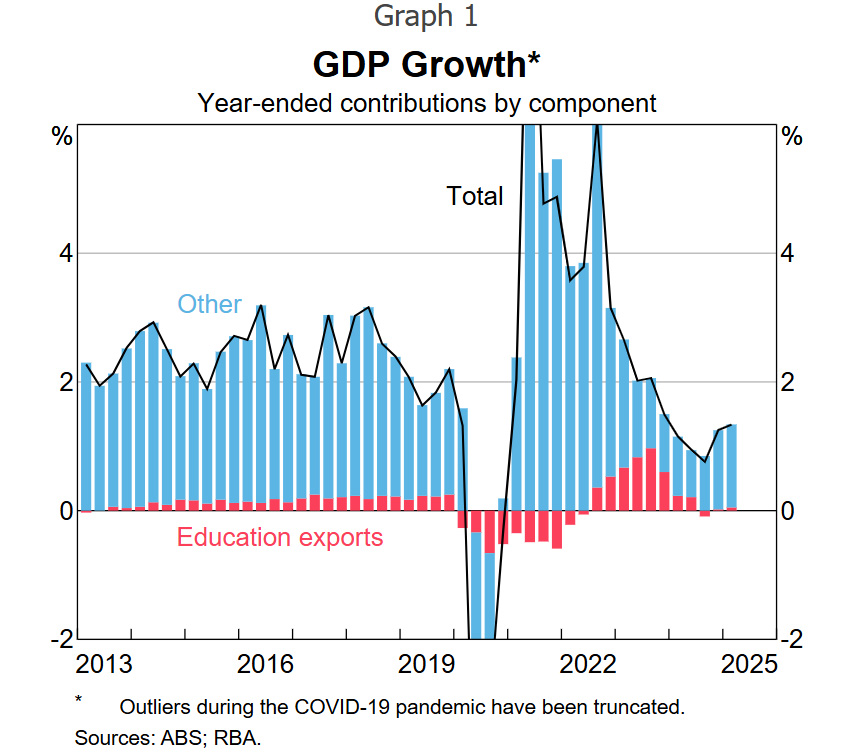
International students play a significant role in the Australian economy by spending on goods and services and providing labour for Australian businesses. The number of international students grew strongly after international borders reopened following the COVID-19 pandemic; education exports are currently Australia’s fourth largest category of export, at approximately $50 billion in 2023/24. International students have been an important driver of net overseas migration and GDP growth in recent years (Graph 1).
This article begins by stepping through developments in international student flows since the start of the pandemic in 2020. It then examines the ways in which international students interact with and contribute to the Australian economy, first by taking an economy-wide view of how international students contribute to supply and demand, and then considering their specific interactions with the market for goods and services, the labour market and the housing market. Finally, it concludes by assessing whether large changes in international student numbers have affected macroeconomic outcomes in recent years. Throughout the article, our analysis primarily considers how international students interact with and contribute to the economy from a shorter run perspective; longer run effects are outside the scope of the work.
Recent developments in international student flows
Global demand for education in Australia grew solidly in the decade prior to the pandemic. This reflected a range of factors, including rising household disposable income in Asia, the active promotion of Australia as an education destination, changes to migration policies that enabled higher education students to work in Australia after their studies, global population growth, and the depreciation of the Australian dollar after the mining boom (Grozinger and Parsons 2020; Norton 2024). However, with the introduction of border restrictions in March 2020 to contain the spread of the COVID-19 virus, new students were unable to enter the country. As a result, the number of international students onshore fell sharply (Graph 2).
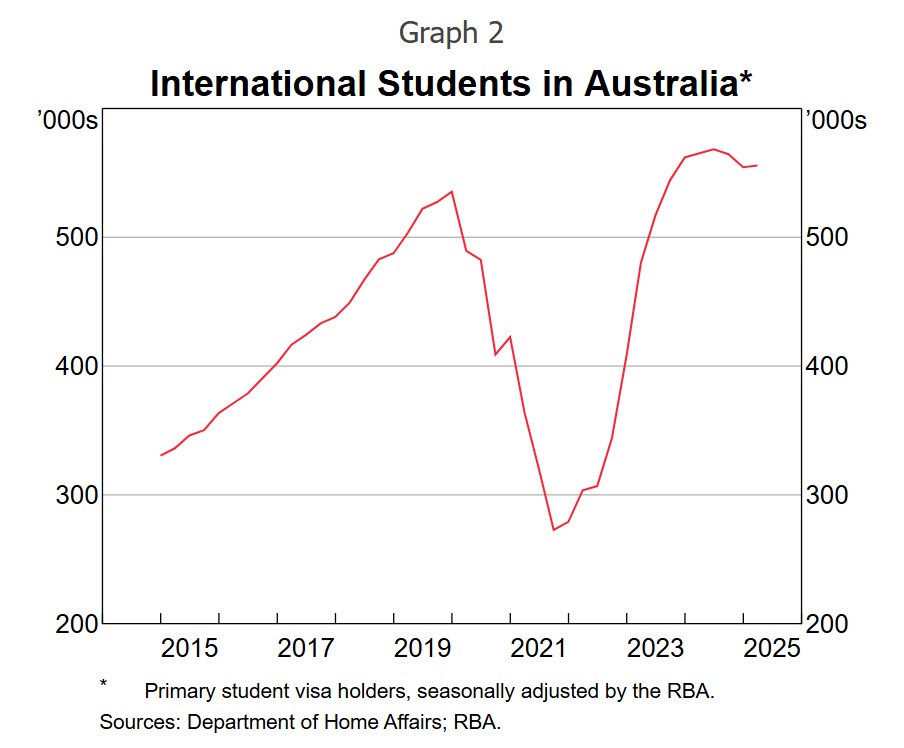
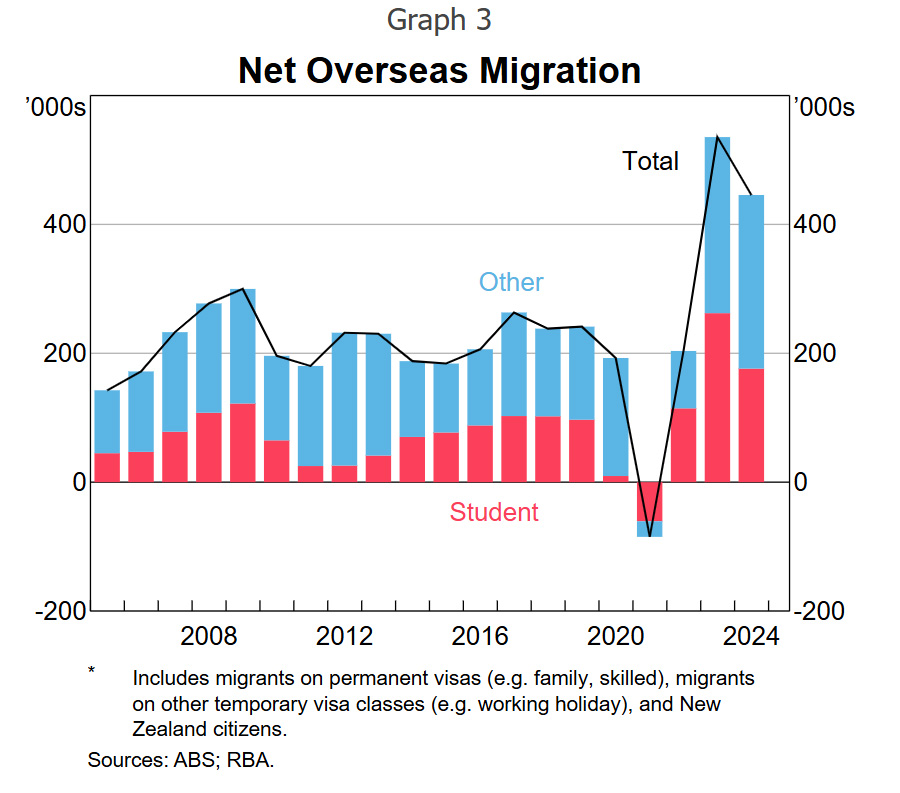
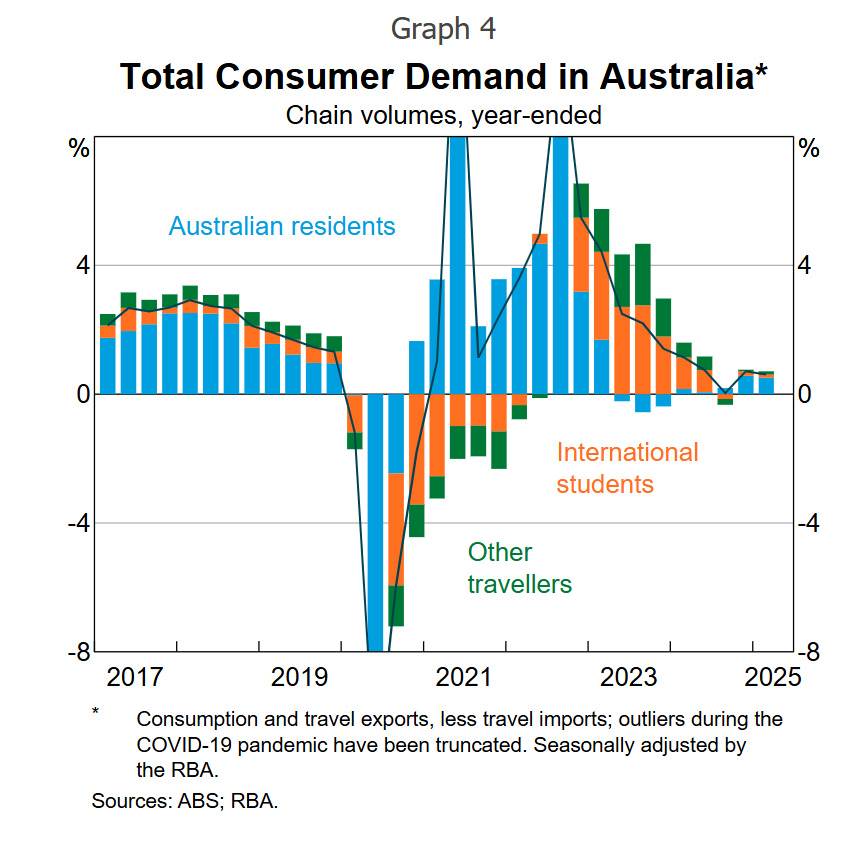
After Australia’s international borders reopened in late 2021, the number of international students onshore rose rapidly. While student arrivals quickly returned to around pre-pandemic levels, departures were lower because there were fewer students onshore to depart. Overall, these dynamics led to the international student stock rising sharply from just under 300,000 in 2022 to 560,000 by the end of 2023. Accordingly, international students were an important driver of net overseas migration during this period, accounting for around half of Australia’s total net overseas migration (Graph 3). Spending by international students was also an important contributor to growth in consumer demand in Australia following the pandemic (Graph 4).
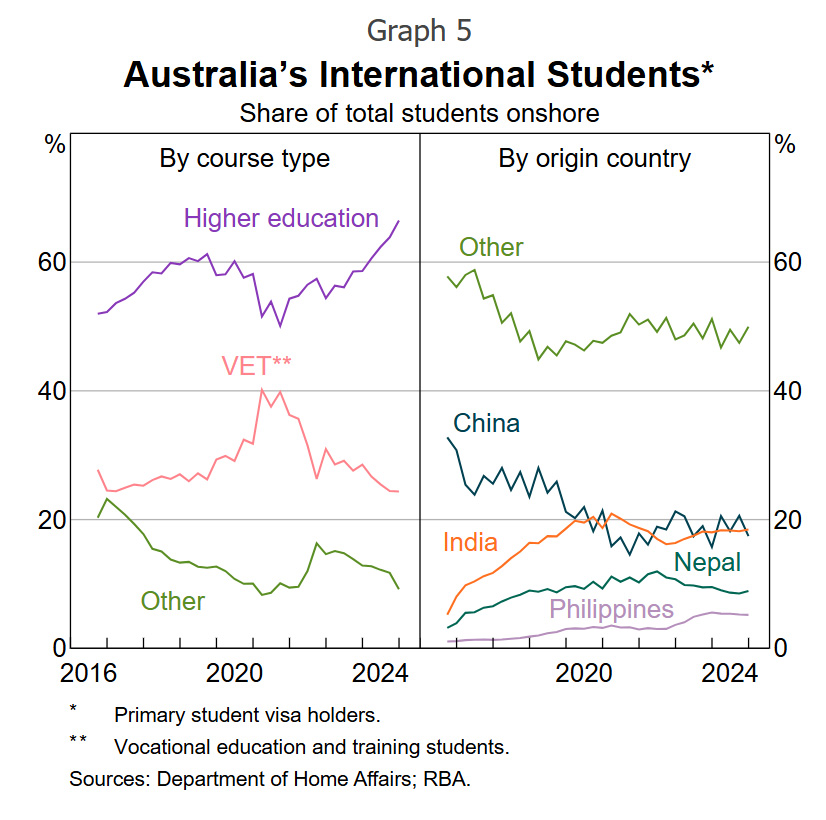
As the student stock has recovered, the share of international students studying higher education courses has risen, while the share studying vocational education and training (VET) and other types of courses has declined. Most international students are from Asian countries, with Chinese and Indian students making up close to two-fifths of those studying higher education courses (Graph 5).
More recently, growth in the number of students onshore has slowed. Student visa grants have fallen, particularly for VET students since mid-2023, and the contribution of international students to growth in total consumer demand has fallen after driving growth following the pandemic. During this time, the Australian Government has tightened processing standards and increased requirements for student visa applicants, including by increasing proof of savings and English language requirements, raising visa application fees, and introducing a Genuine Student Test, in which students must demonstrate they are entering Australia for the purpose of studying (Norton 2024).1 The Government also reintroduced a cap on how many hours international students can work (48 hours per fortnight during teaching periods). Nevertheless, the number of international students onshore is still near record highs, and timely Australian Bureau of Statistics (ABS) data indicate that student visa arrivals have exceeded departures in recent months, suggesting the number of students onshore is growing.